
Why Kuderna–Danish Evaporation Is Still Prevelant in Sample Prep
Despite advances in automation, Kuderna–Danish (KD) evaporation continues to be widely used across environmental, food, and chemical testing laboratories. Many preparation workflows tied to guidance from the United States Environmental Protection Agency still rely on KD-style concentration because of its reliability, solvent compatibility, and ability to produce consistent extract volumes for GC-MS or LC-MS analysis.
But while the chemistry hasn’t changed much, lab expectations have. Today’s analytical labs care just as much about:
• Throughput
• Technician time
• Reproducibility
• Safety
• Solvent recovery
• Cost per sample
In other words, KD isn’t just glassware anymore — it’s a productivity step that can either accelerate or bottleneck your workflow.
Two Systems, Two Very Different Workflows
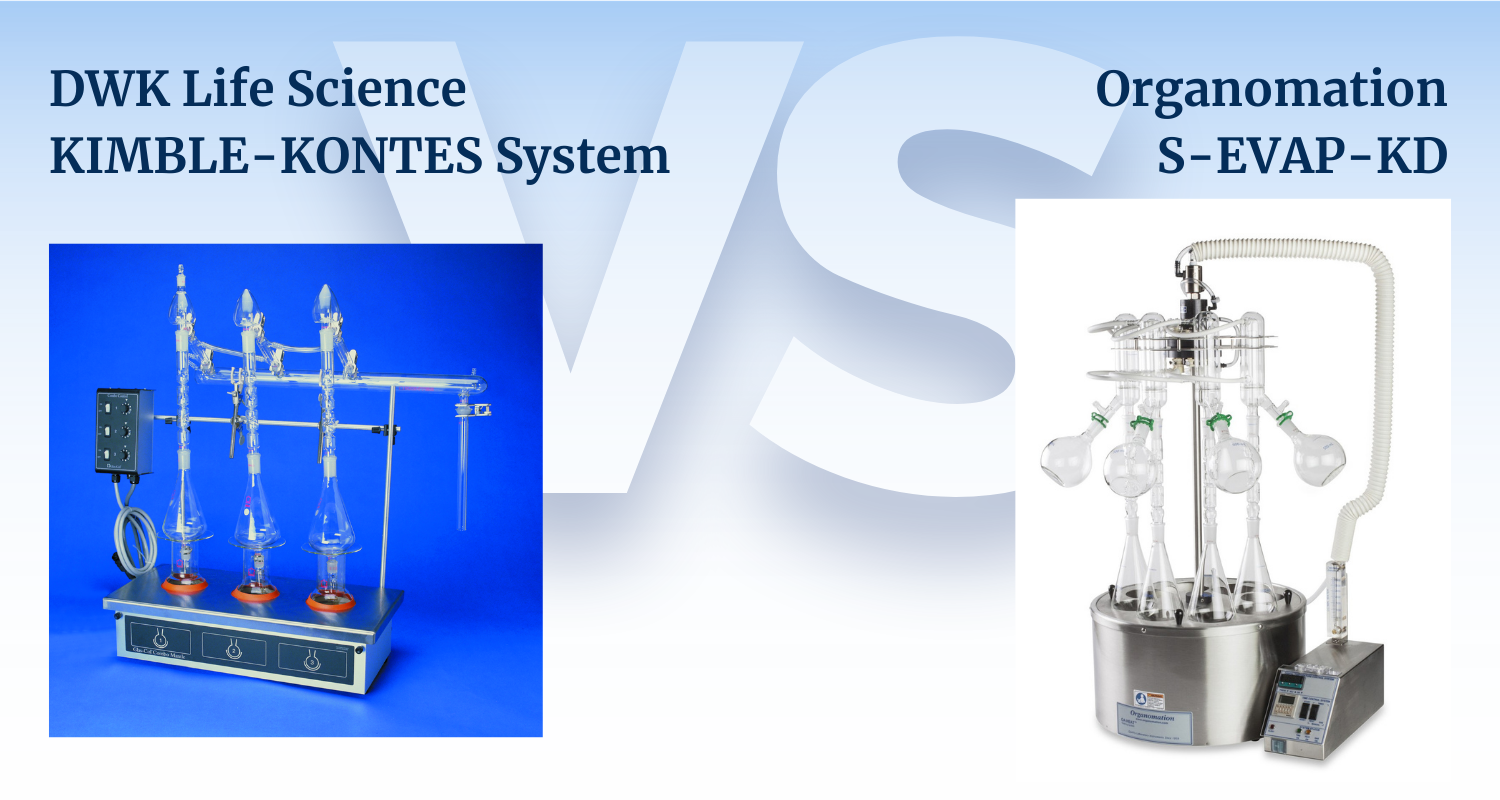
Both the Organomation S-EVAP-KD and the KIMBLE KONTES Linear Solvent Recovery System from DWK Life Sciences are designed specifically for KD evaporation. However, they are built around very different operating philosophies.
One prioritizes compact simplicity for occasional use. The other is engineered for parallel processing and daily production. That distinction becomes critical once your lab moves beyond just a few samples per run.
If Your Lab Runs KD Occasionally… Simplicity Wins
For smaller labs or academic research groups, KD evaporation may only happen a few times per week. In those cases, a compact, straightforward linear setup can be perfectly adequate.
These environments typically value:
• Lower initial investment
• Minimal training
• Small footprint
• Straightforward manual operation
If evaporation isn’t a daily bottleneck, additional automation may not provide enough benefit to justify complexity.
If Your Lab Runs KD Daily… Throughput Changes Everything
As soon as KD becomes part of your daily workflow, the math changes fast.
Environmental testing labs, contract labs, and regulated facilities often process dozens of extracts per day. Waiting for small batches to finish — or manually monitoring each run — adds up to hours of lost analyst time.
Parallel evaporation allows multiple samples to concentrate simultaneously, keeping technicians focused on higher-value tasks like extraction, cleanup, or instrument prep. That’s where the S-EVAP-KD is designed to stand out.
Instead of concentrating samples one at a time or in very small groups, labs can process larger batches in parallel with:
• synchronized heating
• timed runs
• reduced hands-on monitoring
• improved consistency between operators
For high-volume labs, that translates directly into faster turnaround and fewer workflow interruptions.
Automation, Safety, and Solvent Recovery Matter More Than You Think
Modern laboratories also face increasing pressure around safety, compliance, and sustainability. Features such as:
• digital temperature control
• integrated timers
• configurable solvent recovery
• improved hood safety options
help ensure consistent results while minimizing solvent exposure and waste.
Manual systems can absolutely work — but they require more oversight and introduce more operator variability, which is not ideal in regulated environments or audited workflows.
When repeatability and defensibility are priorities, automated controls often become a deciding factor.
So What’s the Real Difference?
Here’s the simplest way to think about it:
Linear KD systems → best for occasional, low-volume use
Parallel KD systems → built for daily production and scalability
If you’re only running a couple samples, both approaches may feel similar. If you’re running batches all day, the difference becomes obvious very quickly.
Labs often discover that the “less expensive” option on day one costs more long-term in technician time and slower throughput.
See the Full Side-by-Side Comparison
This article only covers the high-level takeaways. Our detailed KD Evaporator Comparison Matrix includes:
✔ Capacity comparisons
✔ Workflow recommendations
✔ Temperature control differences
✔ Solvent recovery features
✔ Footprint and installation notes
✔ Performance considerations
✔ Selection guidance by lab type
👉 Download the full comparison guide here to see the complete breakdown and determine which system best fits your workflow, or speak with an applications specialist at sales@organomation.com for personalized recommendations.