
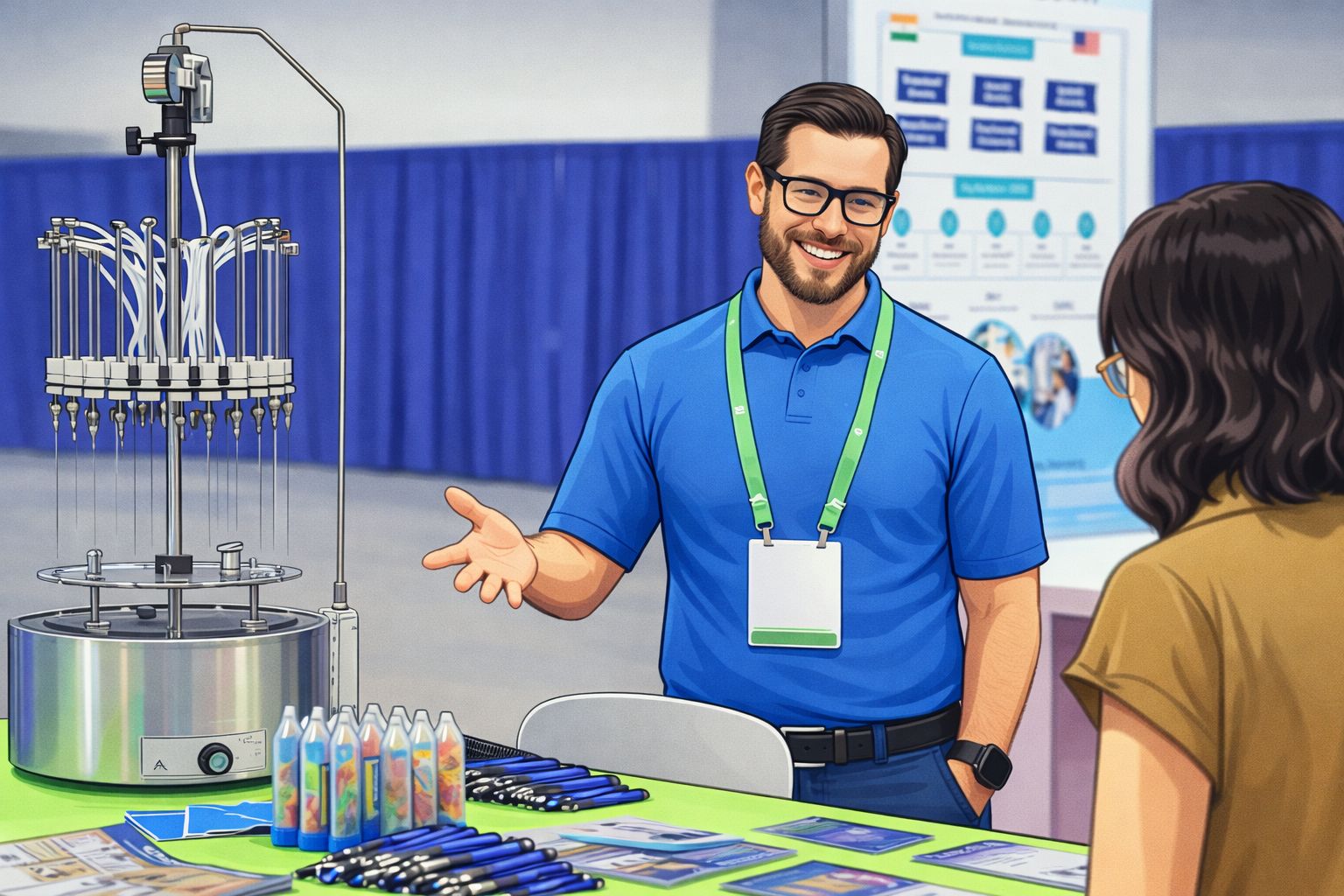
I just got back from the 74th annual ASMS Conference on Mass Spectrometry and Allied Topics in San Diego, and I'm still sorting through my notes. This show drew an estimated 6,300 to 7,000 scientists for five days of oral sessions, roughly 3,000 posters, and one of the busiest exhibit floors in the conference's history. If you work anywhere near analytical chemistry, ASMS is the one week a year where you can watch the entire mass spectrometry industry show its hand at once.
I made a point of sitting in on the Bruker press conference in person this year, and I spent the rest of the week working the floor, talking to vendors, and tracking announcements from the companies whose instruments sit downstream of the sample prep equipment we build every day. What struck me most wasn't any single instrument. It was how consistently every major manufacturer pointed in the same three directions: deeper resolution for complex biology, AI baked directly into the software, and faster answers for the regulated labs running PFAS, food safety, and environmental testing. Here's what I saw.
Bruker: Pushing Resolution to the Extreme
Bruker's press conference was packed, and for good reason. The headline launch was the timsMRMS, a system that combines trapped ion mobility spectrometry (TIMS) with magnetic resonance mass spectrometry (MRMS) — better known to most of us as Fourier transform ion cyclotron resonance (FTICR-MS). Bruker is currently the only commercial source for MRMS technology, and pairing it with TIMS gives the instrument mass resolving power between one million and ten million, with parts-per-billion mass accuracy.
Bruker also expanded its 4D proteomics lineup. The timsUltra AIP platform, combined with new razor-PASEF acquisition methods and Spectronaut 21 software, can now identify more than 10,000 proteins in HeLa cell lines, or 6,500+ proteins at a throughput of 500 samples per day. On the structural side, the timsOmni platform picked up a new Argon collision gas option and a multi-stage trapped electron-based dissociation method that delivers a four-fold sensitivity increase for top-down characterization of proteoforms, antibodies, and glycoproteins. Bruker also announced a partnership with Integrated Protein Technologies that automates buffer exchange ahead of timsOmni analysis, cutting sample prep time to under two minutes.
Thermo Fisher: The Biggest Orbitrap Refresh in Years
Thermo Fisher came to ASMS with a full Orbitrap portfolio refresh. On the research side, the new Orbitrap Tribrid Apex and Orbitrap Excedion mass spectrometers are built to handle increasingly complex proteomics, multiomics, and genetic medicine samples. The Excedion in particular is tuned for drug metabolism studies and oligonucleotide and peptide analysis, with an enhanced dynamic range that detects three to five times more compounds in complex matrices.
What caught my attention as someone whose business lives in environmental and food safety labs were the two new GC-MS platforms aimed squarely at PFAS and persistent organic pollutant testing: the Orbitrap Exploris GC S, built for dioxin and POP analysis with more than double the resolution of many existing systems, and the Orbitrap Exploris EFOX for high-resolution contaminant screening. Thermo also showed the TSQ Certis triple quadrupole for regulated bioanalysis and QA/QC work, which runs 15% faster and goes more than twice as long between maintenance events. For labs already drowning in PFAS method validation, that kind of uptime matters as much as raw sensitivity.
Waters: A Bigger Footprint, Literally
Waters showed up at ASMS just four months after closing its combination with BD's Biosciences and Diagnostic Solutions businesses, and the new structure was on full display. The headline launch was the Cyclic IMS P20, a high-resolution structural and spatial omics platform combining multipass cyclic ion mobility separation with an expanded set of fragmentation and imaging tools. Waters says it delivers more than 10 times the MS/MS sensitivity of its predecessor and extends the upper mass range past 100 kDa, opening the door to larger protein complexes and higher-order assemblies.
Waters also continued its proteomics push with the Xevo MRT P10, a high-resolution multi-reflecting time-of-flight benchtop system built for high-throughput multiomics and biopharma workflows. It's a clear signal that the "two-horse race" between Bruker and Thermo Fisher in high-end proteomics now has more competitors at the table.
SCIEX: Smaller, Greener, and Faster
SCIEX, a Danaher company, launched the novus V55 triple quadrupole — the fifth generation in a lineage that traces back to the original TAGA 6000 in 1981. The pitch here is efficiency as much as performance: a 35% smaller footprint than the SCIEX 5500+, a 40% reduction in both energy use and lab cooling requirements, and an accelerated MRM mode capable of acquiring up to 1,000 MRM transitions per second. For pharmaceutical impurity testing, bioanalysis, food testing, and PFAS work, that combination of speed and a smaller utility footprint is a real consideration when labs are planning new instrument real estate.
SCIEX paired the hardware with SCIEX OS 5.0, adding AI-assisted productivity tools, and rolled out ZT Scan DIA 3.0, a data-independent acquisition workflow for the ZenoTOF 8600 that narrows precursor isolation windows to sharpen selectivity in complex DIA experiments.
mzio: Making Mass Spec Data Vendor-Agnostic
This is the one I was most personally invested in. Recently, I interviewed Dr. Ansgar Korf, CEO and co-founder of mzio, for my separation science podcast. At ASMS, mzio announced FAIR-MS, an AI-powered initiative to make historical mass spectrometry data searchable and reusable across instruments, labs, and measurement conditions — regardless of which vendor's instrument generated it. As Korf put it, the goal is to turn "the FAIR data principles into practical reality."
That vendor-agnostic philosophy runs through everything mzio does. The company works directly with SCIEX, Waters, Agilent, and Bruker on its mzmine data platform, and at ASMS it released a major mzmine update with expanded vendor format support, dedicated lipid and small-molecule dashboards, and a new impurity workflow that correlates orthogonal detectors with MS data. If you've ever managed a lab running instruments from three different manufacturers — which describes most labs I talk to — you understand exactly why this matters. Data shouldn't be trapped in a vendor silo just because the hardware is.
What This Means If You're Not Buying a New Mass Spec This Year
Most labs aren't walking away from ASMS with a new seven-figure instrument. But every one of these launches has a quiet dependency that's easy to overlook: none of them work without clean, properly concentrated samples going in the front end. PFAS analysis was the dominant applied-science theme at this year's conference, reflecting years of regulatory momentum and expanding monitoring requirements, and that trend runs straight through Thermo's new GC-MS platforms, Bruker's timsMetabo contaminant workflows, and the broader push toward high-resolution accurate-mass methods for environmental monitoring. Every one of those workflows still depends on solvent extraction, evaporation, and concentration steps long before a sample ever reaches the ion source.
That's the part of the tandem LC-MS and GC-MS conversation that doesn't get a press conference, but it's where labs actually lose or gain sensitivity. An under-concentrated extract means a method that technically works on paper but underperforms on the bench. It's the reason nitrogen blowdown evaporation remains the standard sample prep step ahead of GC-MS and LC-MS/MS methods for PFAS, pesticides, and POPs — gentle, inert, and precise enough not to undo the resolution that companies like Thermo Fisher and Bruker just spent a week showing off.
Worth a Listen
If the data interoperability angle from mzio's announcement interests you, go back and listen to my conversation with Ansgar Korf on Concentrating on Chromatography. We talked about what it actually takes to make mass spec data portable across a mixed-vendor lab, and a lot of what he described is now showing up in FAIR-MS.
ASMS will be back next year, and if the pattern from San Diego holds, expect even more AI baked into acquisition software, more resolution chasing smaller and smaller signals, and more attention paid to the regulated testing labs that don't get the spotlight but keep this entire industry funded.