
.jpeg)
When research demands evolve, laboratory workflows have to evolve with them. That's exactly what happened at the Metabolism Core Facility at Sanford Burnham Prebys, where increasing LC-MS sample preparation needs pushed a homemade evaporation system beyond its practical limits.
After winning Organomation's Homemade Evaporator Contest, the team upgraded to a 24 Position MICROVAP Nitrogen Evaporator, transforming what had become a bottleneck into a standardized, high-throughput workflow.
Supporting Metabolism Research Through Advanced Analytical Workflows
The Metabolism Core Facility at Sanford Burnham Prebys supports researchers with metabolomics analysis using both GC-MS and LC-MS while also developing and validating custom analytical methods for unique research applications. As LC-MS projects became more common, the facility needed an evaporation solution capable of efficiently handling larger solvent volumes while maintaining the consistency expected in a core laboratory environment.
The team primarily evaporates methanol and acetonitrile-based samples—often containing up to 1 mL of solvent—prior to LC-MS analysis. A typical batch consists of approximately 20 samples, with evaporation performed at either 37°C for heat-sensitive metabolites or 45°C for more robust applications.
A Homemade Solution That Reached Its Limits
Like many laboratories, the team initially developed an in-house nitrogen evaporation setup to support method development. Their DIY system successfully demonstrated that nitrogen evaporation could improve their workflow compared to a centrifugal evaporator (SpeedVac), but it wasn't designed for the demands of routine sample processing..jpeg?width=374&height=334&name=DIY%20Setup%20-%20David%20Scott%20-%20Copy%20(2).jpeg)
Several challenges became increasingly apparent:
- Nitrogen flow could not be accurately measured or standardized, making method reproducibility more difficult.
- Gas distribution across samples was inconsistent, requiring continual adjustment.
- Setup required significant manual effort before each run.
- Checking sample progress meant repositioning evaporation needles, slowing the workflow.
- The homemade system required approximately 2.5 hours to evaporate 1 mL of an 80% methanol solution.
For a shared core facility supporting multiple research groups, these limitations made standardized operation increasingly difficult.
Transitioning to the 24 Position MICROVAP
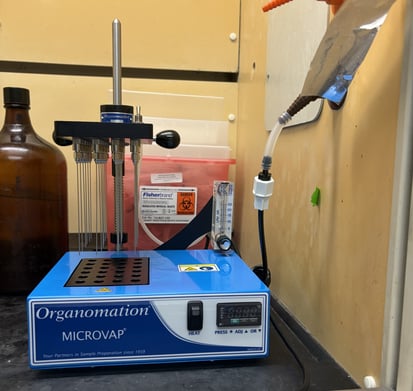
After receiving the 24 Position MICROVAP through Organomation's Homemade Evaporator Contest, the team quickly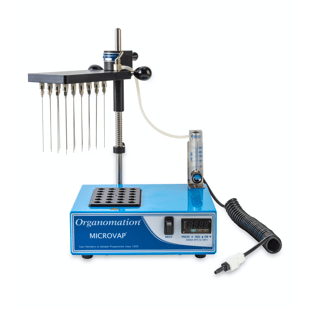 integrated the instrument into their LC-MS sample preparation workflow.
One of the most noticeable improvements was the ability to establish standardized operating conditions. Adjustable, repeatable nitrogen flow settings eliminated much of the variability associated with their homemade setup while providing consistent evaporation across every sample position.
The MICROVAP also simplified daily operation. Faster setup, even gas distribution, and easy sample visibility reduced the hands-on attention previously required, allowing staff to spend more time supporting researchers instead of managing the evaporator.
Faster Processing and Greater Confidence
Beyond improved usability, the team observed significant performance gains.
During a head-to-head comparison performed at 37°C—the temperature the laboratory uses for heat-sensitive metabolites—the MICROVAP evaporated 1 mL of an 80% methanol, 20% water mixture in approximately 75 minutes, while the homemade evaporator required 2.5 hours. Since the MICROVAP has the potential to be operated at 130°C for more robust analytes, the potential time savings for those applications are even greater. These comparisons also exclude the additional setup time required by the DIY system.
- Standardized nitrogen flow for reproducible methods
- Uniform evaporation across all samples
- Reduced nitrogen waste through a less leaky system
- Faster setup with minimal manual adjustments
- Easier monitoring of sample progress
- Elimination of concerns about sample bumping and cross-contamination associated with centrifugal evaporation
- Increased throughput for routine LC-MS sample preparation
Looking Ahead
What began as a creative homemade solution successfully supported early method development, but as demand increased, the laboratory needed a more robust and reproducible platform.
Today, the MICROVAP has become an integral part of the Metabolism Core Facility's LC-MS sample preparation workflow, providing the consistency, speed, and ease of use required for routine operation.
As Katrina Paras summarized:
"The MICROVAP is a much welcome addition to our workflow, and we plan to utilize it heavily for LC-MS sample preparation. It has cut down on sample processing times and is very easy to use. While our homemade evaporator certainly did the job for initial methods development, it would have presented a real bottleneck for routine sample processing. With the MICROVAP, this is no longer a concern.
Also, everyone we have interacted with at Organomation has been a pleasure to work with and I look forward to continuing to build our relationship with the company!"
For laboratories transitioning from improvised equipment to standardized workflows, this case demonstrates how the right evaporation system can improve throughput, reproducibility, and overall efficiency without compromising sample quality.
Looking to replace your homemade evaporation setup? Contact Organomation at sales@organomation.com to discuss the right nitrogen evaporator for your workflow.