
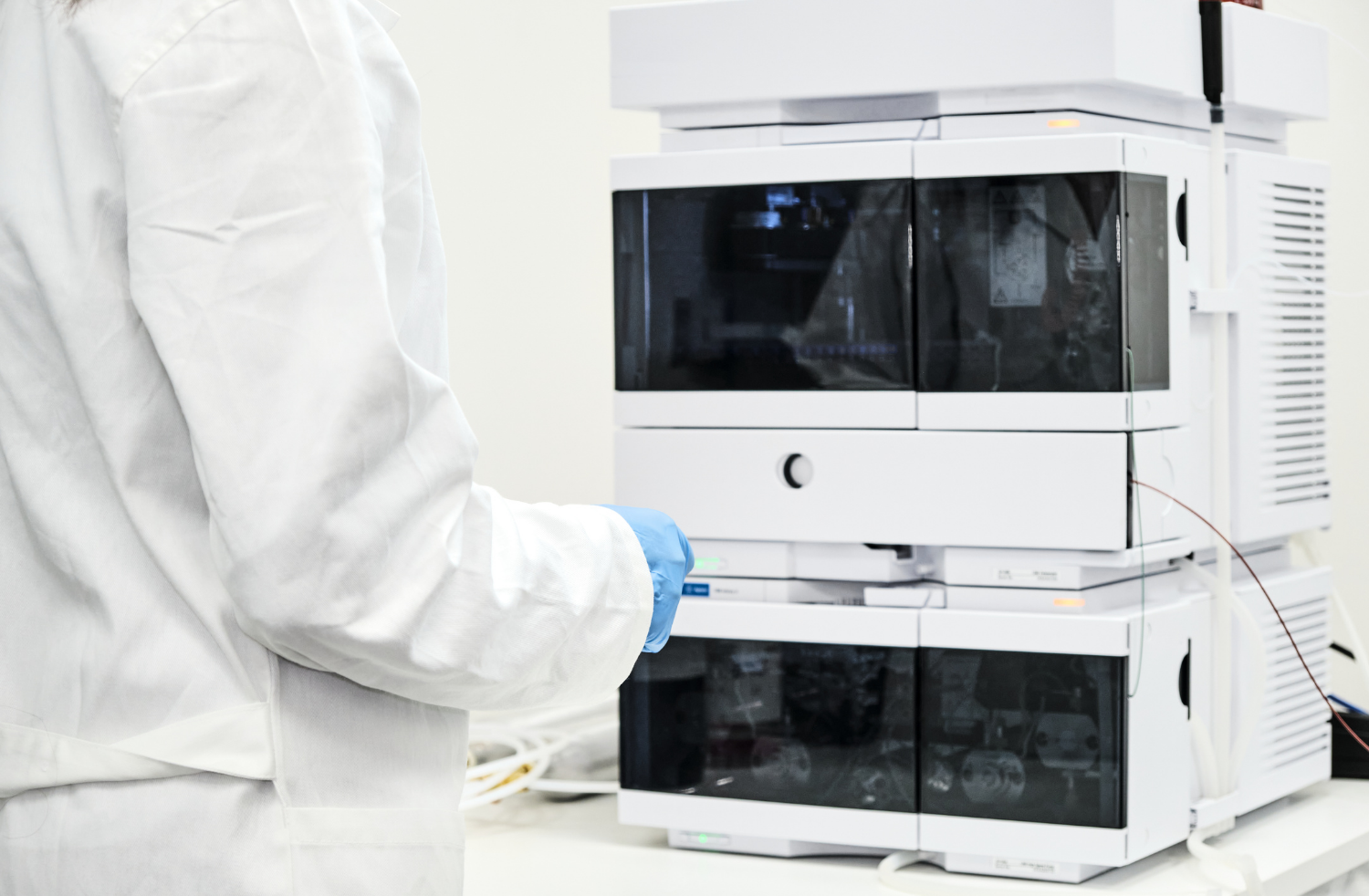
When most people picture modern analytical chemistry, they picture towering LC-MS instruments churning through automated sample queues. But on the latest episode of the Concentrating on Chromatography podcast, Organomation General Manager David Oliva sat down with Dr. Madalyn Radlauer, Associate Professor of Chemistry at San Jose State University, for a conversation that pulled the curtain back on a different reality: much of the most consequential chemistry — the kind that builds new catalysts, maps polymer architecture, and benchmarks decades-old reactions against tomorrow's innovations — still runs on thin layer chromatography (TLC), classical column chromatography, and size exclusion/gel permeation chromatography (SEC/GPC).
Dr. Radlauer's lab studies organometallic catalysis and structured polymers, including single-chain nanoparticles and star polymers designed to mimic the protective microenvironments that enzymes create around their active sites. That work depends on separation science at nearly every step — not glamorous LC-MS workflows, but the bench-level techniques that generations of synthetic chemists have relied on to know whether a reaction worked.
Watch the full conversation with Madalyn Radlauer:
TLC as the Synthetic Chemist's Daily Compass
"As a synthetic lab, TLC is a great way to monitor reactions," Dr. Radlauer explained, describing how her group runs thin layer chromatography to determine whether ligand precursor syntheses — the building blocks for her metal-based catalysts — have gone to completion. TLC's appeal lies in its simplicity: a mixture is spotted near the base of a silica- or alumina-coated plate, developed in a closed chamber with an appropriate mobile phase, and visualized once the solvent front has migrated most of the way up the plate.
The retention factor, or Rf, calculated as the distance traveled by the compound divided by the distance traveled by the solvent front, gives chemists a fast, reproducible fingerprint for each spot on the plate. Because TLC is inexpensive, rapid, and requires only milligram quantities of material, it remains one of the most widely used qualitative and semi-quantitative separation tools in organic and inorganic synthesis labs worldwide. Proper technique matters more than it might appear: chamber equilibration, correct spotting volume, and consistent plate activation all affect resolution and reproducibility, which is why Organomation has published detailed, evidence-based protocols covering TLC sample preparation and broader chromatography sample preparation practices for labs looking to standardize their methods.
Sample concentration ahead of spotting is itself a common bottleneck. Organomation's own technical blog notes that nitrogen evaporators such as the MULTIVAP play a pivotal role in concentrating test samples ahead of TLC, ensuring analytes are sufficiently concentrated for clean, well-resolved spots before they ever touch the plate. Solvent selection for the mobile phase is equally critical, and Organomation's guide to commonly used solvent mixtures highlights how systems like hexane–ethyl acetate remain a workhorse combination for normal-phase TLC and related extractions.
Column Chromatography: Slower, but Still Essential
TLC's real value in Dr. Radlauer's lab extends beyond monitoring reactions — it directly informs how her group purifies material afterward. "We'll also run TLC to help us determine how to purify it if we decide to use column chromatography," she noted, describing the classic workflow in which an Rf value observed on a small plate is scaled up to a preparative silica gel column. Traditional column chromatography, while time- and solvent-intensive, remains prized for its reliability: as Dr. Radlauer put it, going from "a mixture of products" to a fully separated, NMR-confirmed pure compound is one of the most satisfying moments in synthetic chemistry.
She also highlighted a lesser-known variant her lab has adopted: dry column vacuum chromatography (DCVC). First refined by Pedersen and Rosenbohm as an improvement on Harwood's original technique, DCVC uses vacuum-assisted elution through a dry-packed, dry-loaded silica bed to achieve resolution that can exceed standard flash chromatography while using significantly less solvent, less silica, and less time. Fractions are gradient-eluted from nonpolar to polar solvent and monitored by TLC throughout, tying the two methods together in a single, more sustainable purification workflow. For a lab that runs frequent ligand syntheses, that reduction in solvent consumption and turnaround time is not a minor convenience — it is a meaningful step toward greener bench practice, a value Dr. Radlauer explicitly connected to her broader research philosophy around catalysis and efficiency.
SEC and GPC: Seeing What Nothing Else Can Show
If TLC and column chromatography answer "is my reaction done" and "is my compound pure," size exclusion chromatography answers a question that is unique to macromolecular chemistry: how big, exactly, is this polymer, and how much does that size vary from chain to chain? Dr. Radlauer described GPC — a type of SEC used specifically for synthetic polymers in organic solvents — as the chromatographic technique her lab relies on most heavily, because it can characterize materials ranging from hundreds of grams per mole up to hundreds of thousands of grams per mole.
The separation mechanism itself is unusual among chromatographic methods. Rather than relying on chemical affinity between analyte and stationary phase, SEC/GPC separates macromolecules purely by hydrodynamic size: larger polymer coils are excluded from the pores of the packing material and elute first, while smaller molecules diffuse into the pores and elute later. This entropy-driven mechanism means that instrument calibration must be tailored to the solvent-polymer pairing being studied, because a polymer's hydrodynamic volume — and therefore its apparent elution size — changes depending on how well the eluent solvates it.
This distinction proved critical in Dr. Radlauer's star polymer research. Her lab was using refractive index detection alone and, based on an early-eluting peak, believed it had successfully cross-linked many polymer arms into a protective star-shaped core. Only after acquiring a light-scattering detector did the team discover it was actually only linking about five chains — far short of the tens of arms needed to shield the catalytic core the way a metalloenzyme's protein scaffold protects its active site. Because refractive index and UV detectors respond to concentration while light-scattering detectors respond to the absolute size of the eluting species, combining detector types gave her group an accurate, calibration-independent measurement of molar mass rather than a relative estimate. This is consistent with established GPC/SEC literature, which describes light scattering as the method of choice for determining absolute molar mass and identifying subtle structural changes such as cross-linking or branching that conventional calibration alone would miss.
Peer-reviewed chromatography literature reinforces why GPC/SEC has become, in the words of one review, "a blessing and a curse" for polymer science: it is indispensable for characterizing molar mass distributions, but results are only as reliable as the calibration standards and detector combination used. GPC/SEC remains the field's default technique for determining number- and weight-average molar mass and dispersity, values essential to quality control and structure-property studies across the polymer industry.
Benchmarking, Metathesis, and the Case for Simpler Separations
The conversation also touched on a subtler theme relevant to any lab evaluating separation strategy: not every characterization question requires isolating pure product. Dr. Radlauer's group studies olefin cross-metathesis, the carbon-carbon bond-reshuffling reaction developed by Robert Grubbs, Richard Schrock, and Yves Chauvin that earned the trio the 2005 Nobel Prize in Chemistry. Ruthenium-based Grubbs catalysts remain the field's workhorse, prized for their bench stability and selectivity.
Historically, comparing new metathesis catalysts against established ones has meant running the reaction, isolating product by column chromatography, and reporting isolated yield — a process that, multiplied across dozens of catalyst variants and reaction conditions, consumes enormous lab time. Dr. Radlauer's group is instead piloting GC-MS as a combined separation-and-characterization step, allowing selectivity data to be gathered directly without a full preparative purification for every test point. It is a reminder that TLC, column chromatography, and SEC/GPC are not simply "older" methods being phased out by mass spectrometry-based techniques; they occupy a distinct and still-necessary niche, particularly wherever preparative-scale purity, macromolecular sizing, or fast reaction monitoring is the actual analytical question being asked.
Why This Matters for Labs Choosing Their Chromatography Toolkit
The throughline across Dr. Radlauer's research — from ligand synthesis to star polymer architecture to metathesis benchmarking — is that no single chromatographic technique answers every question. TLC remains unmatched for fast, low-cost reaction monitoring and purification planning. Column chromatography, including efficient variants like DCVC, remains the standard for isolating grams of pure material. SEC/GPC remains the only practical way to measure polymer size and dispersity at all, and pairing conventional detectors with light scattering is often the difference between an accurate molar mass and a misleading one. For labs building or refining their own separation workflows, Organomation's technical library on TLC sample preparation, chromatography sample prep, and evaporation ahead of TLC offers practical, evidence-based guidance built for exactly this kind of bench-level decision-making.