
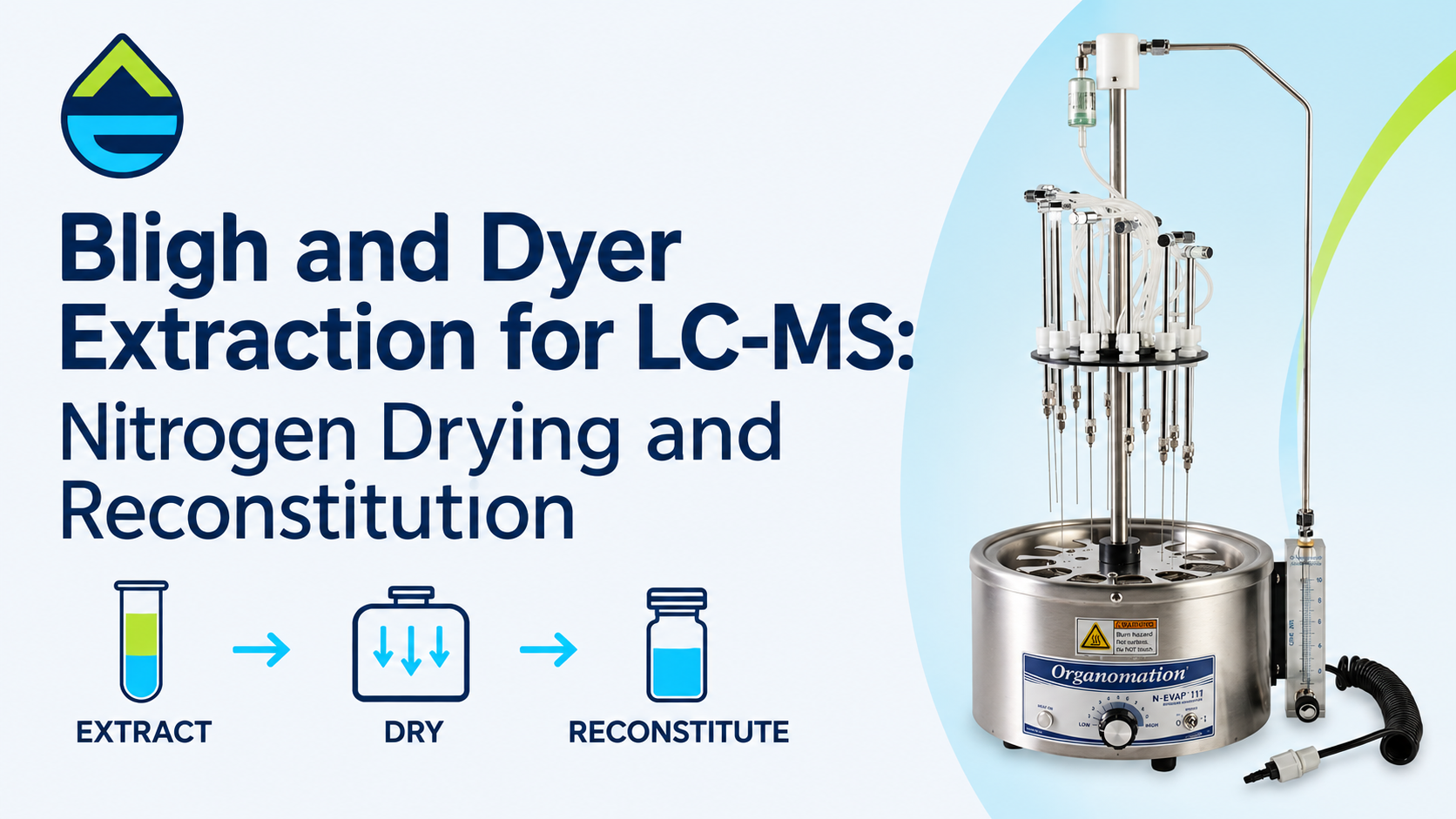
Effective lipidomics sample preparation for HPLC has three connected goals: recover the lipids of interest, limit unwanted changes during handling, and deliver an extract suited to the chromatographic method, as emphasized in good-practice recommendations for MS-based lipidomics. Bligh and Dyer extraction is a strong starting point for many workflows because its chloroform–methanol–water system supports broad lipid extraction, with particular value for polar lipids such as glycerophospholipids.
For workflows that dry and reconstitute the recovered organic phase, nitrogen blowdown provides a practical link between extraction and HPLC: published methods use it to remove extraction solvents before introducing the lipids in a defined analytical solvent. The important task is to develop extraction, evaporation, and reconstitution together rather than optimize each in isolation.
What makes a lipid extract ready for HPLC?
Extracting a lipid and preparing it for injection are not the same achievement: lipidomics protocols separately address organic-phase recovery, solvent removal, reconstitution, and chromatographic analysis. Use the following questions to define the endpoint of sample preparation:
- Recovery: Are the target lipid classes recovered reproducibly from the actual sample matrix?
- Integrity: Have handling conditions limited oxidation, hydrolysis, and other unwanted transformations?
- Cleanliness: Has phase collection avoided unnecessary transfer of protein, aqueous material, and debris?
- Solubility: Are the recovered lipids dissolved in the final solvent rather than remaining as a film or precipitate?
- Injection suitability: Have solvent composition, sample concentration, and injection volume been evaluated together?
These questions should guide method development before a large sample set is processed. Organomation’s broader Lipidomics Sample Preparation resource provides additional application context for extraction and concentration.
Why Bligh and Dyer extraction is a strong fit
Lipids are chemically diverse, so a solvent system must accommodate more than one kind of interaction: chloroform and methanol are useful for lipids with both hydrophobic and polar characteristics, while lipid association with proteins and other sample components complicates extraction from real biological matrices. Bligh and Dyer combines organic and aqueous components in a process that moves from extraction to phase separation, allowing recovery of the lower, chloroform-rich lipid-containing phase.
This approach has practical value beyond its long history: a study using NIST human plasma reference material compared Bligh and Dyer, Folch, and MTBE-based extraction and found that Bligh and Dyer and Folch performed well across the tested plasma-to-solvent ratios. That study also showed that increasing solvent relative to sample improved responses for many measured lipid species, demonstrating why the name of an extraction method alone does not determine its performance, as reported in the sample-loading comparison.
For method selection, start with the lipid classes and matrix rather than assume one extraction covers everything:
| Analytical priority | What it means for method selection |
|---|---|
| Broad profiling with substantial phospholipid interest | Bligh and Dyer is a well-supported candidate; its relatively higher methanol proportion favors polar lipids such as glycerophospholipids. |
| Strong emphasis on nonpolar lipids | Compare performance with Folch, whose more chloroform-rich organic phase supports nonpolar lipid solubility, including triglycerides. |
| Polar anionic targets such as S1P or LPA | Evaluate a published acidified extraction designed for those targets, with careful control of acid concentration and time because acid-sensitive hydrolysis can alter the measured composition. |
| High-throughput handling or avoiding chloroform | Consider whether an alternative such as MTBE extraction offers a better operational fit; method suitability still depends on the target lipids. |
The practical conclusion is not that every laboratory should switch to Bligh and Dyer. It is that Bligh and Dyer deserves serious consideration when its class coverage, matrix performance, and phase-handling requirements match the study.
Control two ratios, not just one
A commonly reported Bligh and Dyer chloroform:methanol:water composition is 2:2:1.8 by volume, but this describes the ternary extraction mixture rather than the composition of the recovered lower phase, as illustrated by the published plasma extraction procedure. When adapting a protocol, account for the aqueous sample and any added buffers instead of treating the solvent recipe as independent of sample water.
The second ratio is sample amount relative to total extraction solvent: in the human plasma comparison, the authors tested 1:4, 1:10, 1:20, and 1:100 plasma-to-solvent ratios and recommended 1:20 as a useful balance for the studied plasma lipidomics workflow. Under that study’s design, 50 µL of plasma at 1:20 corresponded to 1,000 µL of extraction solvent before re-extraction, not a universally transferable recipe for every tissue or cell pellet, as shown in the experimental design.
For your own method-development worksheet, record sample volume or mass, added aqueous volume, each solvent volume, and whether re-extraction is included. When scaling the method, evaluate both the mixture composition and sample loading rather than simply doubling the sample while leaving the solvent unchanged.
Build a reproducible extraction-to-dry-down workflow
Preserve the sample before measuring it
Enzymatic and chemical changes can continue during handling, and prolonged room-temperature exposure can change lipid composition through processes including hydrolysis and peroxidation. Plan collection, cooling or freezing, extraction timing, and storage as part of the analytical method rather than as logistics outside it.
For each batch, document time out of cold storage and use consistent handling across study groups. If antioxidants are considered, evaluate them within the complete analytical method rather than assume adding an antioxidant is automatically appropriate.
Add internal standards before extraction
Good-practice guidance recommends adding suitable internal standards before extraction so they can accompany the sample through preparation, with at least one appropriate exogenous standard per lipid class as a minimum starting point for reliable comparisons. A standard added only after extraction cannot experience losses that have already occurred.
Choose standards that represent the target classes and analytical behavior, and check that they do not overlap endogenous signals. For quantitative LC-MS work, remember that accurate compensation for ionization effects depends on chemical similarity and coionization of analyte and internal standard, not merely the presence of any lipid standard in the vial.
Collect the organic phase cleanly
In Bligh and Dyer extraction, the organic layer is on the bottom, so collecting it requires working past the aqueous layer and protein interface, creating opportunities for contaminant transfer, lipid loss, and analyst-to-analyst variation. Establish a consistent collection procedure and a defined recovered volume.
Avoid chasing the final visible trace of solvent through the protein interface just to maximize apparent yield. If recovery needs improvement, evaluate a controlled second extraction; the plasma comparison used re-extraction and combination of the chloroform layers, while also recognizing the added time and solvent demand.
Why nitrogen blowdown matters after Bligh and Dyer extraction
The recovered extraction phase is not automatically the best injection solution: published workflows dry the lipid fraction and reconstitute it in solvents selected for the downstream LC method. Nitrogen blowdown enables this solvent exchange without tying the final sample volume to the volume needed for efficient extraction.
This gives researchers two separate controls. Use enough extraction solvent to recover the target lipids, then choose the reconstitution volume to suit the assay’s working concentration rather than deliberately under-solvate the extraction to obtain a concentrated final sample.
A nitrogen stream accelerates evaporation by sweeping solvent vapor away from the liquid surface, as described in Organomation’s How to Dry Lipid Extracts. Nitrogen is also useful when limiting oxygen exposure is a priority, consistent with lipid-stability recommendations to protect extracts from oxygen and light.
Develop the blowdown step around four controls:
- Gas flow: Use enough flow to support solvent removal without splashing or disturbing the residue; an Agilent lipid-preparation workflow specifically recommends reducing nitrogen flow at low remaining volumes to prevent sample ejection.
- Temperature: Establish an analyte-appropriate setting rather than use maximum heat; Agilent’s mammalian-cell lipid protocol uses nitrogen at 30°C, which is a protocol example, not a universal lipidomics setpoint.
- Geometry: Standardize vessel type, starting volume, and gas-outlet position in the method record. Check the low-volume endpoint separately from the high-volume portion of drying.
- Endpoint: Define when the solvent-removal step is complete and proceed consistently to reconstitution or validated storage. Do not assume extra drying time always improves sample quality.
Nitrogen blowdown is an established choice, but the universal requirement is not nitrogen itself: some protocols permit vacuum concentration as an alternative solvent-removal method. The method should specify the drying approach and demonstrate that it works for the target lipids.
Reconstitution: balance lipid solubility with HPLC compatibility
Reconstitution deserves the same attention as extraction: published lipidomics workflows use different solvents for reversed-phase LC and HILIC, including isopropanol for one reversed-phase method and at least 80% acetonitrile for its HILIC adaptation. These examples illustrate method dependence, not interchangeable recipes.
Select the solvent and injection volume together: Agilent notes that changing chromatography type or using larger injections can require different lipid reconstitution solvents. A useful development experiment is to split a pooled extract across candidate solvents and compare dissolution, replicate peak areas, retention times, and peak shape at the intended injection volume.
Use these practical checks before committing the full study:
- Dissolution: Inspect the vial after mixing for a persistent film or precipitate. Use any sonication or additional mixing step consistently and evaluate it with the analytes of interest.
- Final volume: Record the actual reconstitution volume and any subsequent dilution. Keep these separate from the initial extraction and collected-phase volumes.
- Clarification: If the procedure includes centrifugation or filtration, assess the resulting lipid recovery. Do not assume every cloudy component is harmless or that every clarification step is loss-free.
- Injection behavior: Compare replicate injections and, where appropriate, a dilution series before declaring a stronger sample concentration better.
For example, reducing a 1.0 mL collected extract to a 100 µL final solution gives a nominal tenfold concentration if the same lipid mass is retained. It does not imply a tenfold increase in LC-MS signal, because matrix components and solvent conditions affect electrospray ionization efficiency.
Troubleshooting before the HPLC sequence
Treat an unexpected chromatogram as a reason to investigate the entire preparation, not automatically to repeat the extraction. The checks below are suggested diagnostic experiments rather than guaranteed explanations for a particular sample.
| Observation | Useful checks |
|---|---|
| Low signal across multiple classes | Review sample loading and solvent volumes, inspect the vial for undissolved residue, and compare internal-standard behavior; published work shows that sample-to-solvent ratio can change measured lipid responses. |
| Poor repeatability between preparations | Compare phase collection, recovered volumes, drying endpoints, and reconstitution records; organic-phase collection is a recognized source of lipid loss and analyst variability. |
| Peak distortion or retention changes | Test solvent composition and injection volume using a pooled extract; one published lipidomics workflow specifically cautions that larger injections can shift retention times. |
| Weak LC-MS response in a concentrated extract | Run a controlled dilution series and review internal standards because co-extracted matrix components can change ionization efficiency. |
| Suspected oxidation or unexpected degradation products | Compare handling times, temperature, light exposure, storage, and gas protection against the method’s sample-stability plan. |
| Signals also present in blanks | Investigate solvent, vessel, reagent, and handling backgrounds; lipidomics guidance emphasizes blank monitoring, especially for ubiquitous fatty acids. |
Include solvent blanks, extraction blanks, and pooled quality-control samples in the study design, with randomized sample injections and periodic QC measurements, following the approach illustrated in a published LC-HRMS lipidomics workflow. Think of these as complementary controls: no single blank or QC sample answers every preparation and instrument question.
Published example: extraction, N-EVAP drying, and HPLC-MS/MS
A study by Fabri and colleagues, involving researchers at UFSCar, USP, Unicamp, and U.S. institutions, provides a specific example of Organomation N-EVAP use ahead of HPLC-MS/MS. The researchers prepared Aspergillus fumigatus sphingolipids using Mandala extraction, Bligh and Dyer extraction, base hydrolysis, and drying in an “Organomation N-EVAP™ 112”.
They then dissolved the dried extracts in 150 µL of methanol containing 1 mM ammonium formate and 0.2% formic acid before C8 HPLC separation and triple-quadrupole mass spectrometry. The example demonstrates how drying connects an extraction sequence to a defined analytical solution.
One detail should not be transferred blindly: mild alkaline treatment can remove ester-linked glycerolipids and enrich alkaline-stable components such as sphingolipids. Include that step only when it fits the analytical targets, not as a default addition to broad lipid profiling.
Choosing a nitrogen evaporator for lipid extracts
Start with the vessels, solvents, sample volumes, and number of extracts per batch, then consider how the instrument supports consistent endpoint handling. For example, the current 12-position Organomation N-EVAP offers individual gas-flow control and a standard holder accommodating vessels with outside diameters of 10–30 mm.
The most useful purchasing discussion connects those features to a defined workflow rather than treats the evaporator as a stand-alone solution to analytical variability. Bring the extraction composition, anticipated volume range, temperature constraints, and reconstitution plan into the equipment-selection conversation.
Developing a Bligh and Dyer workflow for HPLC? Discuss your lipid-extract drying requirements with Organomation and explore the N-EVAP nitrogen evaporator family.
Frequently asked questions
Does Bligh and Dyer extraction require nitrogen blowdown?
Bligh and Dyer is the extraction procedure, while nitrogen blowdown is a downstream drying technique used in published extraction-to-LC-MS workflows. If the method calls for a dried extract, solvent removal is required; nitrogen is an established option, while some published workflows also allow vacuum concentration.
What solvent should I use to reconstitute lipids for HPLC?
Use a solvent system demonstrated to dissolve the target lipids and work with the intended chromatography and injection volume. Published methods use different reconstitution conditions for reversed-phase LC and HILIC, so there is no single solvent recipe for every lipidomics assay.
Is a stronger lipid signal proof of better extraction?
Not by itself: both extraction conditions and electrospray matrix effects can change the measured response. Evaluate recovery, repeatability, internal-standard behavior, blanks, and dilution behavior together rather than rank methods by raw peak area alone.