
Introduction
Modern analytical workflows demand speed, reproducibility, and precision all qualities essential for laboratories analyzing food, environmental, and pharmaceutical samples. By integrating advanced extraction with reliable evaporation, labs can achieve substantial improvements in efficiency and results. The combination of the CEM EDGE Automated Solvent Extraction System and Organomation nitrogen blowdown evaporators offers a seamless and highly effective approach to challenging sample preparation.
The CEM EDGE: Rapid Automated Solvent Extraction [1]
- Versatile Applications: The EDGE system handles a broad range of matrices, from food and soils to environmental contaminants, using pressurized solvent extraction to achieve rapid results.
- Automation & Consistency: With autosampling, pre-programmed methods, and integrated Q-Disc® filtration, the EDGE system minimizes manual steps, ensuring reproducibility.
- High-Quality Extracts: Filtration is built into the process, delivering extracts ready for further processing or direct analysis, as suited to each lab's requirements.
Why Pair with Organomation Blowdown Systems?
While the EDGE system generates clean extracts, certain high-sensitivity analysis methods or instrument-specific conditions may require further concentration. Organomation's nitrogen blowdown evaporators are designed for this crucial step:
- Controlled Solvent Evaporation: Gentle nitrogen gas reduces the extract volume carefully, minimizing risk of analyte loss [2].
- Efficiency for Batch Processing: Multiple samples can be processed in parallel, supporting high-throughput labs [2].
- Seamless Compatibility: EDGE extracts fit directly into standard Organomation systems, streamlining the hand-off between extraction and concentration.
Case Study in Detail: CEM EDGE for Pesticide Extraction from Strawberries [3]
Background
Food testing laboratories face the challenge of efficiently extracting and concentrating pesticide residues from the product, while maintaining high turnaround time. The goal was to maximize throughput with automated extraction systems, while maintaining data integrity and meeting stringent regulatory requirements for both sensitivity and reproducibility [3].
Traditional Approach Limitations [3]
- Conventional QuEChERS methods required multiple manual steps, including extraction and clean-up, with total extraction time between 20 and 60 minutes per sample.
- Manual Processing Challenges: The QuEChERS process process can be time-consuming and, because it is manual, is prone to error.
Integration of EDGE and Organomation Systems
Step 1: Automated Extraction Using CEM EDGE [3]
- Single-Step Extraction and Clean-Up: The EDGE system enabled complete extraction and clean up of strawberry samples in 7–8 minutes, which included sample rinsing, filtration, and system washing.
- Enhanced Sample Handling: The use of Q-Matrix Hydra further simplified the extraction process by removing water from wet samples in-situ, eliminating additional sample handling requirements.
- Improved Sample Size Flexibility: The addition of agitation and multiple rinses on one of the EDGE pesticide residue methods allowed for extraction of larger samples and significantly reduced solvent usage.
Step 2: Efficient Concentration with Organomation Nitrogen Blowdown
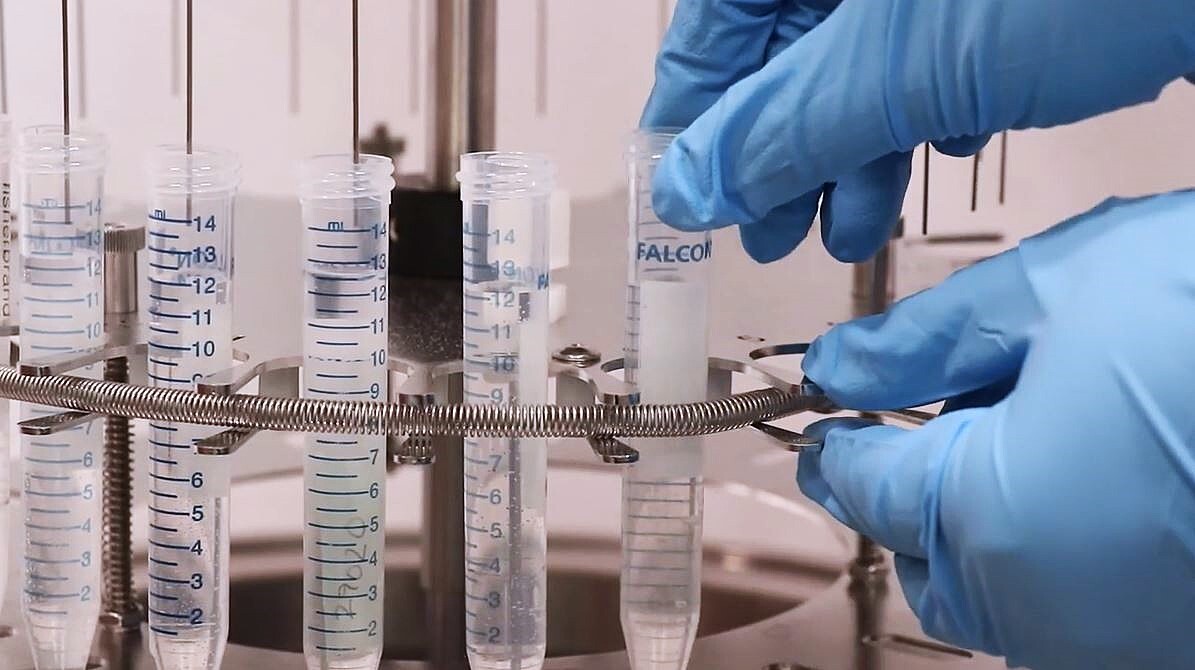
- Post-Extraction Processing: Following extraction, the extract was transferred to an Organomation N-EVAP Nitrogen Evaporator for evaporation to less than 5 mL. Samples were then diluted to 5 mL with acetonitrile containing 1% acetic acid.
- Controlled Volume Reduction: The Organomation system provided precise concentration capabilities essential for achieving the required detection limits needed in trace pesticide analysis [5].
Validated Outcomes and Metrics [3]
- Comparable Recovery Performance: The EDGE efficiently extracted pesticides from strawberry certified reference materials with recoveries comparable to the traditional QuEChERS process. This validation confirmed that the EDGE could serve as a suitable alternative method for matrices where QuEChERS was specifically developed, as was seen in this case.
- Significant Time Savings: A time savings of 60% was found when using the EDGE, compared to the QuEChERS method, which would be beneficial for increased sample throughput and overall laboratory productivity.
- Reduced Solvent Consumption: When using the additional agitation in the EDGE method, a 20% solvent savings was achieved.
- Enhanced Sample Confidence: The increased sample size capability provided greater confidence in sample homogeneity and representativeness of the total batch.
Analytical Validation
The extracted samples underwent analysis using Waters Acquity UPLC system with Xevo TQD triple quadrupole mass spectrometer [3]. Multiple pesticides were successfully quantified using MRM transitions, with each sample analyzed in triplicate to ensure data reliability [3]. The comparable recoveries obtained between EDGE and QuEChERS extractions validated the effectiveness of the integrated approach [3].
Impact on Laboratory Operations [3]
- Automated Efficiency: The EDGE offers the benefit of simplified automated extraction with comparable recoveries to traditional methods, reducing manual intervention and associated errors.
- Broad Applicability: The same method is applicable for all food samples, both wet and dry, and covers a wide range of pesticides.
- Temperature Flexibility: For heat-labile pesticides, room temperature extraction can be performed on the EDGE.
- Ideal for Testing Laboratories: The EDGE is ideal for testing laboratories seeking repeatable results across all food samples through one simple, automated method.
Summary Workflow: From Strawberry to Result
1. Sample Preparation: Strawberry certified reference material combined with Q-Matrix Hydra in Q-Cup with Q-Disc sandwich configuration
2. Automated Extraction: 7-8 minute extraction cycle including rinsing, filtration, and system washing
3. Concentration: Nitrogen evaporation using Organomation N-EVAP to achieve target volume
4. Analysis: Direct injection into LC-MS/MS for pesticide quantification
Conclusion
The integration of the CEM EDGE extraction system with Organomation nitrogen evaporators represents a validated advancement in food contaminant testing. This system delivers automated efficiency, substantial time savings, and solvent conservation while maintaining analytical performance [3]. Additionally, these methods produce comparable results to the established QuEChERS methodology [3]. Laboratories would benefit from reduced manual intervention, enhanced throughput, and consistent reproducibility, all while meeting the demanding requirements of regulated food testing environments [5].
This workflow and case study are based on published CEM applications demonstrating the integration of automated extraction and evaporation technologies for improved sample preparation in food testing laboratories [3].
Citations
- https://cemcontenttype.s3.amazonaws.com/content/media-library/downloads/brochure-edge-b140-english.pdf
- https://blog.organomation.com/blog/nitrogen-blowdown-evaporator-buyers-guide
- https://www.chromatographyonline.com/view/rapid-extraction-of-pesticides-from-a-strawberry-crm
- https://www.organomation.com/products/nitrogen-evaporators/n-evap
- https://www.organomation.com/pesticide-sample-preparation