
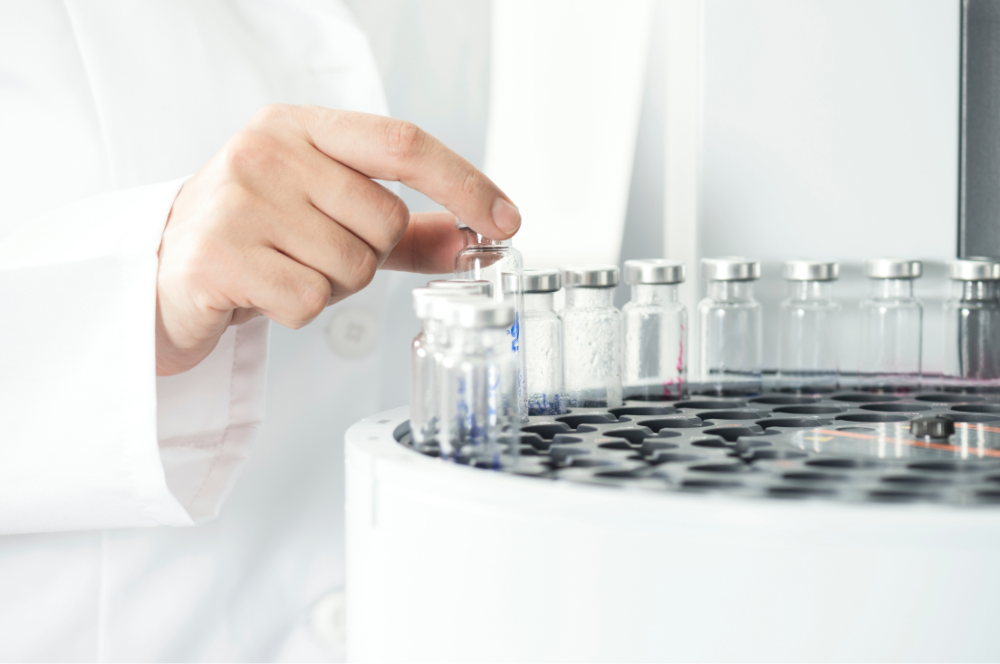
DMSO, DMF and NMP are valuable because they dissolve compounds and support reactions that can be difficult to run in more volatile media. Those same properties can make them persistent during sample preparation.
The companion article, Why Centrifugal Evaporation Fits DMSO, DMF and NMP Sample Preparation, explains how deep vacuum, controlled heat and centrifugal force work together. This article answers a different question:
How are laboratories actually using centrifugal evaporation to remove DMSO, DMF and NMP?
Published methods document direct removal of all three solvents. The applications include preparing DMSO compound stocks for Log D and solubility assays, drying DMF peptide and medicinal-chemistry libraries, and removing NMP from polymerization samples before analysis or product isolation. [1, 2, 3]
Use cases at a glance
|
Solvent |
Published workflow |
Purpose of removal |
Format |
|
DMSO |
Prevent a storage cosolvent from influencing partition measurement |
96-position glass-vial plate [3] |
|
|
DMSO |
Prepare solid-like compound deposits before aqueous equilibration |
96-position vial rack [4] |
|
|
DMF |
Remove DMF and reducing agent before peptide cyclization |
Full 96-well plates [2] |
|
|
DMF |
Isolate reaction products before weighing and characterization |
24 parallel reaction tubes [5] |
|
|
NMP |
Prepare aliquots for analysis and crude polymer for solvent exchange |
Small vials and a 5 mL reaction sample [1] |
These publications used centrifugal evaporators from several manufacturers. They establish credible centrifugal evaporation applications, but they do not constitute performance testing of a particular CentriVap configuration. Method transfer still requires evaluation of the sample, solvent load, vessels, rotor, pump, cold trap, temperature limit and endpoint.
DMSO before Log D
Researchers use centrifugal evaporation to remove DMSO from compound-library aliquots before partition testing, preventing DMSO from acting as a cosolvent during the assay.
In a high-throughput Log D method developed at AstraZeneca, compounds were stored as 10 mM solutions in DMSO. Researchers transferred 20 µL of each solution into a 96-position glass-vial plate and used a Genevac HT4 to remove DMSO from samples at 40 °C under full vacuum for 30 minutes. The dried compounds were redissolved in octanol, combined with pH 7.4 phosphate buffer and analyzed after phase equilibration. [3]
This was more than a convenient dry-down step. Log D describes how a compound distributes between aqueous and organic phases at a specified pH. Residual DMSO introduces another solvent capable of changing compound solvation and therefore the observed distribution.
The practical sequence was:
1. Dispense compound aliquots from centralized DMSO stocks.
2. Remove DMSO across the complete plate.
3. Add octanol and aqueous buffer to each dried compound.
4. Equilibrate the phases and quantify the compound in each phase.
This workflow is relevant to discovery laboratories that manage compounds as DMSO stocks but need downstream measurements to reflect behavior without a strong organic cosolvent.
DMSO before solubility
A dried-DMSO design is also used to prepare compound-library samples for equilibrium-solubility measurements.
A fully integrated early drug-metabolism and pharmacokinetics assay panel transferred 50 µL portions of 10 mM DMSO compound solutions into 1 mL glass flat-bottom vials arranged in a 96-position rack. DMSO was evaporated for one hour at 40 °C in a Genevac HT-4 before phosphate buffer was added and the samples were equilibrated for 20–24 hours. [4]
An earlier publication describing the dried-DMSO equilibrium-solubility method explains the rationale: compounds stored centrally as 10 mM DMSO solutions were dried to generate solid-like material for solubility measurement. This helps keep residual DMSO from increasing apparent solubility and making the result less representative of the intended aqueous test system. [6]
What these DMSO cases show
- The input is a standardized DMSO stock, not an isolated solid.
- The solvent is removed in a downstream-compatible vial or plate, reducing transfers.
- Parallel processing supports compound-library throughput.
- The endpoint protects analytical integrity, rather than simply producing a visibly dry vessel.
When building a centrifugal evaporator method for DMSO, define success using the downstream assay. Visual dryness alone may be insufficient when trace DMSO could bias a physicochemical measurement.
DMF from peptide plates
A published method used centrifugal evaporation to remove DMF directly from full 96-well peptide plates before cyclization.
In a parallel peptide-library workflow, 5 µmol resin-linked peptides were released into 200 µL of DMF containing 100 mM 1,4-benzenedimethanethiol and 100 mM triethylamine. A Christ RVC 2-33 CDplus IR centrifugal vacuum evaporator removed the DMF and reducing agent at 0.1 mbar, 30 °C and 400 × g. The process took less than one hour with all 96 wells occupied. [2]
LC–MS indicated that the reducing agent had been removed, although some peptides contained up to 10% back-oxidized material. That result is useful method-development evidence: successful DMF evaporation does not eliminate the need to evaluate chemical changes that can occur as samples concentrate or encounter oxygen. [2]
After dry-down, the peptide products entered the next chemical operation without individual liquid–liquid extraction or vial-by-vial workup. The plate format was preserved across synthesis, solvent removal and downstream modification.
Why the peptide example matters
DMF is widely used in solid-phase peptide synthesis because it solvates protected amino acids, coupling reagents and growing peptide chains. The challenge arises downstream, when DMF may interfere with another reaction, purification or assay.
The published method demonstrates that centrifugal evaporation can:
- Remove DMF from small peptide samples.
- Process a complete 96-well plate in parallel.
- Maintain a moderate set temperature.
- Prepare samples for a subsequent chemical reaction.
DMF after parallel synthesis
Centrifugal evaporation also supports medicinal-chemistry workups when DMF is the reaction solvent.
University of Oxford researchers used DMF stock solutions to prepare a 24-member array of 4-substituted 2-aminothiazoles. Each reaction combined 750 µL of a 0.24 M α-bromoketone solution with 750 µL of a 0.20 M thiourea solution, followed by heating, scavenging and filtration. The DMF-containing filtrates were collected into weighed tubes and concentrated in a Genevac Atlas HT-8 before crude yield, HPLC purity, mass spectrometry and proton NMR measurements. [5]
The workflow produced 50–70 mg of each array member, with an average crude yield of 85% and average purity of 92%. Because weighing and characterization followed centrifugal evaporation, removing DMF was the bridge between parallel reaction processing and product assessment. [5]
This represents a familiar medicinal-chemistry constraint: parallel synthesis creates many modest-volume reactions simultaneously, but one-flask-at-a-time evaporation can become the bottleneck. A centrifugal vacuum concentrator allows the parallel structure of the experiment to continue through workup.
Two DMF endpoints
The peptide and heterocycle studies illustrate different objectives:
- Reaction-ready residue: Remove DMF and an interfering reagent before the next transformation. [2]
- Characterization-ready crude product: Remove DMF before weighing, HPLC, MS and NMR. [5]
A sample intended for immediate redissolution may require a different endpoint from one being weighed for crude yield. The downstream use should therefore define the DMF method and its acceptance criteria.
NMP from polymerization
Researchers have used centrifugal evaporation for NMP solvent removal from both analytical aliquots and preparative polymerization mixtures.
A branched-polylactide study used NMP for DBU-catalyzed ring-opening polymerization of lactide. The solvent’s polarity helped solubilize multifunctional initiators, including polyols used to create branched polymer architectures. The work produced linear, star and comb structures, with molecular-weight dispersities generally below 1.1. [1, 7]
For reaction monitoring, approximately 50 µL aliquots were collected in glass vials containing acetic acid in NMP to quench the catalyst. The aliquots were dried in a Genevac centrifugal evaporator for 60 minutes at 30 °C and 1 mbar before proton NMR and GPC/SEC analysis. [1]
The researchers also documented a preparative workup. After six hours, 5 mL of crude reaction mixture was quenched with acetic acid in NMP. Excess NMP was removed in a Genevac at 1 mbar and room temperature. The crude polymer was then redissolved in 2 mL dichloromethane, precipitated into cold isoamyl alcohol, reprecipitated with cold methanol and finally dried to a fine white powder. [1]
Why this NMP case is important
The study establishes two distinct applications:
- Analytical sample preparation: Remove NMP before NMR and chromatographic molecular-weight analysis.
- Preparative solvent exchange: Remove excess NMP before redissolving and precipitating the polymer.
The preparative endpoint is especially informative. The process did not depend on evaporating NMP and immediately obtaining the final polymer powder. Instead, centrifugal evaporation enabled a controlled solvent-exchange and precipitation sequence—often a more practical approach for polymers, oligomers and viscous residues.
Shared process logic
DMSO, DMF and NMP support different branches of chemistry, but these publications follow a common process pattern.
The solvent enables the upstream step
DMSO supports centralized compound storage. DMF supports peptide processing and parallel heterocycle synthesis. NMP enables a polar polymerization medium capable of dissolving multifunctional initiators. [1-3]
It becomes undesirable downstream
DMSO can alter partition or solubility measurements. DMF must be cleared before another reaction, weighing or instrumental characterization. NMP must be removed before analysis or polymer precipitation. [1-5]
Samples remain small and parallel
The reported formats extend from approximately 50 µL reaction aliquots through 200 µL peptide samples and 1.5 mL parallel reaction mixtures to a 5 mL polymerization workup. Several methods used 24- or 96-position formats. [1-5]
The endpoint defines success
Success means an unbiased assay, a reaction-ready residue, a weighable crude product, an analyzable sample or material ready for solvent exchange. These criteria are more meaningful than solvent disappearance alone.
Applying this to CentriVap
The studies establish real high-boiling solvent sample preparation, but they did not test CentriVap equipment. Translating the applications to a Standard CentriVap or CentriVap Pro should begin with the required endpoint and work backward through the complete system. [8, 9]
- Vacuum: Can the loaded system maintain the pressure required by the least volatile solvent?
- Heat transfer: Can the method provide enough energy without exceeding the analyte’s temperature limit?
- Vessel and rotor: Does the configuration accommodate the required vial, tube or plate and its working volume?
- Vapor capture: Is the CentriVap cold trap suitable for the vapor load and pump-protection requirement? [10]
- Chemical compatibility: Are the chamber, rotor, tubing, seals, trap and pump compatible with every component?
- Endpoint validation: Will residual solvent, recovery, degradation and residue morphology be measured rather than inferred?
Mixed-solvent samples deserve particular attention. A volatile cosolvent may evaporate first and load the cold trap while DMSO, DMF or NMP becomes progressively enriched in the remaining liquid. Method development should account for that changing composition rather than treating the starting solution as a constant solvent system. [11]
For installation and routine operation details, consult the CentriVap and Cold Trap user manual, including vial loading, trap operation and solvent disposal requirements. [12]
Define the endpoint
|
Endpoint |
Published example |
Validation question |
|
Assay-ready residue |
DMSO removal before Log D or solubility testing |
Does residual DMSO measurably affect the assay? |
|
Reaction-ready residue |
DMF removal before peptide cyclization |
Are DMF and interfering reagents below acceptable limits, and did the peptide remain intact? |
|
Characterization-ready crude |
DMF removal after parallel aminothiazole synthesis |
Is the residue suitable for weighing, HPLC, MS and NMR? |
|
Solvent-exchange-ready material |
NMP removal before polymer redissolution and precipitation |
Can the product be quantitatively redissolved and recovered without changing its molecular characteristics? |
These endpoints should guide a CentriVap feasibility study. Drying time by itself cannot demonstrate fitness for purpose.
Frequently asked questions
Can centrifugal evaporation remove DMSO from compound stocks?
Yes. Published 96-position methods removed DMSO from compound stocks before Log D and equilibrium-solubility testing. The reported examples processed 20 or 50 µL portions of 10 mM DMSO solutions at 40 °C before adding the assay medium. [3, 4]
Why remove DMSO before Log D or solubility testing?
DMSO is a strong organic cosolvent. If it remains, the experiment may characterize a DMSO-containing mixture instead of the intended aqueous–organic or aqueous system. Published methods therefore use a dried-DMSO design. [3, 6]
Can DMF be removed from a 96-well plate?
Yes. A published peptide method removed 200 µL DMF samples from a fully occupied plate in less than one hour at 0.1 mbar, 30 °C and 400 × g. [2]
Has centrifugal evaporation been used for synthetic chemistry in DMF?
Yes. Examples include a 24-member aminothiazole array in which approximately 1.5 mL DMF reaction filtrates were evaporated before weighing and characterization, plus plate-based peptide processing before cyclization. [2, 5]
Has NMP been removed from an actual reaction mixture?
Yes. In the branched-polylactide synthesis, excess NMP was removed from 5 mL of quenched crude polymerization mixture at 1 mbar and room temperature before solvent exchange and precipitation. [1]
Do these studies prove CentriVap performance?
No. They demonstrate credible uses of centrifugal evaporation as a technology. A specific CentriVap configuration must be verified with the actual solvent load, vessels, rotor, pump, trap, temperature limit and residual-solvent requirement.
From evidence to method
The physical properties of DMSO, DMF and NMP explain why deep vacuum matters. The published workflows show why laboratories use it.
Centrifugal evaporation prepared DMSO compound stocks for more defensible Log D and solubility measurements. It moved DMF peptide and medicinal-chemistry samples into the next reaction or analytical step without abandoning parallel processing. It removed NMP from polymerization samples before NMR, GPC/SEC, solvent exchange and precipitation. [1-5]
That evidence complements the engineering case: centrifugal evaporation is not merely compatible with difficult solvents under suitable conditions. It is already used in practical workflows where recovery, throughput and downstream compatibility matter.
Learn more about why centrifugal evaporation fits DMSO, DMF and NMP, compare evaporation methods for small-volume samples, explore CentriVap centrifugal evaporators, or use the evaporation-method recommendation tool to evaluate solvent, volume, vessel format, throughput and endpoint. [10, 13, 14]
References
-
Versatile Preparation of Branched Polylactides by Low-Temperature ... - We describe how the organocatalytic, 1,8-diazabicyclo[5.4.0]undec-7-ene (DBU)-based lactide ring-ope...
-
A Fully Integrated Assay Panel for Early Drug Metabolism and ... - by J Wernevik · 2020 · Cited by 49 — Solvent DMSO is evaporated in a Genevac HT-4 evaporator (Igenev...
-
Application of a Dried-DMSO rapid throughput 24-h equilibrium solubility in advancing discovery candidates - PubMed - A rapid throughput equilibrium solubility measurement is described. The method utilizes central liqu...
-
Versatile Preparation of Branched Polylactides by Low-Temperature, Organocatalytic Ring-Opening Polymerization in N-Methylpyrrolidone and Their Surface Degradation Behavior - PubMed - We describe how the organocatalytic, 1,8-diazabicyclo[5.4.0]undec-7-ene (DBU)-based lactide ring-ope...
-
Standard CentriVap Vacuum Concentrator - CentriVap Benchtop Vacuum Concentrators accelerate evaporation of small-volume samples by combining ...
-
CentriVap Pro Vacuum Concentrator - The CentriVap Pro Benchtop Vacuum Concentrator accelerates concentration of multiple small samples b...
-
Centrifugal Evaporators - CentriVap Benchtop Vacuum Concentrator accelerates evaporation of small-volume samples using heat, v...
-
THE CHALLENGE OF MIXED SOLVENTS - The way that this is achieved with a Genevac system is by keeping the sample holder block or swing (...
-
Labconco CentriVap and Cold Trap Users Manual - The end of the run can be signaled by a manually preset timer. Nine different protocols can be store...
-
Selecting the Right Evaporation Method for Small-Volume ... - Centrifugal evaporators impose a mandatory 45-minute warmup period before sample processing can begi...
-
Evaporation Method Recommendation Tool - Organomation - With so many sample concentration methods and techniques, it can be challenging to know which evapor...