
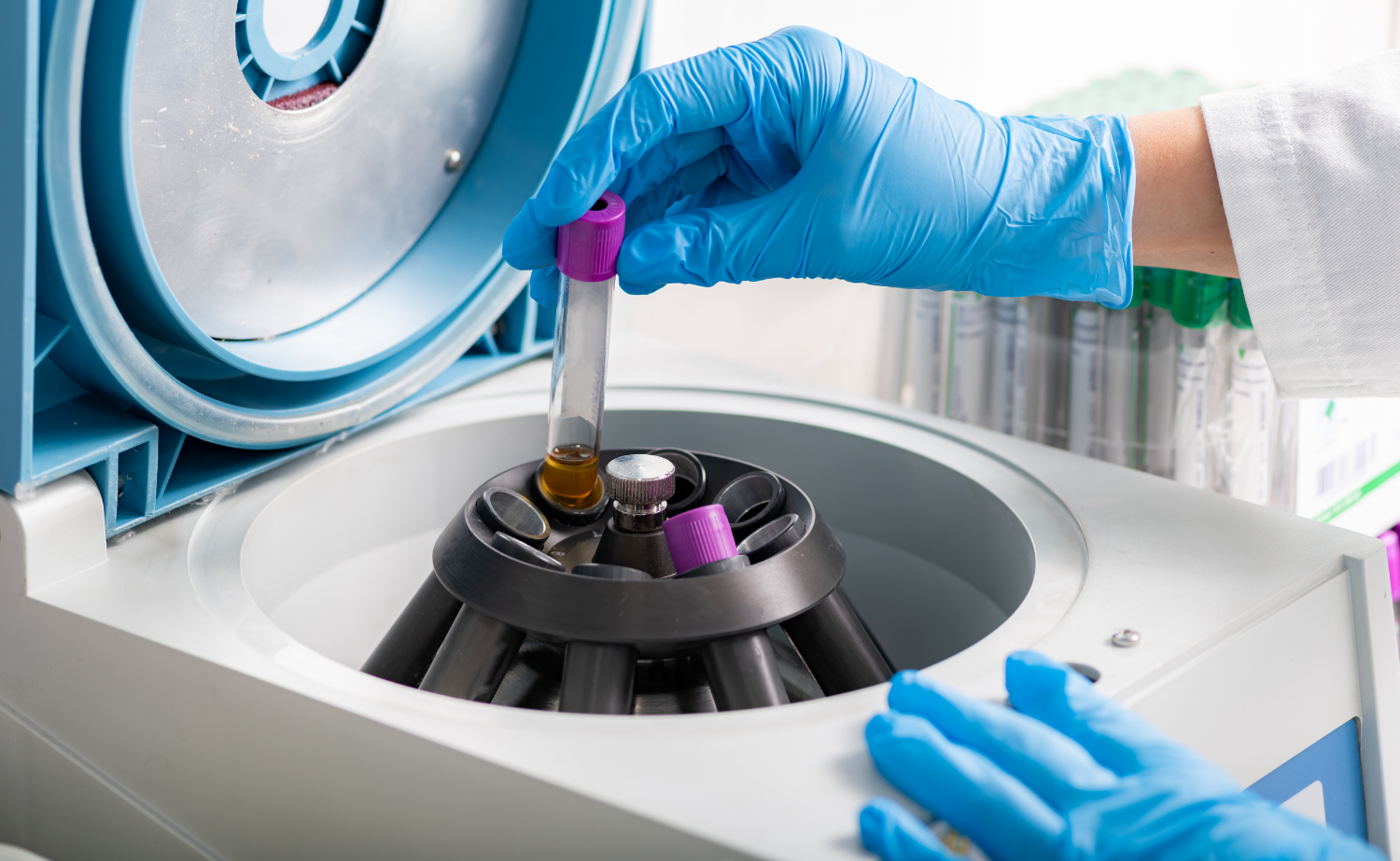
DMSO, DMF and NMP are difficult to remove from small samples because they have high normal boiling points and low vapor pressures near room temperature. A properly configured centrifugal vacuum concentrator is often the best fit because deep vacuum lowers the temperature required for evaporation, controlled heat supplies the energy the process needs, and centrifugal force helps control bumping, splashing and sample loss. [1, 2]
For laboratories handling multiple tubes or vials, the CentriVap product line brings these mechanisms together in a parallel, small-sample platform. Rather than trying to overcome a stubborn solvent primarily with hotter gas or longer exposure, CentriVap changes the pressure conditions under which the solvent can leave the sample. [3]
Why are DMSO, DMF and NMP difficult to evaporate?
The short answer: Their low volatility under ambient conditions makes routine surface evaporation slow, especially after more volatile cosolvents have already disappeared.
DMSO, DMF and NMP are polar aprotic solvents used widely in synthesis, compound management, analytical sample preparation and pharmaceutical research. Their solvating power is useful at the bench—but their physical properties can make them difficult at the concentration step.
|
Solvent |
Normal boiling point |
Representative vapor pressure near 25°C |
Practical implication |
|
Approximately 153°C [4, 5] |
Approximately 3.9 mmHg, based on compiled physical-property data [6] |
More difficult to remove than common volatile organic solvents, but responsive to low-mmHg vacuum |
|
|
Approximately 189°C [7, 8] |
Approximately 0.6 mmHg, based on compiled physical-property data [8] |
Requires substantially deeper vacuum for low-temperature removal |
|
|
Approximately 202°C [9, 10] |
Approximately 0.7 mbar, based on compiled physical-property data [9] |
Deep vacuum and effective vapor handling are central to practical removal |
These are representative pure-solvent data, not guaranteed CentriVap operating conditions. Actual evaporation depends on solvent composition, dissolved solids, sample volume, vessel geometry, heat transfer, chamber pressure, vapor load and the performance of the complete vacuum system.
The problem becomes most noticeable near the endpoint. In a mixed-solvent sample, methanol, acetonitrile or another volatile component may evaporate first. The remaining liquid becomes progressively enriched in DMSO, DMF or NMP, and the least volatile component begins to control the rate of the process.
How does vacuum lower evaporation temperature?
Vacuum lowers the pressure surrounding the sample. Because a liquid boils when its vapor pressure equals the surrounding pressure, reducing chamber pressure allows the solvent to boil at a lower temperature.
DMF provides a clear example. Its normal boiling point is approximately 153°C, yet compiled physical-property data place its boiling point near 25°C at approximately 3.7 mmHg. The solvent has not changed; the pressure boundary condition has. [6, 11, 12]
This distinction matters for small samples. Attempting to approach a high solvent boiling point with atmospheric-pressure heating may expose an analyte, matrix or residue to unnecessary thermal stress. Deep vacuum can shift the process toward a much lower sample temperature while still providing a thermodynamic route for solvent removal.
DMSO and NMP generally demand a stronger vacuum than DMF for comparable low-temperature evaporation because their vapor pressures near room temperature are lower. Pump selection is therefore part of method design—not an accessory decision made after the concentrator has been chosen. [6, 8, 9]
DMF boils at approximately 153°C under atmospheric pressure, but published physical-property data place its boiling point near 25°C at about 3.7 mmHg. [6, 11]
For a deeper explanation of how vacuum, heat and rotation work together, see Organomation’s guide to centrifugal vacuum concentration.
Why is controlled heat still important?
Vacuum lowers the required boiling temperature, but it does not eliminate the energy needed to vaporize a solvent. As molecules leave the liquid phase, they remove energy and cool the sample. Without adequate heat transfer, evaporation can slow even when chamber pressure is sufficiently low.
A CentriVap vacuum concentrator balances these variables by combining reduced pressure with controlled heat. The Standard CentriVap provides a 0–100°C temperature range, programmable heat and run parameters, and capacity for up to 148 samples, depending on the rotor. [13]
For larger or more configurable workloads, the CentriVap Pro supports a 0–100°C range, rotor speeds from 500 to 1,800 rpm, up to 312 sample positions in compatible configurations, saved methods and an optional 300-watt Heat Boost. [14]
The goal is not maximum temperature. It is to provide enough energy to sustain evaporation at the selected pressure while staying within the sample’s thermal limits. The optimal settings depend on the solvent system, target endpoint, sample stability, fill volume, vessel and total rotor load.
How does centrifugal force protect samples?
Centrifugal force helps keep liquid in each vessel while vacuum is applied, reducing the risk of bumping, foaming, splashing and sample loss. Organomation describes the technology as applying vacuum only after samples are rotating, helping evaporation proceed from the liquid surface while retaining the sample in the vessel. [1, 15]
Bumping occurs when boiling is delayed and then begins suddenly. Under vacuum, that rapid release can eject droplets from a tube or vial. For a scarce compound or low-mass analytical residue, even a small loss may affect recovery, reproducibility or the next assay.
Independent peer-reviewed research supports the underlying mechanism: high-rpm centrifugal motion can help suppress violent boiling while producing an exposed liquid film favorable to solvent removal. That study demonstrated ambient-temperature removal of difficult solvents including DMF, DMSO and NMP under vacuum, although it evaluated a different apparatus and should not be presented as direct CentriVap performance data. [2]
Centrifugal force should not be described as making bumping impossible. Solvent composition, pressure ramp, vessel fill, nucleation behavior and operating method still matter. Its value is that it adds a physical containment mechanism that ordinary static-vessel evaporation does not provide.
When is CentriVap the best fit?
CentriVap is a strong fit when a high-boiling solvent controls the endpoint, samples are small and processed in parallel, and preventing excessive heat exposure or sample loss matters. Organomation’s evaporation-method comparison likewise identifies DMSO, DMF and NMP removal as a core use case for centrifugal concentration. [15]
The application is particularly well aligned when:
- DMSO, DMF, NMP or a similar low-volatility solvent remains after volatile cosolvents evaporate.
- Multiple tubes or vials must be concentrated under consistent programmed conditions.
- The compound is scarce, valuable or sensitive to unnecessary heat.
- Bumping, splashing or foaming would compromise the workflow.
- The laboratory needs to concentrate directly in a compatible downstream vessel.
- The required pump, CentriVap cold trap, rotor and wetted materials can be configured for the solvent system.
- The intended endpoint is a smaller volume or dryness rather than bulk solvent recovery from a large flask.
The Standard CentriVap accommodates volumes from a few microliters to 25 mL and up to 148 samples, depending on configuration. The CentriVap Pro expands the range to 50 mL per vessel and up to 312 sample positions with compatible double-stacked rotors. [13, 14]
CentriVap versus nitrogen blowdown
For small samples dominated by DMSO, DMF or NMP, centrifugal vacuum evaporation offers a more direct physical solution than nitrogen blowdown: it lowers surrounding pressure rather than relying mainly on gas flow and heat to accelerate surface evaporation.
Nitrogen blowdown evaporation is valuable for many routine methods. A stream of dry gas sweeps solvent vapor away from the liquid surface, maintaining a concentration gradient that supports continued evaporation. It is often practical for relatively volatile solvents, concentration to a visible residual volume and validated analytical methods that specify nitrogen. [16]
The limitation appears when a low-volatility solvent controls the endpoint. Nitrogen flow does not lower total ambient pressure in the way a vacuum system does. Increasing block or bath temperature can improve the evaporation rate, but it may also increase thermal exposure and gas consumption. Organomation’s small-volume nitrogen blowdown versus centrifugal evaporation guide therefore distinguishes volatile-solvent applications from high-boiling-solvent applications rather than declaring one technology universally superior. [15]
|
Decision factor |
Centrifugal vacuum evaporation |
Nitrogen blowdown |
|
High-boiling solvent |
Deep vacuum directly lowers the boiling condition |
Gas flow removes surface vapor but does not materially lower total pressure |
|
Thermal strategy |
Reduced pressure plus controlled heat |
Surface gas exchange plus bath or block heat |
|
Bumping control |
Centrifugal force helps retain samples during reduced-pressure boiling [1, 15] |
Avoids vacuum-induced boiling, although gas flow and heating still require method control |
|
Parallel small samples |
Rotor-based processing across compatible tubes, vials and plates [13, 14] |
Parallel capacity depends on the selected nitrogen evaporator and manifold design |
|
Strongest fit |
Difficult solvent controls the endpoint; lower-temperature evaporation and sample retention matter |
Volatile solvent, prescribed method or concentration to a monitored residual volume |
This is not a claim that nitrogen cannot remove DMSO, DMF or NMP. Heated blowdown can remove small quantities, but it may require higher temperatures or longer processing. Organomation’s guide to when nitrogen blowdown is preferable provides the complementary cases, including many volatile solvents and workflows where nitrogen is the better fit. [17]
Configure the complete system
Successful high-boiling-solvent evaporation depends on the complete CentriVap system: concentrator, rotor, pump, cold trap, tubing, seals and method settings.
Match the pump to the solvent
DMF can reach its boiling condition near room temperature in the low-mmHg range, while DMSO’s lower room-temperature vapor pressure generally calls for a deeper vacuum to achieve similar low-temperature behavior. Pump selection must account for required working pressure, vapor load, chemical resistance and the intended endpoint. [6, 8]
The pump’s published ultimate vacuum is not necessarily the pressure achieved in a loaded operating chamber. Tubing conductance, fittings, leaks, solvent vapor, trap behavior and pump condition all affect working pressure.
Protect the pump with a cold trap
A CentriVap cold trap condenses solvent vapor before it reaches the vacuum pump, helping protect the pump and contain solvent vapors. Organomation offers CentriVap cold-trap configurations at −50°C, −84°C and −105°C, with a four-liter collector; selection should reflect the solvent system and vapor load. [18]
Trap temperature alone does not establish capture efficiency for every solvent. Vapor pressure at the trap temperature, flow rate, surface area, trap loading and system conductance all matter.
Confirm chemical compatibility
Every wetted or vapor-exposed component matters: chamber, rotor, shaft, lid, seals, tubing, trap and pump. Standard and acid-resistant configurations differ, and the CentriVap Pro offers PTFE-coated options for applications requiring additional chemical resistance. [14]
Before running DMSO, DMF, NMP or any solvent mixture, review the current product manual, solvent safety data, vessel limits, ventilation, vapor capture and exhaust management. Final configuration and operating parameters should be confirmed with Organomation or Labconco application support.
Optimize the method
A robust method considers:
- Starting solvent composition and how it changes during evaporation.
- Sample count, volume and total vapor load.
- Vessel material, dimensions and fill depth.
- Target chamber pressure and pressure ramp.
- Chamber set point and actual sample-temperature limit.
- Cold-trap starting temperature and capacity.
- Desired endpoint: reduced volume, film, pellet or dryness.
- Analyte recovery, degradation and residual-solvent acceptance criteria.
Avoid assuming that the deepest possible vacuum or highest available temperature will always produce the best result. Fast pressure reduction can increase bumping risk, and excessive heat can damage a sensitive sample. The best method balances vapor pressure, heat transfer, sample behavior and endpoint control.
Application example
A medicinal chemistry group has 48 small vials containing product residues in a volatile organic solvent with DMSO. The volatile fraction leaves readily, but DMSO becomes enriched and controls the final drying step.
A properly configured CentriVap addresses the limiting solvent. Deep vacuum creates a viable lower-temperature route for DMSO evaporation, controlled heat replaces energy lost through evaporation, and centrifugal force helps retain each sample as boiling begins. The batch can be processed in compatible vessels under one programmed method rather than handling every vial as an isolated surface-evaporation task. [7, 8]
The exact drying time cannot be predicted from boiling point alone. A credible estimate requires the starting volume, DMSO fraction, solids content, vessel geometry, number of samples, operating pressure, temperature, pump performance and cold-trap conditions.
Frequently asked questions
Can a centrifugal evaporator remove DMSO?
Yes. A suitably configured centrifugal evaporator for DMSO can remove DMSO from small samples. Because DMSO has a normal boiling point near 189°C and a vapor pressure of only about 0.6 mmHg at 25°C, effective low-temperature removal requires a sufficiently deep vacuum, controlled heat and appropriate vapor handling. [7, 8]
What is the best way to evaporate DMF from small samples?
For multiple small samples where lower-temperature processing and bumping control matter, centrifugal vacuum evaporation is often the best fit. DMF boils near 153°C at atmospheric pressure but near 25°C at approximately 3.7 mmHg, illustrating how vacuum can dramatically lower the required boiling temperature. [6, 11]
Can CentriVap remove NMP?
A properly selected CentriVap system can be configured for high-boiling solvents such as NMP, but pump depth, chemical compatibility, cold-trap performance and total vapor load must be evaluated. NMP’s normal boiling point is approximately 202°C and its room-temperature vapor pressure is low, making vacuum-system design especially important. [9, 10]
Why use centrifugal evaporation instead of nitrogen blowdown for DMSO?
Centrifugal evaporation lowers chamber pressure, allowing DMSO to evaporate or boil at a much lower temperature than it would near atmospheric pressure. Nitrogen blowdown removes vapor at the liquid surface but does not directly lower the solvent’s boiling condition. Centrifugal force also helps contain small samples during reduced-pressure boiling. [8, 15, 16]
Does centrifugal force make evaporation faster?
Its clearest role is sample control: centrifugal force helps limit bumping, foaming, splashing and sample loss while vacuum is applied. Rotation may also increase exposed film area in some geometries, but the rate effect depends on the instrument, rotor, vessel and sample. [1, 2, 15]
Does vacuum evaporation eliminate the need for heat?
No. Lower pressure reduces the temperature required for boiling, but vaporization still consumes energy and cools the sample. Controlled heat replaces part of that energy and helps sustain the evaporation rate.
Which vacuum pump is appropriate for DMSO, DMF or NMP?
Pump selection depends on the pressure required, solvent compatibility, vapor load and desired endpoint. The pump and cold trap should be selected as one system, and the configuration should be confirmed for the specific chemistry. [18]
Is centrifugal evaporation always better than nitrogen blowdown?
No. Nitrogen blowdown evaporators remain useful for relatively volatile solvents, methods that prescribe nitrogen and workflows requiring concentration to a monitored residual volume. Centrifugal evaporation becomes especially compelling when a high-boiling solvent controls the endpoint and multiple small samples require lower-temperature operation and bumping control. [15, 17]
Choose CentriVap around the endpoint
DMSO, DMF and NMP are not difficult because laboratories lack enough heat. They are difficult because their vapor pressures are low under ordinary conditions. Centrifugal evaporation addresses that underlying limitation by lowering chamber pressure, while controlled heat sustains phase change and centrifugal force helps protect each sample.
For multiple small samples, that combination makes CentriVap a strong, purpose-built fit—particularly when the solvent controlling the endpoint is also the solvent least suited to routine surface evaporation.
Explore CentriVap centrifugal evaporators or use Organomation’s evaporation-method recommendation tool to begin matching the technology to the solvent, sample volume, vessel format, throughput, endpoint and temperature limit. [3, 19]
References
-
What is a Centrifugal Vacuum Concentrator? - A centrifugal vacuum concentrator is a laboratory instrument that uses centrifugal force, vacuum, an...
-
A Versatile Method of Ambient-Temperature Solvent Removal - by IV Kolesnichenko · 2019 · Cited by 23 — their boiling points are lowered to 30 °C. DMF (153 °C), ...
-
Centrifugal Evaporators - CentriVap Benchtop Vacuum Concentrator accelerates evaporation of small-volume samples using heat, v...
-
Formamide, N,N-dimethyl- - Reference, Comment. Tboil, 426. ± 1. K, AVG, N/A, Average of 8 values; Individual data points. Quant...
-
Formamide, N,N-dimethyl- - n.i.g.. Melting point, -60.4. Boiling point, 153. Gas Chromatography. Go To: Top, Condensed phase th...
-
Dimethylformamide | HCON (CH3)2 | CID 6228 - PubChem - Dimethylformamide | HCON(CH3)2 or C3H7NO | CID 6228 - structure, chemical names, physical and chemic...
-
Dimethyl Sulfoxide | (CH3)2SO | CID 679 - PubChem - Dimethyl Sulfoxide | (CH3)2SO or C2H6OS | CID 679 - structure, chemical names, physical and chemical...
-
NMP, 1-Methyl-2-Pyrrolidone, ACS Grade - Water-Miscible Organic Solvent
-
Dimethylformamide | HCON(CH3)2 | CID 6228 - PubChem - 4 Boiling Point. 300 to 313 °F at 760 mmHg (NTP, 1992). National ... Investigations show that dimeth...
-
Formamide, N,N-dimethyl- - Formamide, N,N-dimethyl-. Formula: C3H7NO; Molecular weight: 73.0938 ... Reference, Comment. Tboil, ...
-
Standard CentriVap Vacuum Concentrator - CentriVap Benchtop Vacuum Concentrators accelerate evaporation of small-volume samples by combining ...
-
CentriVap Pro Vacuum Concentrator - The CentriVap Pro Benchtop Vacuum Concentrator accelerates concentration of multiple small samples b...
-
Selecting the Right Evaporation Method for Small-Volume ... - Nitrogen blowdown represents the preferred choice for volatile, potentially explosive solvents inclu...
-
What is Nitrogen Blowdown Evaporation? - On average, it takes only twenty-five minutes to safely concentrate a 10mL sample of methylene chlor...
-
When Nitrogen Blowdown is Preferable Over Centrifugal ... - This allows high boiling point solvents to be evaporated off without damaging the samples with exces...
-
CentriVap Cold Traps - CentriVap Cold Traps safely capture evaporated liquids from CentriVap Vacuum Concentrators, shieldin...
-
Evaporation Method Recommendation Tool - Organomation - With so many sample concentration methods and techniques, it can be challenging to know which evapor...
-
2-Pyrrolidinone, 1-methyl- - 2-Pyrrolidinone, 1-methyl- Formula: C5H9NO Molecular weight: 99.1311 IUPAC. Chemical structure: C5H9...