
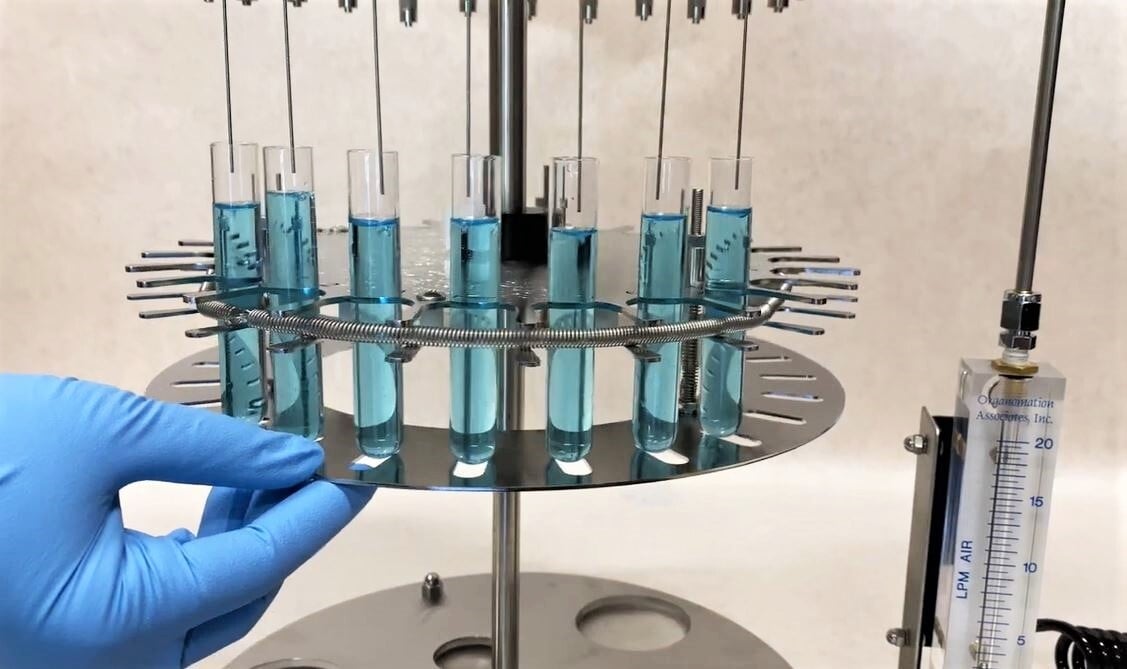
China's food safety, environmental, and human biomonitoring research sectors are among the most active in the world, publishing thousands of peer-reviewed method papers each year in journals such as Chinese Journal of Chromatography (色谱) and international titles like Toxins. A close review of recent literature shows that Organomation's N-EVAP and MULTIVAP nitrogen blowdown evaporators are consistently chosen as the sample-concentration workhorse in these studies, spanning pesticide residue analysis in tea, human biomonitoring of oxidative stress, and multi-mycotoxin surveillance in wheat and urine. This pattern reflects a broader trend: nitrogen evaporation is a near-universal step in modern GC-MS and LC-MS/MS sample preparation, and Chinese laboratories — from university teaching programs to national disease control centers — repeatedly specify Organomation instruments when building or refining these workflows.
Undergraduate Pesticide-Residue Teaching Method, Beijing Union University
A 2026 paper in Chinese Journal of Chromatography by Gu Chunxiu of Beijing Union University's Biochemical Engineering College describes an undergraduate instrumental-analysis teaching experiment built around response-surface-methodology (RSM)-optimized QuEChERS extraction combined with GC-MS to detect bifenthrin pesticide residue in tea. The equipment list for the method places an Organomation N-EVAP-24 nitrogen evaporator alongside an Agilent 7890A-5975C GC-MS, an IKA vortex mixer, and a Beckman high-speed centrifuge as core instrumentation for the entire sample-preparation pipeline. After QuEChERS clean-up with anhydrous MgSO4, PSA, and C18 sorbents, extracts were dried under nitrogen at 45°C on the N-EVAP before reconstitution in ethyl acetate-acetone for GC-MS analysis, a step essential to reaching the method's reported bifenthrin recovery of 90.33% after RSM optimization. The validated method was applied to 38 commercial tea samples, of which 12 tested positive for bifenthrin, with none exceeding China's national food-safety limit (GB 2763-2021) of 5 mg/kg. Notably, this paper is explicitly a teaching-curriculum design intended to train pharmaceutical-engineering undergraduates in real-world GC-MS operation, meaning the N-EVAP is being introduced to the next generation of Chinese analytical chemists as standard sample-prep equipment.
Human Biomonitoring of Oxidative Stress, China CDC
A second paper, published in Chinese Journal of Chromatography by researchers at the China CDC Key Laboratory of Environment and Population Health (National Institute of Environmental Health), developed a solid-phase extraction (SPE) coupled UPLC-MS/MS method to quantify four oxidative-stress biomarkers — 8-OHdG, 8-OHG, diY, and HNEMA — in human urine. These biomarkers reflect oxidative damage to DNA, RNA, protein, and lipids respectively, and are used to assess population-level health risk from environmental pollutant exposure. The instrumentation list specifies an Organomation MULTIVAP-48 nitrogen evaporator working alongside a Waters I-Class Plus UPLC-MS/MS (TQ-XS), a Scientific Industries vortex mixer, and a Millipore ultrapure water system. The nitrogen-blowdown step was used during SPE elution optimization to concentrate methanol eluates before reconstitution in mobile phase, a critical part of achieving the method's detection limits of 7-18 ng/L and spiked recoveries of 96.9%-105.6% across the four analytes. The validated assay was applied to 40 real urine samples collected in Beijing, with all four biomarkers detected at a 100% detection rate — demonstrating the practical, government-laboratory-grade reliability of the Organomation-supported workflow.
Multi-Mycotoxin Surveillance in Wheat and Urine
A third study, published in the MDPI journal Toxins, developed a UPLC-MS/MS method for simultaneous determination of 28 mycotoxins in wheat products and human urine, applied to biomonitoring samples collected through the Beijing Chaoyang District Center for Disease Control and Prevention. The reagents and instrumentation section lists an Organomation N-EVAP-24 nitrogen evaporator directly alongside a Shimadzu LC-MS-8060NX triple quadrupole mass spectrometer, an Eppendorf refrigerated centrifuge, a Mettler Toledo balance, and a Waters BEH C18 UPLC column. After SPE clean-up using Prime HLB cartridges, both wheat and urine extracts were evaporated to near dryness under a stream of nitrogen in a 37°C water bath — the standard N-EVAP operating mode — prior to reconstitution for injection. The resulting method achieved spiked recoveries of 70.2%-120% in wheat and 79.3%-120% in urine, with detection limits down to 0.0001 µg/L in urine, and was used to detect at least five to seven mycotoxins in real samples, including tenuazonic acid (TeA) and fumonisin B1 (FB1) at the highest concentrations. This paper illustrates Organomation's applicability beyond pesticide and biomarker analysis into large-panel food-safety and mycotoxin exposure surveillance, a fast-growing research area in China given rising attention to Fusarium and Alternaria toxins in wheat supply chains.
Cross-Study Comparison of Organomation Applications
|
Study |
Institution |
Organomation Model |
Analytical Target |
Detection Technique |
|
Bifenthrin in tea (2026) |
Beijing Union University |
N-EVAP-24 |
Pesticide residue (bifenthrin) |
GC-MS |
|
Oxidative stress biomarkers (2025) |
China CDC / National Institute of Environmental Health |
MULTIVAP-48 |
8-OHdG, 8-OHG, diY, HNEMA in urine |
UPLC-MS/MS |
|
Multi-mycotoxin panel (2026) |
Beijing Chaoyang District CDC / collaborators |
N-EVAP-24 |
28 mycotoxins in wheat and urine |
UPLC-MS/MS |
These three papers span three distinct application domains — pesticide residues, human oxidative-stress biomonitoring, and mycotoxin food safety — yet all rely on the same underlying Organomation nitrogen-evaporation step to concentrate extracts before final chromatographic separation and mass-spectrometric detection. This cross-domain consistency underscores the versatility of the N-EVAP and MULTIVAP platforms as a "universal" sample-concentration bridge compatible with GC-MS, UPLC-MS/MS, and QuEChERS or SPE-based workflows alike.
Why Nitrogen Evaporation Remains Indispensable
Nitrogen blowdown evaporation is favored over vacuum or rotary evaporation in trace-residue and biomonitoring work because it allows gentle, low-temperature solvent removal without degrading thermally labile analytes such as pesticides, mycotoxins, or oxidative-stress markers, while minimizing analyte loss to adsorption or oxidation. Organomation, founded in 1959 by Dr. Neal McNiven, pioneered the first commercially successful multi-sample nitrogen evaporator and has continued to refine this technology for more than six decades, with N-EVAP and MULTIVAP lines now marketed as compatible with both GC-MS and LC-MS/MS sample-prep pipelines used by instrument makers such as Agilent and Waters. The company's own materials describe the N-EVAP line as "the most cited nitrogen blowdown evaporator brand in U.S. EPA methods," a claim consistent with its appearance across the U.S. regulatory literature and, as the papers reviewed here show, across an expanding footprint of Chinese peer-reviewed analytical chemistry.
Implications for the Chinese Market
The recurrence of Organomation equipment across independent Chinese research groups — a university teaching laboratory, a national disease-control research institute, and a district-level CDC food-safety program — signals organic adoption driven by performance and reliability rather than a single institutional relationship. Given China's expanding regulatory emphasis on food-safety monitoring (GB 2763 pesticide MRLs, mycotoxin surveillance) and human-exposure biomonitoring programs, demand for validated, citation-backed sample-preparation instrumentation is likely to grow. This body of peer-reviewed evidence — spanning pesticide residues in tea, oxidative-stress biomarkers in urine, and multi-mycotoxin panels in wheat and urine — offers Organomation a credible, evidence-based narrative for demonstrating both technical trust and broad applicability to prospective Chinese laboratory customers and international researchers alike.