
Understanding the Nitrogen Evaporation Process - The Science Behind Nitrogen Blowdown
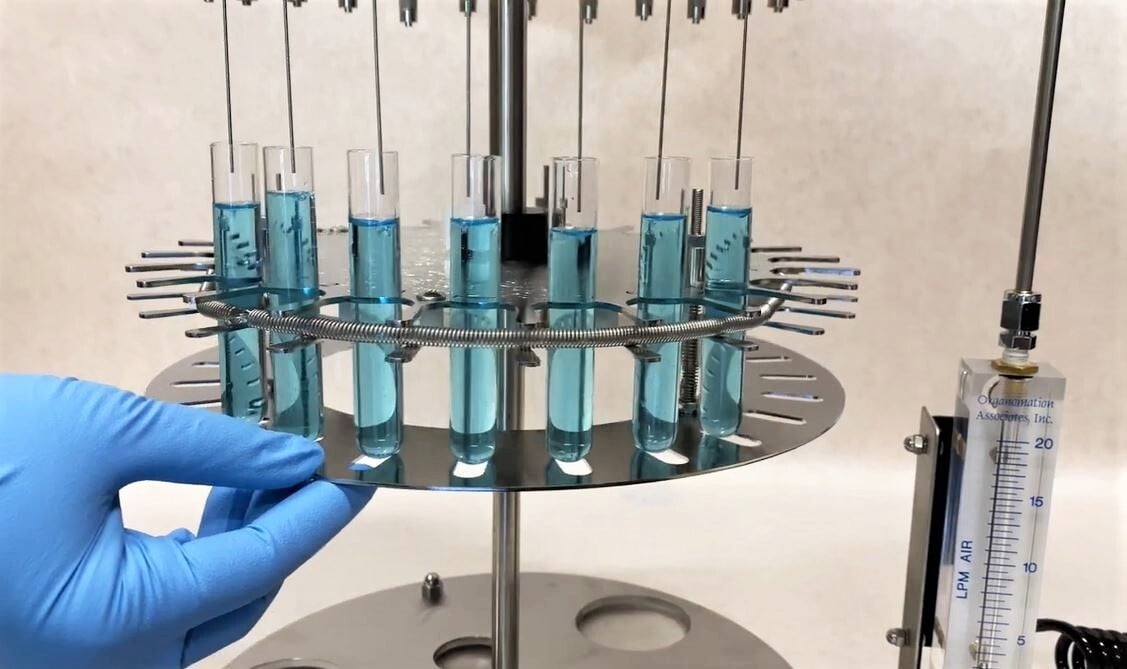
Nitrogen evaporation operates on fundamental principles of vapor pressure reduction and controlled heat application. The process works by directing a gentle stream of inert nitrogen gas across the sample surface, which effectively removes vapor-saturated air and prevents solvent molecules from returning to the liquid phase. This technique is effective because nitrogen's inert properties ensure no chemical interference with sensitive analytical samples.
The process involves placing samples in a heated water bath or dry block, typically maintained at temperatures 3-5°C below the solvent's boiling point. Individual nitrogen delivery needles are positioned just above each sample surface, creating a controlled microenvironment that optimizes evaporation rates while preserving sample integrity.
Temperature Control and Safety Considerations
Temperature control is critical in analysis because some compounds are heat-sensitive, including 3-monochloropropane-1,2-diol (3-MCPD), a contaminant found in edible oils. The Food Safety and Standards Authority of India (FSSAI) method specifies nitrogen evaporation temperatures of 35-40°C for evaporation to dryness, with recommended temperatures ranging depending on the solvent system used [1]. This precise temperature control prevents thermal degradation of analytes while ensuring efficient solvent removal.
Nitrogen Evaporation in Official Analytical Methods
AOCS Methods and International Standards
Multiple official methods for 3-MCPD analysis incorporate nitrogen evaporation as a mandatory step. The AOCS Cd 29a-13 method, widely recognized for its reliability, specifies "evaporated to dryness under a stream of nitrogen" at multiple critical points in the analytical procedure [2]. This method has been extensively validated through proficiency testing and forms the basis for numerous national and international standards.
The ISO 18363 method series also requires nitrogen evaporation steps. In ISO 18363-3, an “evaporation unit (nitrogen)” is specified as essential equipment, and the procedure states that samples should be evaporated to dryness using a stream of nitrogen [3].
FSSAI Method Requirements
The FSSAI method for 3-MCPD determination provides detailed nitrogen evaporation protocols. The method specifies two critical evaporation steps [1]:
1. Initial Phase Separation: After liquid-liquid extraction, "the upper layer was transferred to an empty glass tube and evaporated to dryness under a stream of nitrogen (35-40°C)"
2. Final Derivatization Step: Following phenylboronic acid derivatization, "Evaporate the organic phase to dryness under a stream of nitrogen. Dissolve the residue in 400 μl of n-heptane"
The Derivatization Connection - Phenylboronic Acid Chemistry
Nitrogen evaporation is particularly critical when performing a derivatization. Phenylboronic acid (PBA) is used as the derivatization reagent for 3-MCPD analysis because PBA reacts with the diol functional groups in 3-MCPD to form stable cyclic boronate derivatives that are amenable to GC-MS analysis [4]. The evaporation step serves dual purposes: concentrating the analytes for improved sensitivity and removing excess derivatization reagent that could otherwise interfere with chromatographic separation.
The FSSAI method specifically describes this process: "Add 250 μl of phenylboronic acid into the lower aqueous phase...Extract the phenylboronic derivatives...Evaporate the organic phase to dryness under a stream of nitrogen" [1]. This careful coordination between derivatization and evaporation ensures optimal analytical performance.
Solvent Selection and Evaporation Efficiency
Different analytical methods employ various solvent systems that influence nitrogen evaporation requirements. Common solvents include hexane, n-heptane, diethyl ether, and iso-octane. Each solvent presents unique evaporation characteristics that must be considered when optimizing nitrogen flow rates and temperatures. For example, diethyl ether evaporates more readily than hexane because of its higher volatility, requiring adjusted nitrogen flow rates to prevent sample loss.
Quality Assurance and Method Performance
Limits of Detection
Proper nitrogen evaporation technique is essential for achieving the low detection limits required for 3-MCPD analysis in edible oils. Effective sample concentration through solvent evaporation enables the analytical sensitivity needed to detect 3-MCPD esters at low levels.
Nitrogen Supply and Generation
Reliable nitrogen supply is essential for consistent evaporation performance. Many laboratories utilize on-site nitrogen generators to ensure continuous, high-purity gas supply while reducing operational costs compared to cylinder gas. These systems eliminate supply interruptions that could compromise analytical workflows.
Future Developments and Global Trade Implications
Method Optimization, International Standards, and Global Trade Implications
Ongoing research continues to refine protocols for 3-MCPD analysis. Improvements focus on reducing analysis time, enhancing automation, and improving method robustness across different oil matrices. Advanced evaporation systems with precise temperature and flow control contribute to these optimization efforts.
The development of harmonized international analytical standards is becoming increasingly important as the global palm oil trade faces stricter food safety requirements. International organizations and regulatory bodies, including the FDA and the European Union, actively monitor potential health risks and establish maximum allowable limits for 3-MCPD in food products [5, 6].
Beyond regulatory compliance, analytical reliability also influences market competitiveness. Producers and laboratories that can consistently demonstrate low contaminant levels through robust testing methods are better positioned to meet quality expectations and maintain access to global markets.
Conclusion
Nitrogen evaporation is a fundamental and indispensable component of modern 3-MCPD analysis in edible oils, particularly within the global palm oil industry. Its ability to gently concentrate samples while efficiently removing interfering solvents makes nitrogen evaporation especially well suited for the sensitive detection of these contaminants. Its inclusion in official methods from organizations such as AOCS, ISO, and regulatory authorities like FSSAI underscores its critical role across diverse regulatory frameworks.
As a cornerstone technique, nitrogen evaporation enables laboratories and industries to meet increasingly stringent food safety requirements while supporting the continued flow of global edible oil trade. A thorough understanding and proper implementation of nitrogen evaporation is essential to ensure accurate, reliable results that both safeguard public health and facilitate compliant international commerce.
Citations:
- https://fssai.gov.in/upload/uploadfiles/files/Method%20for%20determination%20of%20fatty%20acid%20esters%20in%20edible%20oil.pdf
- https://www.sciencedirect.com/science/article/abs/pii/S0956713523002244
- https://www.iso.org/obp/ui/en/#iso:std:iso:18363:-3:ed-2:v1:en
- https://europepmc.org/article/pmc/4609979
- https://www.fda.gov/food/process-contaminants-food/3-monochloropropane-12-diol-mcpd-esters-and-glycidyl-esters
- https://eur-lex.europa.eu/eli/reco/2014/661/oj