
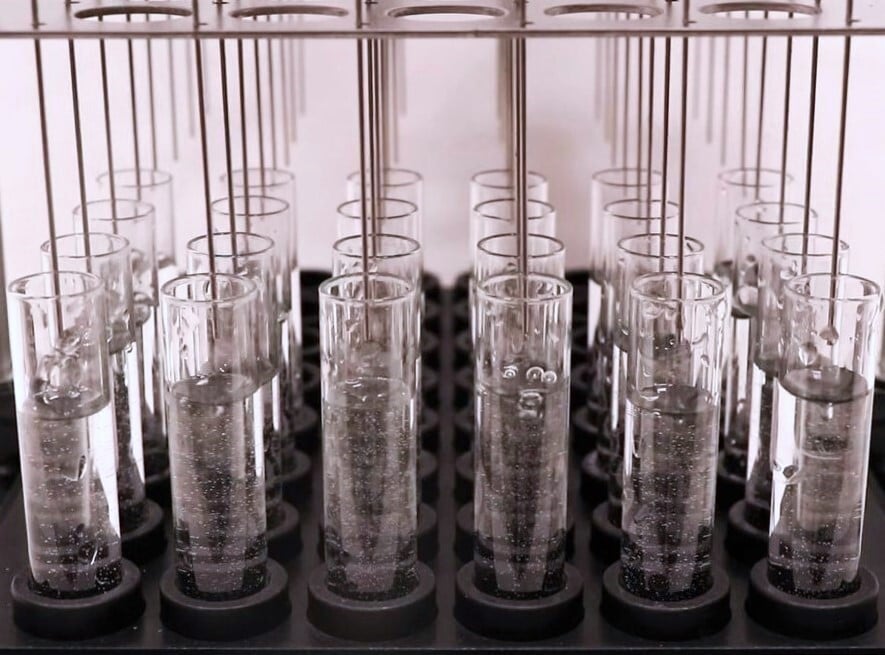
A Trusted Instrument in a National Public Health Laboratory
When one of the world's largest public health agencies needs to detect trace-level biomarkers in tens of thousands of human urine samples, instrument reliability is not optional — it is a prerequisite for national-scale environmental health surveillance. The China CDC Key Laboratory of Environment and Population Health, housed within the National Institute of Environmental Health (NIEH), Chinese Center for Disease Control and Prevention, has built its sample preparation workflows for two recent peer-reviewed biomonitoring methods around a single piece of equipment: the Organomation MULTIVAP-48 nitrogen evaporator.
Both studies, published in the Chinese Journal of Chromatography (色谱), describe ultra-performance liquid chromatography-tandem mass spectrometry (UPLC-MS/MS) methods developed to support China's national human biomonitoring efforts — one targeting oxidative stress biomarkers and the other targeting personal care product (PCP) exposure biomarkers. In both cases, the MULTIVAP-48 was the nitrogen blowdown instrument specified in the "Instruments, Reagents, and Materials" section of the methodology, alongside equipment from Waters, Millipore, and Ohaus.
Application 1: Measuring Oxidative Stress From Environmental Exposure
Researchers at NIEH, led by corresponding authors Zhang Xu and Zhu Ying, developed and validated a solid-phase extraction (SPE)–UPLC-MS/MS method to simultaneously quantify four oxidative stress biomarkers in human urine: 8-hydroxy-2′-deoxyguanosine (8-OHdG), 8-hydroxyguanosine (8-OHG), 4-hydroxynonenal mercapturic acid (HNEMA), and L,L-dityrosine (diY) — markers of oxidative damage to DNA, RNA, lipids, and proteins, respectively. Elevated oxidative stress is a recognized physiological response to environmental pollutant exposure, making these biomarkers valuable tools for early detection of pollutant-related health risk.
The published method lists a MULTIVAP-48 nitrogen blowdown evaporator (美国 Organomation 公司) as core sample preparation equipment, used during the SPE elution step to concentrate the methanol eluate containing 8-OHdG, 8-OHG, and HNEMA down to 0.5 mL before reconstitution and injection. This concentration step was essential to the method's sensitivity: the researchers achieved limits of detection between 7 and 18 ng/L and limits of quantification between 22 and 60 ng/L — outperforming five previously reported methods compared in the paper's method-comparison table, none of which measured all four biomarker classes simultaneously.
Applied to 40 real urine samples collected in Beijing under ethics approval from the NIEH Ethics Committee, the method detected all four biomarkers at a 100% detection rate, with median concentrations of 2.89 μg/L (8-OHdG), 12.36 μg/L (8-OHG), 37.66 μg/L (diY), and 96.92 μg/L (HNEMA). The authors noted that consistent, low-noise sample concentration was critical given the moderate-to-strong matrix effects (42%–137%) observed prior to isotope correction — underscoring why a dependable nitrogen evaporation step mattered to overall method accuracy.
Application 2: Tracking Personal Care Product Exposure Nationwide
A separate NIEH team, led by corresponding authors Lin Xiao and Zhu Ying, used the same MULTIVAP-48 platform in an earlier 2023 study developing a method to simultaneously measure 12 typical personal care products (PCPs) in human urine — five paraben preservatives, five benzophenone UV absorbers, and two antimicrobial agents (triclosan and triclocarban). PCPs are pervasive in cosmetics, sunscreens, and detergents, and chronic exposure has been linked in the epidemiological literature to immune and reproductive health effects.
Here, too, the MULTIVAP-48 was used post-SPE to reduce the 4 mL methanol eluate to near-dryness before reconstitution in 500 μL of acetonitrile-water for injection, a step the researchers optimized alongside solid-phase extraction cartridge selection and enzymatic hydrolysis conditions. The resulting method delivered method detection limits (MDLs) of 0.06–1.09 μg/L across all 12 targets and was validated against NIST SRM 3672 reference material, with seven repeated measurements falling within 1.2%–4.0% relative standard deviation of certified reference values.
The validated method was applied to 127 real human urine samples from a regional Chinese population under institutional ethics review. Ten of the 12 targeted PCPs were detected, with methylparaben, ethylparaben, and propylparaben showing the highest detection rates (up to 99.7%) and concentrations, while individual participants showed benzophenone-3 exposure as high as 1,140 μg/L — evidence of the method's dynamic range and its practical value for population-level exposure surveillance.
Why the MULTIVAP Fits China CDC's Workflow
Both papers reflect a broader pattern in China CDC's environmental health biomonitoring pipeline: a preference for solid-phase extraction (SPE) coupled with controlled nitrogen blowdown ahead of UPLC-MS/MS analysis, rather than derivatization-heavy GC-MS or direct-dilution approaches that the authors themselves critique as less suitable for large sample batches or as introducing greater measurement bias. The MULTIVAP-48's design — evenly distributed nitrogen flow control across rows of samples, a heated dry block ranging from 30°C to 120°C, and substantially lower gas consumption than comparable evaporators — supports exactly this kind of high-throughput, reproducible concentration step at national laboratory scale.
Organomation's own published comparisons show the advantage in gas efficiency that matters for labs running large biomonitoring cohorts: a 48-position dry MULTIVAP requires only 16 L/min of nitrogen, versus 160 L/min for a comparably sized competing evaporator, translating into materially lower operating costs for labs processing hundreds of samples per batch. This efficiency, combined with the acid- and corrosive-solvent resistance built into MULTIVAP dry-block models, aligns with the demands of a public health laboratory tasked with running SPE-based biomonitoring methods across large population cohorts.
NIEH's Role in National Biomonitoring
The National Institute of Environmental Health operates as China CDC's national-level technical guidance center for environmental and health-related product safety, established in 2002 and tasked with population exposure surveillance, laboratory standards management, and technical training for local disease control agencies across China. Both featured studies were conducted within the institute's Key Laboratory of Environment and Population Health and received either National Natural Science Foundation of China or central government funding, reflecting their status as state-supported public health research rather than isolated academic exercises.
|
Study |
Biomarkers Measured |
Sample Size |
MULTIVAP Role |
Detection Performance |
|
Feng et al., 2025, Chinese Journal of Chromatography[^1] |
40 urine samples |
Concentrating SPE methanol eluate to 0.5 mL |
100% detection rate; LOD 7–18 ng/L |
|
|
Han et al., 2023, Chinese Journal of Chromatography[^2] |
12 personal care products (parabens, benzophenones, antimicrobials) |
127 urine samples |
Concentrating 4 mL methanol eluate near-dry |
10/12 compounds detected; MDL 0.06–1.09 μg/L |
For a national reference laboratory validating methods intended for scale-up across China's disease control network, the choice of a dependable, cost-efficient nitrogen evaporator is not incidental — it is a documented part of the analytical infrastructure underpinning some of the country's most rigorous human exposure science.