
A recent infographic shared by one of Organomation's distributors, titled "Complete Solution for Food Analysis", outlines three foundational testing pillars: Kjeldahl protein analysis, Soxhlet fat extraction, and dietary fiber determination. While these three methods form the backbone of nutritional labeling compliance, they represent only part of what modern food safety programs require. The other half, largely invisible on infographics like this one, involves detecting pesticide residues, veterinary drug contaminants, and other hazards that consumers and regulators demand assurance against. That's where nitrogen blowdown evaporation quietly becomes indispensable.
The Three Pillars Shown in the Infographic
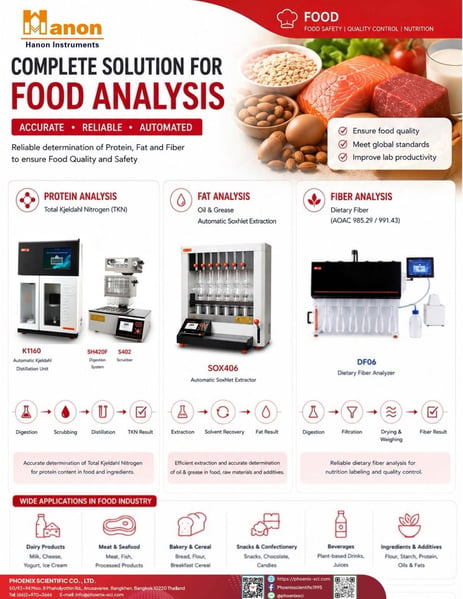
The pictured workflow follows a familiar sequence for each analyte category. Protein content is determined through the Kjeldahl method, which converts organic nitrogen into ammonium sulfate during acid digestion, then releases it as ammonia gas during alkaline distillation, and finally quantifies it through acid titration. This entire sequence, digestion, distillation, titration, calculation, ends without any solvent evaporation step, since nitrogen is captured in aqueous boric acid rather than an organic solvent.
Fat content follows a different path through automatic Soxhlet extraction, where lipids are pulled from the sample matrix using organic solvent, recovered, and weighed to determine oil and grease content. Dietary fiber analysis, using AOAC methods 985.29 and 991.43, relies on enzymatic digestion followed by filtration, drying, and gravimetric weighing rather than solvent-based concentration. None of these three pictured workflows inherently require nitrogen blowdown evaporation as a built-in step.
Why "Complete" Food Analysis Needs More Than Nutritional Panels
Here's the gap worth examining. Nutritional labeling, protein, fat, and fiber content, tells consumers what's in their food, but food safety testing tells regulators and manufacturers what shouldn't be there. Pesticide residues, veterinary drug carryover, and environmental contaminants represent an entirely separate testing dimension that operates on fundamentally different instrumentation: gas chromatography and liquid chromatography coupled with mass spectrometry.
Nitrogen evaporation workstations are used across environmental, food and beverage, medical, and forensic testing specifically because chromatography and mass spectrometry require samples to be concentrated and free of excess solvent before injection. In food and beverage laboratories specifically, nitrogen blowdown evaporators support quality control and safety testing programs designed to confirm products are free from harmful substances, with pesticide residues representing one of the most common testing targets.
The Extraction-to-Concentration Pipeline
Pesticide residue testing in foods like cereals, produce, and dairy follows a workflow that Kjeldahl and fiber methods simply don't share: solvent extraction followed by cleanup, followed by concentration, followed by chromatographic detection. A detailed breakdown of food and beverage evaporation methods explains that nitrogen blowdown is most commonly used to concentrate extracts after solid-phase extraction or liquid-liquid extraction cleanup steps, preparing the sample for downstream GC-MS or LC-MS analysis.
The same source identifies the typical targets of this workflow: pesticide residues, veterinary drug residues, polycyclic aromatic hydrocarbons, and mycotoxins, contaminant classes that show up across nearly every category in the infographic's "wide applications" section, from bakery and cereal products to meat, seafood, and beverages. The technique itself works by directing a controlled stream of nitrogen gas across the sample extract's surface, lowering vapor pressure and accelerating solvent removal while preserving the analyte's chemical integrity, a property that matters enormously when dealing with heat- or oxidation-sensitive pesticide compounds.
A Concrete Example: Flavor and Volatile Compound Testing
One workflow illustrates this concentration dependency particularly well. Solvent-Assisted Flavor Evaporation, used to extract volatile flavor and aroma compounds from complex food matrices, involves extracting the sample with organic solvent, then distilling that extract under high vacuum to isolate volatiles from non-volatile material. Even after this sophisticated distillation step, the resulting volatile fraction still requires further concentration before it's ready for analysis, and nitrogen evaporation is described as indispensable at this final stage. This same principle, extract first, then concentrate under nitrogen before analysis, repeats itself across dozens of food safety and quality testing applications that never appear on protein/fat/fiber infographics.
Where This Matters Most for Food Producers
Manufacturers in categories highlighted on the infographic face very real regulatory exposure if pesticide and contaminant testing isn't part of their quality program alongside nutritional analysis.
- Bakery and cereal products: raw grain inputs carry residual pesticide risk from field application, requiring extraction and concentration before GC-MS confirmation
- Meat and seafood: veterinary drug residues and environmental contaminants like PAHs require the same extraction-to-nitrogen-concentration pipeline before LC-MS/MS detection
- Beverages: plant-based drinks and juices derived from produce carry pesticide residue risk inherited from raw agricultural inputs
- Snacks and confectionery: multi-ingredient products complicate residue testing, often requiring solid-phase extraction cleanup followed by nitrogen concentration to remove matrix interferences before analysis
Why the Two Testing Programs Rarely Share Equipment, But Should Share Lab Space
It's worth noting explicitly: the Kjeldahl, Soxhlet, and dietary fiber instruments shown in this infographic will never require a nitrogen evaporator as part of their direct operation. A lab running only nutritional panel testing has no functional need for nitrogen blowdown equipment. But food safety testing labs, the ones running pesticide residue panels alongside nutritional compliance, depend on nitrogen blowdown as a near-universal step in sample preparation before chromatographic and mass spectrometric analysis.
This creates a practical opportunity for distributors and lab managers. A facility investing in the "Complete Solution for Food Analysis" instrumentation shown here is almost certainly operating within a broader food safety compliance program that may also require pesticide, veterinary drug, and contaminant screening. Recognizing that a nitrogen evaporator isn't a competing purchase to the pictured Kjeldahl and Soxhlet systems, but rather the missing link connecting extraction-based contaminant testing to confirmatory chromatography, helps labs build a genuinely complete food safety and quality program rather than a nutritional-labeling-only operation.