
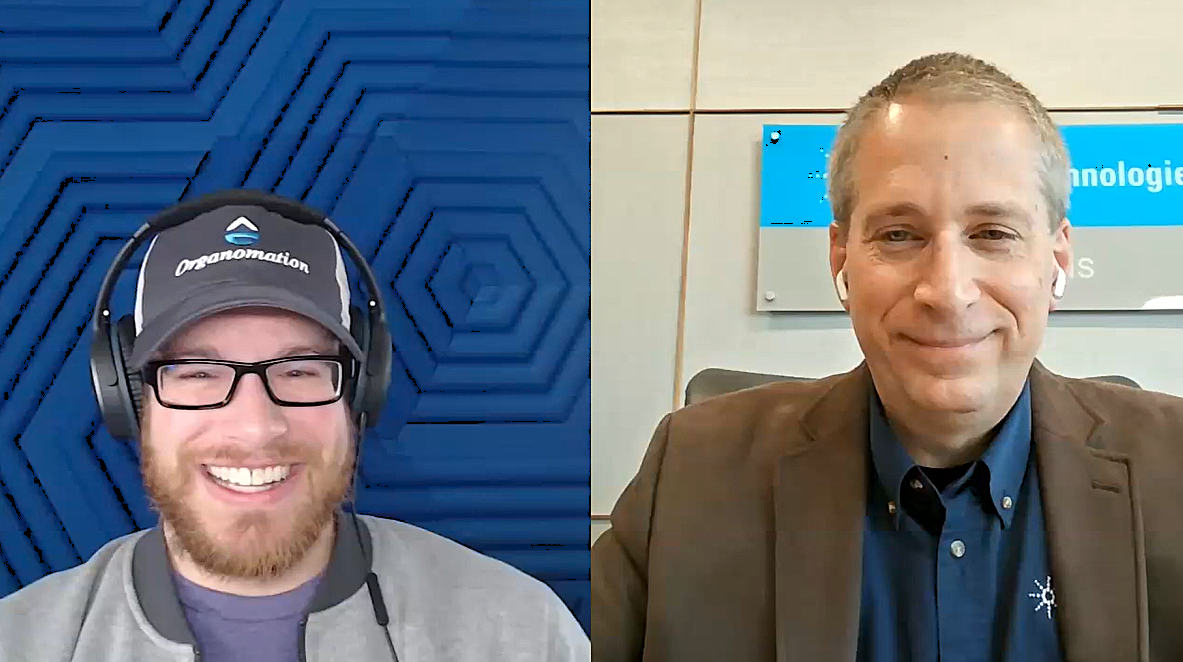
Insights from the Concentrating on Chromatography Podcast, featuring Jim Gearing, Associate Vice President of Marketing, Gas Phase Division, Agilent Technologies
The modern analytical laboratory looks nothing like it did two decades ago. Staffing levels are leaner, turnaround time expectations are tighter, and the scientists operating these systems are often earlier in their careers and less likely to have deep instrumentation-specific training. At the same time, the complexity of the analytical workflow has only grown — particularly in the sample preparation phase that feeds every chromatographic run.
In a recent episode of Concentrating on Chromatography, Organomation General Manager David Oliva sat down with Jim Gearing, Associate Vice President of Marketing for the Gas Phase Division at Agilent Technologies. Gearing brings more than 34 years of experience spanning R&D and product marketing for GC and GC-MS platforms. The conversation ranged from the changing demographics of chromatography users to the rise of intelligent instrumentation — and it surfaced themes that are directly relevant to anyone managing or working in an analytical lab today.
Below, we unpack the key takeaways and connect them to the broader landscape of sample concentration, evaporation, and pre-analytical workflows that Organomation customers navigate every day.
Watch the full podcast:
1. The Chromatography User Has Changed — And Instrumentation Must Keep Up
One of the most candid observations in the conversation came early: today's laboratory professionals use instruments the way they use their smartphones — as tools to get a job done, not as systems to deeply understand.
"They're just using them as a tool... people are busy. They've got smartphones, mobile devices, internet of things in their homes, and they expect a lot more from technology today. And these are the users that are in the laboratory." — Jim Gearing, Agilent Technologies
This shift is not anecdotal. The laboratory science workforce is under significant structural pressure. A 2024 Medical Laboratory Observer survey found that 65% of respondents cited staffing shortages as a key driver of operational inefficiency, leading to heavier workloads and higher burnout rates. The Bureau of Labor Statistics has projected an 11% increase in demand for lab technologist and technician positions by 2030, while supply is constrained by historic retirement rates and insufficient pipeline growth from accredited programs.
The result, as Gearing describes, is a common scenario: one or two people responsible for a room full of instruments, tasked with producing results — fast. In a contract testing environment, samples are revenue. In a manufacturing plant, a slow analytical result can mean lost product. In law enforcement or food safety, a delayed answer can carry regulatory or public health consequences.
For instrument manufacturers and sample preparation equipment suppliers alike, the imperative is the same: reduce the cognitive and procedural burden on the operator without sacrificing data quality.
2. Sample Preparation Remains the Single Biggest Bottleneck in the Analytical Workflow
While much of the conversation centered on GC and GC-MS instrumentation, Gearing closed with an observation that resonates deeply in the sample preparation space: when asked what he would fix with a magic wand, he pointed squarely at data processing time — but acknowledged that the full workflow, from sample to result, is where the real inefficiency lives.
The data on this point is well-established. Research published in LCGC has consistently shown that sample preparation accounts for two-thirds or more of total analysis time in a typical chromatographic workflow. A survey-backed overview in the same publication confirmed that analysts spend more time on sample preparation than on collection, chromatographic analysis, and data management combined. A 2023 review in the Journal of Chromatography A further quantified this burden, noting that sample treatment consumes up to 60% of total analysis time and is the primary determinant of overall analytical productivity.
This is precisely where the Organomation product line intersects with the trends Gearing described. Nitrogen blowdown instruments — including the N-EVAP and MULTIVAP platforms — are designed to remove the manual monitoring burden from the evaporation and concentration step, one of the most time-intensive parts of sample preparation for GC, GC-MS, LC, and LC-MS/MS workflows. When a single technician is managing a room full of instruments, the ability to walk away from a concentrator running 64 samples in parallel is not a luxury — it is a necessity.
3. Intelligent Instrumentation: What It Actually Means
The term 'intelligent instrument' is used frequently in instrument marketing, but Gearing offered one of the clearest functional definitions we have encountered:
"An intelligent system... is a feature that takes a workload or mental effort off of a user and it can deliver the same or better result with very high confidence." — Jim Gearing, Agilent Technologies
Gearing illustrated this with the analogy of adaptive cruise control: the driver sets a target gap and speed, and the system maintains both without constant intervention. The driver retains ultimate control but is freed from continuous micro-adjustments. Applied to chromatography, this translates into several categories of built-in intelligence:
-
Guided maintenance: step-by-step on-screen workflows that walk an operator through inlet maintenance, leak testing, and system health checks without requiring prior experience
-
Early maintenance feedback (EMF): automated tracking of consumable usage (liner injections, septum cycles, column runs) so less experienced operators receive warnings before a mid-sequence failure, not after
-
Peak evaluation: the ability for the GC itself to perform an early chromatographic analysis of a sample and flag retention time shifts, peak width anomalies, or other deviations before the run is complete — enabling real-time process decisions in refinery, chemical plant, or contract testing environments
-
AI-assisted peak integration: machine learning tools that train on a user's manual integration decisions and then replicate them automatically for routine analyses, dramatically reducing post-run data review time
-
MRM Optimizer: automated setup of multiple reaction monitoring transitions in GC-MS/MS, eliminating one of the most tedious manual method development tasks
What makes this definition of intelligence practically useful — and distinct from mere automation — is the emphasis on mental effort transfer. The system does not just execute a task; it takes on the interpretive responsibility that previously required an experienced analyst. For labs with high staff turnover or an increasingly junior bench, this distinction matters enormously.
Gearing was also careful to address a common misconception: intelligent Agilent instruments do not require an internet connection. The browser-based interface and remote access capabilities function entirely within a lab's internal network. An enterprise VPN can extend access to off-site personnel, but connectivity to the public internet is optional, not required. This is a meaningful data security clarification for labs operating under pharmaceutical GMP, environmental regulatory, or defense/government constraints.
4. The Black Box Problem: Balancing Automation with Operator Understanding
One of the most nuanced exchanges in the episode addressed a tension that any technologically sophisticated lab equipment company must navigate: how do you make an instrument intelligent enough to protect less-experienced operators without making it so opaque that no one understands what it is doing?
Gearing used the analogy of photo editing software: you can let the automatic adjustments run, or you can go into the individual channels and understand exactly what was adjusted and why. The instrument's intelligence should be transparent to anyone curious enough to look behind the curtain — but it should not require that curiosity to function correctly for routine work.
This philosophy maps directly onto the design challenge Organomation faces with nitrogen blowdown and evaporation platforms. A researcher using a MULTIVAP for pharmaceutical sample concentration may care deeply about the nitrogen flow rate. A contract lab technician processing 48 environmental extracts before a 10:00 AM GC run needs the same system to run reliably and consistently with minimal configuration. Both users are valid; the instrument needs to serve both without compromising either.
The key insight from Gearing is that the solution is not to choose between simplicity and depth — it is to layer them. Surface-level operation should be simple enough for a first-day technician. But every parameter and every decision the instrument makes should be accessible, auditable, and adjustable for the scientist who needs that control.
5. Lab Director Strategy: Goals, Users, and Solution — In That Order
When asked for his top advice to a lab director evaluating an instrumentation strategy, Gearing offered a deliberately sequenced framework:
-
Goals first: What is the lab trying to accomplish? Is it throughput, cost reduction, sustainability targets, regulatory compliance, or some combination? The answer to this question should drive every subsequent decision.
-
Users second: Who will actually operate the instrumentation? What is their training level? How many staff will the lab run on? Where does the organization want those staff to spend their time — and where is it currently wasting it?
-
Solution third: Only after the first two questions are answered does it make sense to evaluate specific capabilities — speed of analysis, energy consumption, maintenance frequency, uptime reliability, and the ability of a vendor to support a complete workflow rather than just a single instrument.
This framework has direct implications for how labs should evaluate sample preparation equipment, including nitrogen evaporators and concentration systems. An academic lab preparing environmental extracts for LC-MS/MS analysis has different goals, different users, and therefore different solution requirements than a pharmaceutical contract research organization processing plasma samples for PK studies. A nitrogen blowdown system that works perfectly for one may be undersized, oversized, or misconfigured for the other.
Gearing's emphasis on the complete workflow — not just the analytical instrument — is particularly relevant here. As he noted, a GC or GC-MS is only as good as the sample that reaches it. The quality, reproducibility, and speed of the concentration and cleanup steps upstream determine whether the instrument's intelligence and sensitivity are ever fully utilized.
6. From Knowledge Bases to AI: How Labs Are Training the Next Generation
The conversation closed with a discussion of how Agilent supports new users — and how that support model has evolved. Printed manuals were eliminated more than a decade ago. Onboarding now happens at the instrument touchscreen, with guided step-by-step introductions that can be revisited on demand. Short-form video, community forums on agilent.com, and in-person training at Agilent University supplement the embedded resources.
The underlying insight is behavioral: today's laboratory professionals do not want to sit through a 30-minute webinar. They want a three-minute answer to a specific task-based question. This matches how the broader knowledge consumption shift has played out across industries, and it is increasingly reflected in how instrument companies design their support resources.
For labs investing in sample preparation equipment, this trend has a practical implication: look for suppliers who embed operational guidance directly into the product experience, maintain accessible digital documentation, and provide application-specific resources that match the actual use cases in your lab. A concentrator used for pesticide residue analysis in food has a different set of operational questions than one used for extractable and leachable studies in pharmaceutical packaging — and the support resources should reflect that.
What This Means for Organomation Customers
The themes from Jim Gearing's conversation at Agilent map cleanly onto the challenges Organomation has been hearing from its own customer base. Labs are doing more with fewer people. Sample preparation is still the workflow step most likely to create a bottleneck. The expectation for instrumentation that "just works" — reliably, consistently, and without requiring deep expertise — has never been higher.
Organomation's nitrogen blowdown and solvent evaporation platforms are designed with these realities in mind. The MULTIVAP and N-EVAP product lines offer parallel-sample concentration with consistent, reproducible flow control. The NITRO-GEN on-site nitrogen generator eliminates dependence on gas cylinders and the handling overhead that comes with them. Together, these systems are designed to take the monitoring burden off the analyst — freeing them to focus on the high-value work that actually requires their expertise.
As analytical instrumentation continues to get smarter downstream, the upstream sample preparation step needs to keep pace. The intelligent lab is only as fast as its slowest step.