
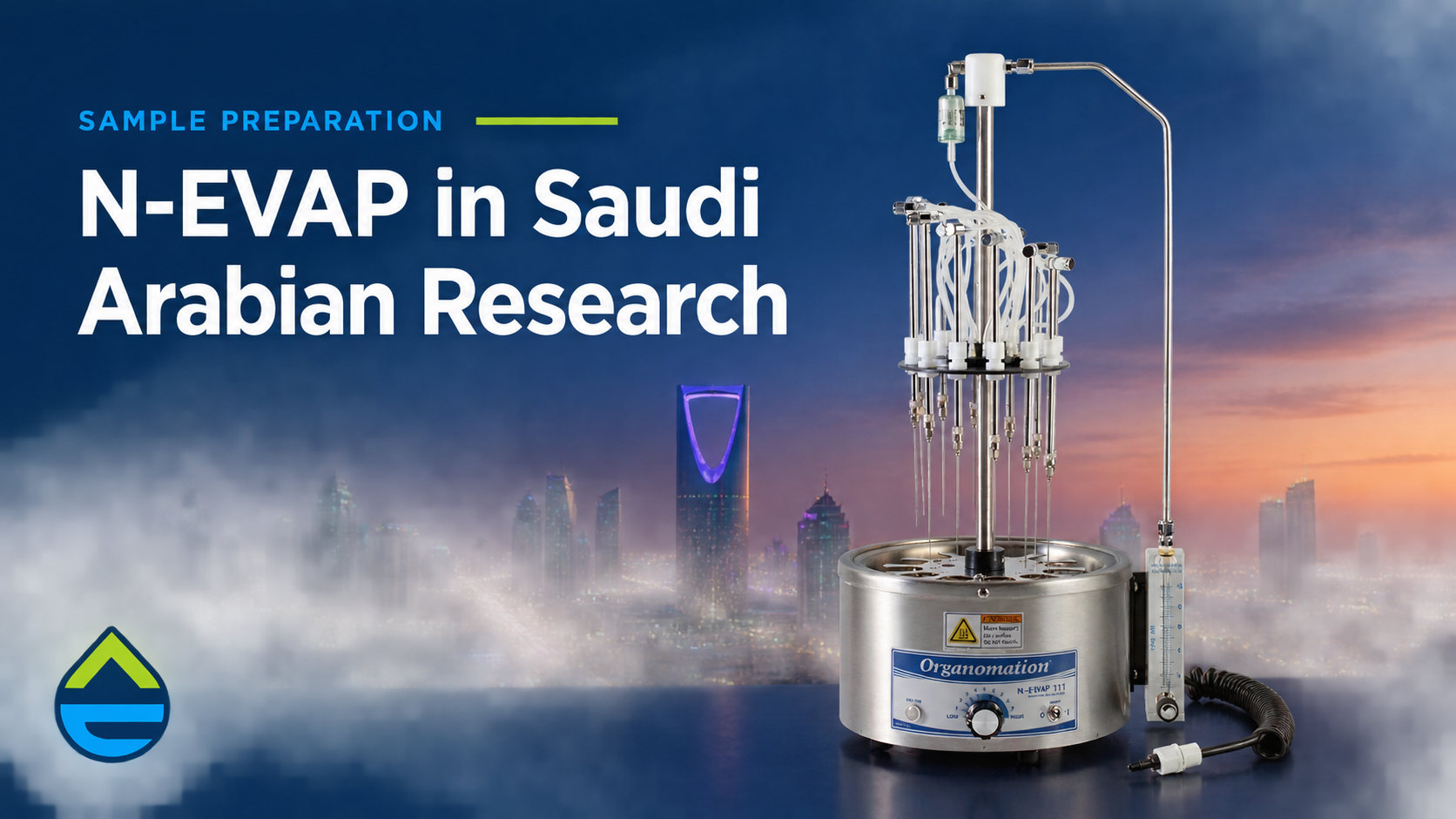
Organomation’s N-EVAP nitrogen evaporator has a documented role in Saudi-affiliated research, supporting solvent removal and reconstitution in pharmaceutical and food-analysis methods. Published applications include dasatinib measurement at King Saud University, simultaneous analysis of dasabuvir and tamoxifen, and tenuazonic acid testing in dried figs.
Across these methods, the evaporator occupies an important position between extraction and measurement: removing extraction solvent so that researchers can reconstitute the recovered analytes for the next analytical step.
Why Evaporation Matters
Nitrogen blowdown directs gas across the sample surface to carry away solvent vapor, with controlled heating available when appropriate for the method. In the published workflows below, this operation enables solvent exchange, extract-volume adjustment, or both before instrumental analysis.
That distinction matters when evaluating a nitrogen evaporator. A dry-down step does not automatically provide net enrichment relative to the original sample; its value may instead be preparing an extract in the solvent and volume specified by a validated method.
Dasatinib Analysis in Riyadh
Researchers at King Saud University in Riyadh developed a UPLC-MS/MS method for dasatinib in rat plasma, applying it to pharmacokinetic studies involving nutraceuticals. Their instrumentation section specifically identifies an Organomation N-EVAP 112 with an OA-SYS heating system.
The preparation combined methanol-based protein precipitation with C18 solid-phase extraction, followed by elution of the retained analytes in 0.5 mL methanol. Researchers then evaporated the methanolic eluate under nitrogen and reconstituted the residue in 0.5 mL acetonitrile before UPLC-MS/MS analysis.
Here, N-EVAP’s fit is particularly clear: it provides the solvent-removal step needed to move from a methanolic SPE eluate to an acetonitrile solution for injection. Because the elution and reconstitution volumes were both 0.5 mL, this example demonstrates solvent exchange rather than a reduction in extract volume.
The complete analytical method achieved a lower limit of quantification of 1 ng/mL in plasma—a result belonging to the combined extraction, evaporation, chromatography, and detection workflow, not to the evaporator alone.
Multi-Analyte Plasma Preparation
A second King Saud University study measured dasabuvir, tamoxifen, and 4-hydroxytamoxifen simultaneously to investigate their pharmacokinetic interaction in Wistar rats. This paper also explicitly identifies the N-EVAP 112 with OA-SYS heating for solvent evaporation.
Starting with 50 µL plasma samples, researchers used protein precipitation followed by mixed-mode strong-cation-exchange SPE. The retained compounds were eluted with 1.0 mL of 5% ammonium hydroxide solution in acetonitrile, evaporated under nitrogen, and reconstituted in 0.5 mL acetonitrile.
For this application, evaporation connects selective SPE cleanup with a defined final extract volume for simultaneous measurement of a drug, another co-administered drug, and an active metabolite. The method achieved reported quantification limits of 20 ng/mL for dasabuvir, 0.1 ng/mL for tamoxifen, and 0.5 ng/mL for 4-hydroxytamoxifen.
For laboratories developing comparable assays, the practical lesson is to evaluate evaporation as part of the complete preparation procedure. Assess analyte recovery, residue redissolution, and final-volume consistency together rather than selecting dry-down conditions on evaporation speed alone.
Related Sorafenib Interaction Research
The supplied research collection also includes a 2019 investigation of sorafenib and iced-tea interactions, using UPLC-MS/MS to measure drug exposure in Wistar rats. It broadens the application context to another pharmacokinetic workflow in which reliable measurement of drug concentrations is central to the study design.
For laboratories considering nitrogen evaporation for similar work, the appropriate starting point is the published extraction procedure and its validation requirements. Transfer the evaporation conditions only after confirming the actual solvent composition, endpoint, analyte recovery, and reconstitution procedure.
Mycotoxin Testing Beyond LC-MS
N-EVAP’s documented applications also extend beyond pharmaceutical bioanalysis: a 2026 Saudi–Egyptian collaboration developed a spectrofluorimetric method for tenuazonic acid in dried figs, identifying an Organomation N-EVAP 112 in its instrumentation section. Although several authors held Saudi university affiliations, the figs were purchased from Egyptian markets, making this Saudi-affiliated research rather than a survey of Saudi food products.
The method placed nitrogen evaporation at two different stages of sample preparation.
- Before microextraction: Researchers extracted homogenized figs with acidified methanol–water, evaporated the recovered supernatant, and reconstituted the residue in water before dispersive liquid–liquid microextraction.
- Before fluorescence measurement: The collected 1-octanol extract underwent another nitrogen dry-down, followed by reconstitution in ethanol for the fluorescence-based procedure.
These two evaporation-and-reconstitution stages show how N-EVAP can support solvent transitions within a multistep method—not merely serve as a final concentration device before chromatography. The authors reported room-temperature nitrogen evaporation; those conditions remain specific to their procedure and should not be interpreted as a universal setting or an evaporation-time specification.
Choosing a Laboratory Configuration
For Saudi Arabian laboratories evaluating a nitrogen evaporator, the relevant questions are practical: Which vessels will be used? How many samples require simultaneous processing? Does the validated procedure require heating or ambient-temperature evaporation?
Organomation’s 24-position N-EVAP configuration accommodates vessels with outside diameters of 10–30 mm using its standard holder, while an optional eight-position holder accommodates larger vessels. An unheated configuration supports ambient-temperature evaporation, providing an option when a procedure does not call for added heat.
Match the instrument configuration to the method rather than assuming that every published N-EVAP reference specifies the same bath, accessories, or operating conditions.
Developing a plasma-extraction, SPE, or food-testing workflow in Saudi Arabia? Contact Organomation to discuss sample vessels, solvent composition, batch size, nitrogen supply, and the N-EVAP configuration appropriate for your procedure.