
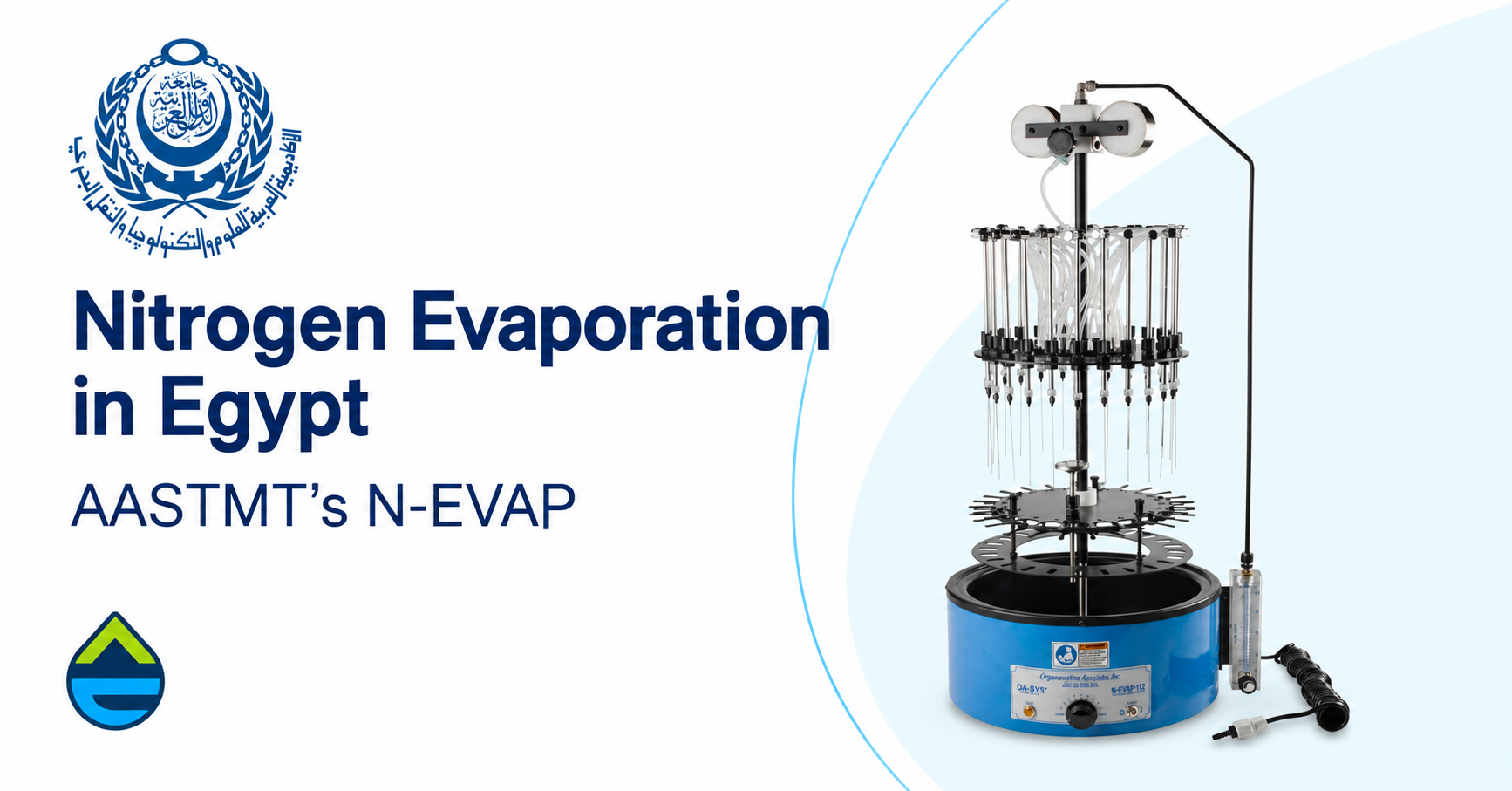
At the Arab Academy for Science, Technology & Maritime Transport (AASTMT) in El Alamein, Egypt, the Central Lab for Pharmaceutical Analysis lists an Organomation 24 Position N-EVAP among its analytical resources. Its published capabilities suggest a particularly plausible role for this nitrogen evaporator: preparing extracted drug samples for HPLC through controlled solvent removal and reconstitution.
About this case study: The equipment listing is documented. The workflow scenarios below are informed interpretations of the laboratory’s published capabilities—not laboratory-confirmed procedures, a customer testimonial, or evidence of measured performance improvements.
A documented Egyptian installation
The Central Lab for Pharmaceutical Analysis supports pharmaceutical testing, method development and validation, and academic research at AASTMT’s College of Pharmacy–Alamein. Its services include drug quantitation in biological fluids, pharmaceutical product analysis, physicochemical evaluation of formulations, and cosmetic quality control.
The laboratory specifically describes its N-EVAP as a 24-position dry-bath instrument with glass beads and an acid-resistant coating. This is not simply a generic reference to nitrogen evaporation: it is a named Organomation instrument with a described configuration.
Alongside the evaporator, AASTMT lists Agilent 1260 Infinity II Prime LC configurations with diode-array detection and refractive-index detection. That equipment provides context for the likely connection between sample extraction, solvent removal, and chromatographic measurement.
The strongest fit: bioanalysis
Drug analysis in biological fluids is the most compelling likely application. AASTMT explicitly advertises this service, and published Egyptian research demonstrates the extraction–evaporation–HPLC sequence that could explain the N-EVAP’s role.
A representative workflow—not a reported AASTMT protocol—would include these stages:
- Extract the target drugs from the biological sample using an appropriate cleanup method, such as solid-phase extraction.
- Collect the drug-containing organic eluate separately from the original matrix.
- Remove the extraction solvent under nitrogen using conditions established for the analytes.
- Reconstitute the residue in a defined volume of a compatible diluent before HPLC analysis.
This sequence is illustrated by a 2024 study from researchers affiliated with Beni-Suef University and Hikma Pharmaceutical Company. Their investigation of metformin and dapagliflozin used solid-phase extraction of spiked human plasma, nitrogen evaporation of the acetonitrile eluate at 40 °C, and reconstitution in mobile phase before HPLC with diode-array detection.
That independent study supplies an Egyptian example of the analytical need—not proof that AASTMT analyzes those drugs, follows that protocol, or provided the study’s evaporator. The defensible connection is that AASTMT offers biological-fluid drug analysis and lists equipment suited to the same general preparation sequence.
Preparing extracts for HPLC
A second likely role is solvent exchange during analytical method development. AASTMT identifies method development and validation among its activities, while Agilent’s chromatography guidance explains that injection-solvent composition and volume can affect HPLC peak shape.
The solvent that extracts a drug effectively is not necessarily the best solvent for injecting it onto a reversed-phase HPLC column. Evaporation followed by reconstitution can move the extract into a more appropriate diluent, or concentrate analytes so that a smaller injection volume can be used.
For AASTMT, that makes selected pharmaceutical extracts and method-development samples plausible candidates for the N-EVAP—not every tablet assay or dissolution aliquot. The value would depend on the complete method, including recovery, stability, and final chromatographic conditions, rather than on concentration alone.
A secondary fit: cosmetics
Cosmetic quality-control testing is another service on AASTMT’s published list, making preparation of selected cosmetic extracts a reasonable secondary application scenario. Published research provides relevant precedent: an investigation of benzophenone UV filters in cosmetics and water used solid-phase extraction, nitrogen evaporation of the eluate, and reconstitution before GC analysis.
The connection is the preparation principle, not an attribution of that assay to AASTMT. Where a cosmetic method calls for solvent exchange or volume reduction after extraction, the N-EVAP could perform that intermediate step; suitability would depend on the compounds, solvents, and validated recovery.
Botanical work deserves a distinction. AASTMT lists volatile-oil analysis in phytochemical extracts and phytopharmaceuticals, but that does not establish that it dries essential-oil samples under nitrogen. Removing volatile target compounds before measuring them would undermine the analysis; this service is therefore not a sound basis for attributing a dry-down workflow to the laboratory.
Why 24 positions matter
Organomation’s 24 Position N-EVAP accommodates multiple sample tubes and provides individual nitrogen-flow adjustment at each position. For a laboratory preparing compatible extracted samples, standards, and quality controls, that offers a practical way to process tubes in parallel.
Individual flow control is not individual temperature control: samples share the bath, so the heating conditions must suit the samples processed together. AASTMT’s listing establishes the instrument’s capacity, but does not report sample throughput, dry-down times, nitrogen savings, or before-and-after productivity results.
Where blowdown does not belong
AASTMT also lists a Shimadzu Nexis GC-2030 with flame-ionization detection and a headspace injector. In pharmaceutical residual-solvent testing, headspace GC measures volatile components released from a sample sealed in a vial—not material remaining after an open-vessel dry-down.
Nitrogen blowdown therefore should not be presented as routine preparation for residual-solvent or volatile-oil measurements: removing the target compounds before measuring them could undermine the analysis. The strongest application story here is controlled solvent removal while retaining suitable target analytes, not evaporation of every sample entering the laboratory.
Conditions matter, too. Organomation’s operating instructions call for balancing sample volume, gas flow, bath temperature, and needle position, avoiding splashing, and monitoring samples when a specific remaining-volume endpoint is required. For regulated bioanalytical work, ICH M10 emphasizes establishing recovery and stability across the actual preparation process.
Common laboratory questions
Why evaporate before HPLC?
Evaporation can reduce extract volume or enable reconstitution in a more suitable injection solvent. Its benefit depends on analyte recovery, stability, selectivity, and the final chromatographic conditions.
Does evaporation replace extraction?
No. In the Egyptian plasma study described above, solid-phase extraction separated the analytes from the sample matrix before nitrogen evaporation removed the eluate solvent. The two operations perform different jobs.
Is LC-MS/MS use confirmed?
The AASTMT pages reviewed identify HPLC configurations with DAD and RID, plus GC with FID and headspace injection. Those listings do not establish an installed LC-MS/MS system or confirm that the N-EVAP supports a mass-spectrometric method.
Planning a similar workflow?
For laboratories in Egypt evaluating nitrogen evaporation for pharmaceutical sample preparation, start with the method: extraction solvent, target-analyte stability, required endpoint, and final injection conditions.
Explore the Organomation 24 Position N-EVAP, or ask Organomation to review the configuration against the proposed application.