
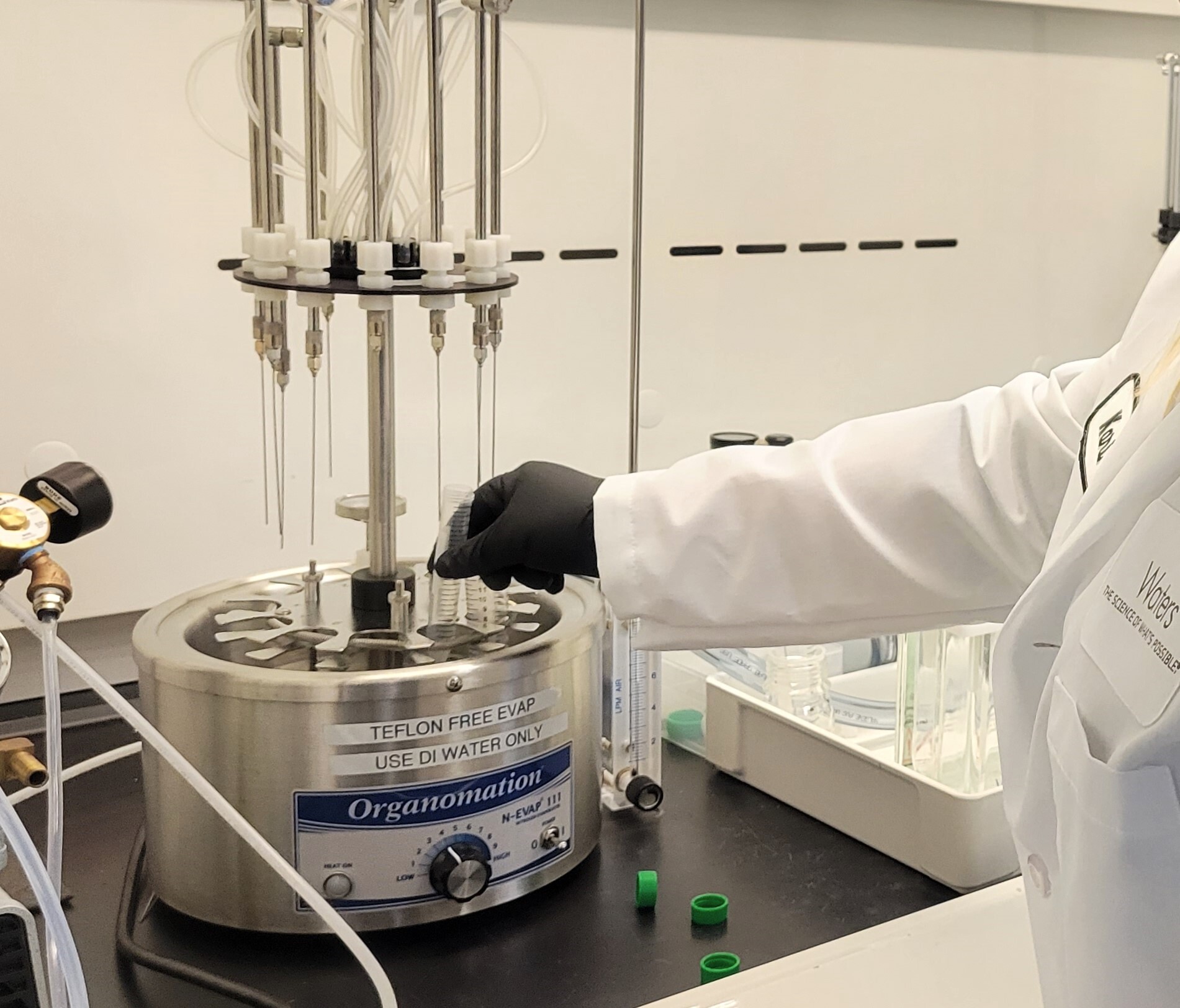
We built a tool that answers a question we get on nearly every sales call and podcast interview: "Who else is using this instrument, and for what?" Today, that question has a real-time answer. Organomation has launched a new citation widget across its nitrogen blowdown evaporator product pages, giving chemists a searchable, filterable window into the peer-reviewed literature that cites our instruments — across the full N-EVAP, MULTIVAP, and MICROVAP lines.
Why We Built This
Organomation has long been recognized as the most cited nitrogen blowdown evaporator brand in U.S. EPA methods, a distinction earned across over six decades of use in environmental, pharmaceutical, food safety, and forensic laboratories. But citation counts on their own don't tell a chemist much. What matters is context: Is this instrument being used for PFAS extracts ahead of LC-MS? Is it showing up in lipidomics workflows? Is it cited in a method validated for a matrix similar to mine?
The new widget, now live across N-EVAP, MULTIVAP, and MICROVAP product pages, is designed to answer exactly that. Rather than pointing visitors to a static list of references, it surfaces the current body of literature citing each instrument line as a live, browsable database. As of launch, the N-EVAP widget indexes 325 citations, MULTIVAP indexes 67, and MICROVAP indexes 44 — and each count grows as new research is published.
Broadening the tool across all three lines matters because chemists don't all work at the same scale, and the citation data bears that out. The N-EVAP's top-cited fields are lipids/lipidomics, fatty acids/FAMEs, pesticides/herbicides, and polar metabolites/metabolomics — consistent with its long history in EPA-method environmental and regulatory workflows.
MULTIVAP's citations skew toward lipids/lipidomics, pesticides/herbicides, polar metabolites/metabolomics, and fatty acids/FAMEs as well, but at higher batch volumes: it's the line researchers reach for when they're running large clinical or environmental cohorts, not single digit sample sets.
MICROVAP's citations cluster around lipids/lipidomics, steroid hormones, polar metabolites/metabolomics, and newborn screening markers — reflecting its role in life-science and clinical labs working with microcentrifuge tubes and small-volume, high-sensitivity assays.
Each instrument line shows up in a different slice of the literature, so giving each one its own citation widget means the filtered results actually reflect how that specific instrument gets used.
How the Filtering Works
I think the filtering is what makes this genuinely useful rather than just a numbers badge. From the widget, chemists can:
1. Jump straight to their field using quick-access tiles for the top application areas cited for that specific instrument — lipids/lipidomics, fatty acids/FAMEs, pesticides/herbicides, and polar metabolites/metabolomics for N-EVAP; lipids, pesticides, metabolites, and fatty acids for MULTIVAP; lipids, steroid hormones, metabolites, and newborn screening markers for MICROVAP — with a "Show all" option expanding to the full list of categories for that line (17 for N-EVAP and MULTIVAP, 14 for MICROVAP).
2. Filter by analyte or application, narrowing results to the specific class of compound they're working with.
3. Filter by analytical technique, so a chemist running GC-MS/MS or LC-MS/MS can see only the papers relevant to their downstream instrumentation.
4. Filter by matrix or sample type, whether that's tissue, plant matter, food, or environmental water.
5. Filter by prep workflow step, useful for anyone trying to see how nitrogen blowdown concentration fits into a broader extraction-cleanup-detection sequence.
6. Filter by solvent removed, relevant for method development and solvent-compatibility questions.
7. Filter by country, which is a nice way to see how globally distributed this research really is.
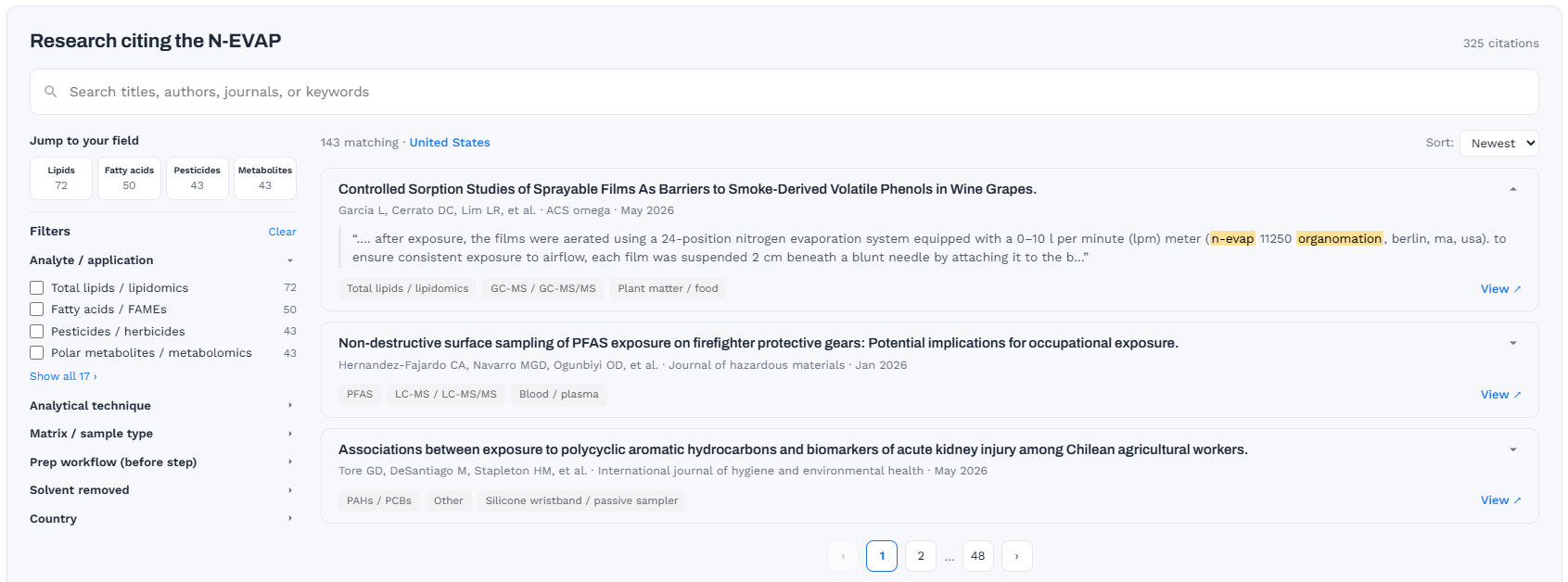
Search results can also be sorted by recency, and each entry links directly out to the original publication. A quick scan of the current N-EVAP results shows the range we're talking about — a QuEChERS-based method for bifenthrin pesticide residues in tea, a machine-learning model for predicting PFAS ionization efficiency, and a sorption study on smoke-derived volatile phenols in wine grapes all appear on the first page alone.
The MULTIVAP widget's recent entries include a biomarker study on cardiac remodeling after first-time heart attacks, research linking mixed organic pollutant exposure to cognitive aging, and a study on how mycorrhizal fungi affect PFAS uptake in cereal crops.
On the MICROVAP side, recent citations include multi-omics work on metabolic rejuvenation in aging models and a gene therapy study for a rare metabolic disorder. That range is the point: across the N-EVAP, MULTIVAP, and MICROVAP lines, our instruments show up everywhere from routine regulatory testing to genuinely novel analytical chemistry.
Built for Chemists, Not Just for Marketing
To be direct about it: we didn't build this as a badge to make the product page look impressive. We built it because when I talk to chemists — on the podcast, at conferences, in tech support calls — they're constantly trying to answer a version of the same question: has anyone published a method that looks like mine, using equipment I already trust? A citation count doesn't help with that. A filterable, searchable database of the actual papers does.
It's also, frankly, a transparency play. Anyone can filter down to their exact analyte and technique and see precisely what's been published, not take our word for it.