
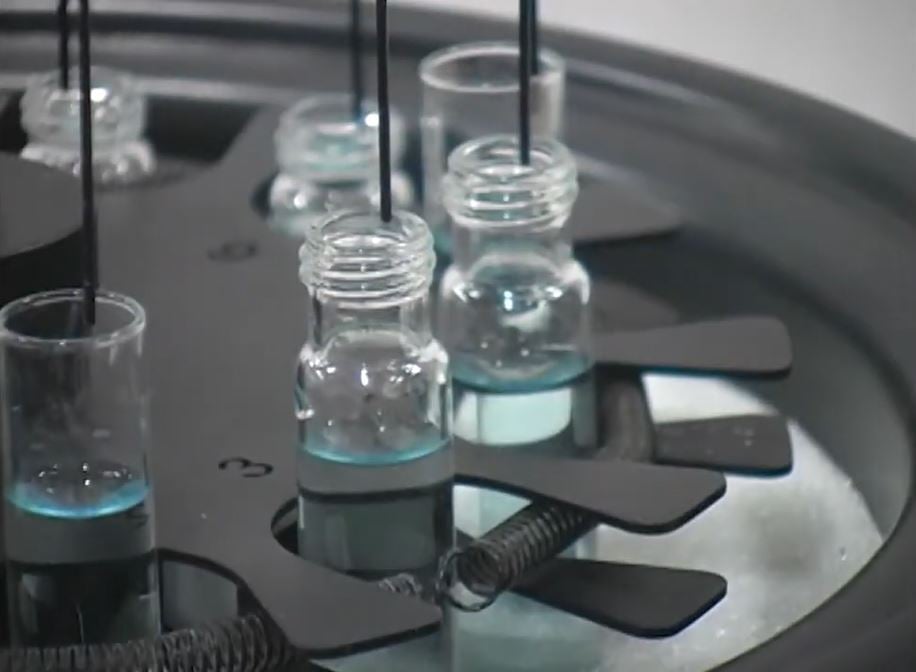
Nitrogen blowdown is most applicable to organotin testing when a laboratory needs to concentrate a solvent extract before gas chromatography, finish an extract after cleanup, or remove solvent before reconstitution. Its role is in sample preparation, not the direct analysis of the original water or sediment. Government method documentation describes gentle nitrogen evaporation in selected organotin workflows—but not every organotin method requires it.
For laboratories investigating this application, the key question is not simply, “Are we testing for organotins?” It is, “Does our preparation method produce a solvent extract that must be reduced to a smaller volume?”
That distinction helps identify where nitrogen blowdown belongs—and where it does not.
What Is Organotin Testing?
Organotin testing measures compounds in which tin is bonded to organic groups. Environmental butyltin analysis commonly distinguishes monobutyltin (MBT), dibutyltin (DBT), and tributyltin (TBT), rather than reporting them as a single combined result. These compounds differ in their chemistry and environmental behavior, making species-specific analysis important.
Historical uses help explain why laboratories investigate these substances. Tributyltin compounds were widely used in antifouling marine paints, while other organotins have been used in plastics stabilization and additional industrial or pesticidal applications. The British Columbia government’s draft organotins-in-water method discusses these uses and their connection to aquatic contamination.
The analytical challenge extends beyond detecting tin. A laboratory must extract the target species, prepare them for the selected separation technique, and demonstrate acceptable recovery and precision throughout the process.
Where Does Evaporation Enter the Workflow?
In solvent-extraction methods, evaporation occurs after the organotins have been transferred into an organic phase. Depending on the procedure, derivatization may occur before extraction or later in preparation. Derivatization changes the target compounds into forms suitable for GC analysis; it is a separate operation from solvent evaporation.
For example, the British Columbia draft water method follows this general sequence:
-
Buffer the water sample.
-
Derivatize the organotins with sodium tetraethylborate.
-
Extract into dichloromethane.
-
Dry the solvent extract over anhydrous sodium sulfate.
-
Concentrate the extract.
-
Perform silica-gel cleanup if necessary.
-
Finish preparation for GC with mass-spectrometric detection.
Nitrogen blowdown is relevant where this sequence requires solvent-volume reduction. It does not replace extraction, derivatization, or chromatographic separation.
Three Scenarios Where Nitrogen Blowdown Is Most Applicable
1. Finishing an Organotin Extract After Cleanup
The clearest documented fit is final extract preparation following cleanup.
The British Columbia draft method includes a conditional silica-gel cleanup procedure for colored extracts or observed interferences. Within that procedure, it explicitly instructs the analyst to concentrate the solution to 2 mL using a gentle nitrogen stream. The preparation uses hexane elution and a 15 mL conical tube.
This is a recognizable nitrogen-blowdown application: a cleaned solvent extract must reach a defined final volume before instrumental analysis.
Two qualifications matter. The document is marked “DRAFT March 11, 2021,” and the explicit nitrogen instruction appears within an optional cleanup branch. It therefore supports nitrogen finishing for that preparation scenario—not a claim that every organotin water sample must undergo nitrogen blowdown.
2. Preparing Water Extracts for Low-Level GC–MS/MS Analysis
Low-level water analysis can require substantial sample enrichment before injection.
A Thermo Fisher Scientific application note published by LCGC describes taking 400 mL of water, ethylating the organotins, extracting into pentane, and slowly evaporating the organic phase to 400 µL before GC–MS/MS analysis.
The original water volume is 1,000 times the final extract volume. That ratio describes nominal sample-to-extract enrichment, assuming quantitative transfer and retention; it is not a measured recovery or a stated solvent-volume reduction factor.
This example illustrates why concentration remains relevant even with a sensitive triple-quadrupole instrument: the preparation determines how much of the original sample is represented in the injected extract.
However, the application note does not identify nitrogen as the evaporation gas or name the evaporator. It establishes the need for controlled evaporation in that workflow, not proof of a specific nitrogen-blowdown implementation.
For a laboratory using this type of solvent-extraction approach, nitrogen blowdown is an option to evaluate against the method’s recovery, endpoint, and precision requirements.
3. Finishing Sediment and Marine-Water Extracts Before Reconstitution
Nitrogen evaporation is also documented in sediment analysis.
A peer-reviewed Cape Town harbour study in the Arabian Journal of Chemistry investigated tributyltin and triphenyltin in sediment and seawater. For sediment, the researchers extracted the sample, concentrated the extract on a water bath, performed silica cleanup and ethylation, and dried the extract over sodium sulfate. They then evaporated the final extract to dryness under gentle nitrogen and reconstituted it in 1 mL of hexane.
The seawater preparation likewise combined water-bath concentration with gentle nitrogen finishing, followed by reconstitution in 1 mL of n-hexane.
This demonstrates two relevant uses:
- Nitrogen blowdown as a finishing step after initial bulk concentration.
- Nitrogen evaporation to dryness when the analytical procedure specifically calls for reconstitution.
The study used GC with flame-photometric detection, not GC–MS/MS. It therefore documents nitrogen evaporation in organotin sample preparation, but does not establish equivalent detection limits or validation for another analytical platform.
When Nitrogen Blowdown May Be Less Applicable
Not all organotin methods produce a solvent extract that needs concentration.
A published headspace solid-phase microextraction method for marine water and sediment uses a fiber to collect ethylated organotin derivatives from the headspace, followed by thermal desorption into the GC inlet. The authors describe the routine workflow as avoiding liquid–liquid extraction and solvent evaporation.
The same paper uses nitrogen to remove methanol from artificially spiked sediment during validation. That is a different purpose from routinely concentrating extracts of unknown samples.
The practical distinction is straightforward:
- Solvent extracts requiring a defined final volume: nitrogen concentration is explicitly documented in the draft water method’s cleanup branch.
- Cleanup eluates requiring final concentration: a directly documented nitrogen-blowdown application.
- Dryness followed by reconstitution: applicable when that endpoint is part of the established procedure.
- Bulk concentration followed by finishing: nitrogen can serve as the finishing operation rather than the entire concentration process.
- Headspace SPME without routine extract evaporation: limited relevance to routine final extract concentration.
An instrument label such as GC–MS/MS does not, by itself, establish the need for an evaporator. The sample-preparation procedure does.
What Should Laboratories Evaluate Before Using Nitrogen Blowdown?
The goal is not simply to remove solvent quickly. It is to reach the required endpoint while preserving acceptable analytical performance.
The British Columbia draft method requires laboratories to demonstrate accuracy, precision, sensitivity, and interference control. It also allows preparation modifications when its prescribed elements and performance requirements are met. Those requirements provide a useful framework for evaluating an evaporation step.
Final Volume Versus Dryness
A retained-solvent endpoint and evaporation to dryness are not interchangeable. The draft water method describes a 2 mL nitrogen-concentration endpoint within its cleanup procedure.
The harbour study instead uses dryness followed by reconstitution. Laboratories should follow the endpoint established for their own method rather than adopting dryness as a default.
Temperature and Gas Flow
The draft water method describes a gentle nitrogen stream but does not establish one universal blowdown temperature or flow rate for organotin analysis.
A reasonable validation approach is to evaluate temperature, gas delivery, vessel geometry, and endpoint control together, then determine whether each target analyte meets the method’s recovery and precision requirements.
Analyte-Specific Recovery
Performance should be assessed across the target panel, not inferred from one compound. The British Columbia draft method assigns different long-term accuracy and precision requirements to TBT and other regulated organotins. That distinction reinforces the importance of checking analytes individually when evaluating a preparation change.
Internal-Standard Timing and Blanks
Standards added before concentration can help evaluate preparation performance. A standard added afterward cannot directly reveal losses that occurred during the preceding evaporation step.
In the draft water method, TBT-d27 is added before derivatization and extraction, while tetrapropyltin is added after concentration. The method also requires materials used in preparation to be monitored for interferences.
For an equipment evaluation, the relevant evidence is therefore the complete preparation result—including appropriate standards, process blanks, and analyte recoveries—not evaporation time alone.
Frequently Asked Questions
Is nitrogen blowdown required for organotin testing?
No. Selected solvent-extraction methods explicitly use nitrogen evaporation, but headspace SPME methods can avoid routine extract evaporation. Applicability depends on the preparation method.
Can nitrogen blowdown be used for sediment organotin analysis?
Yes. Published sediment preparation for tributyltin and triphenyltin includes gentle nitrogen evaporation followed by hexane reconstitution. That example does not automatically validate every sediment matrix or organotin panel.
Should organotin extracts be evaporated to dryness?
Only when the established procedure calls for it. The draft water method describes a finite-volume endpoint, while published sediment research includes dryness followed by reconstitution.
Does GC–MS/MS eliminate the need for extract concentration?
Not necessarily. A published organotin GC–MS/MS application concentrates a pentane extract to 400 µL before injection. The analytical platform and sample-enrichment strategy work together.
Start With the Preparation Method
For laboratories exploring nitrogen blowdown for organotin testing, the most useful first step is to identify the solvent extract, required endpoint, and evidence needed to confirm recovery.
A defined-volume finishing step after cleanup is the clearest documented fit. Dryness and reconstitution are also supported in specific published procedures. Methods that avoid routine solvent-extract evaporation present a different situation.
At Organomation, we view this as a method-first application: establish what the preparation requires, then evaluate an evaporation approach against those requirements—not the other way around.