
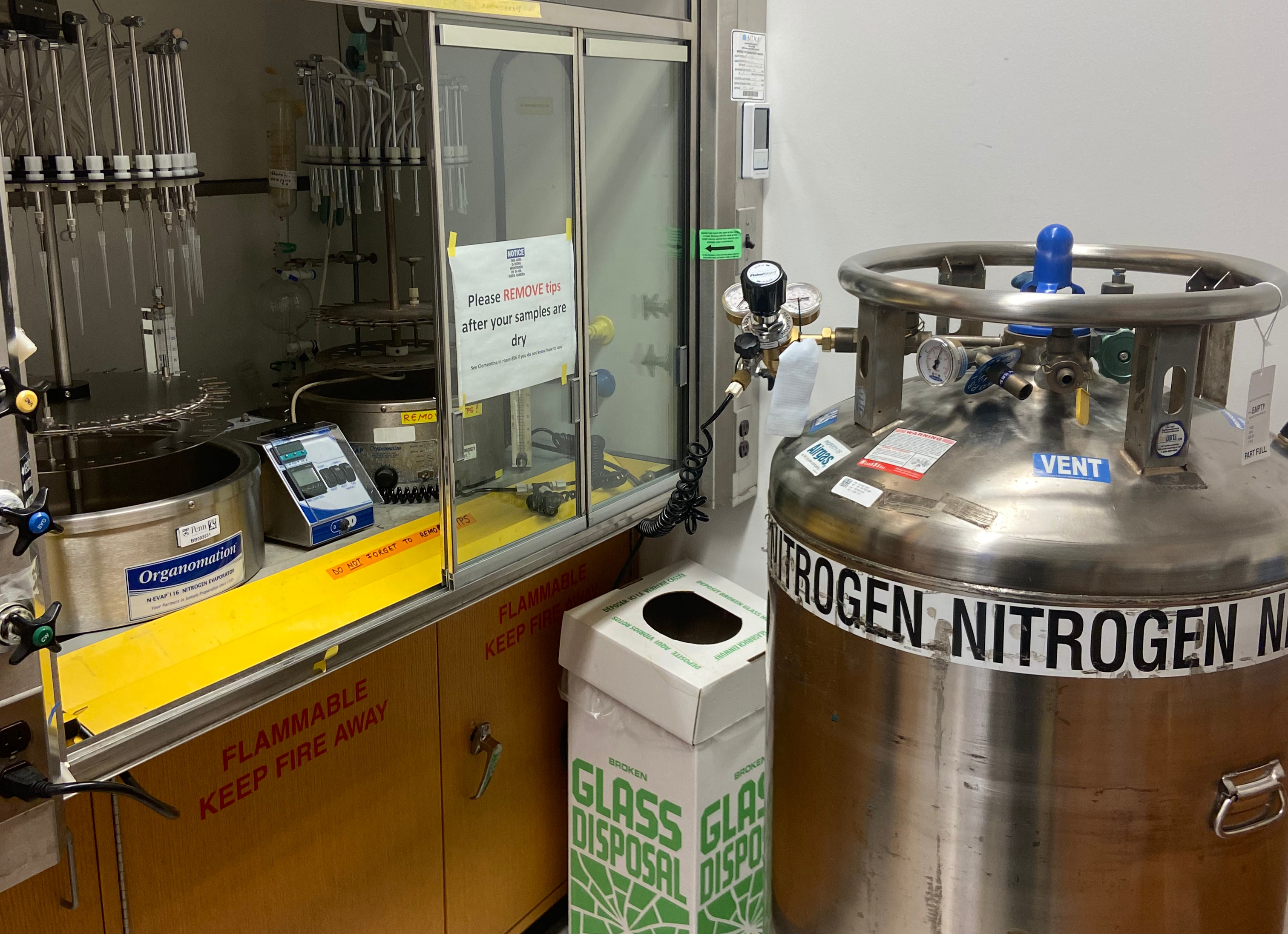
Organomation’s 2025 Nitrogen Usage Survey confirmed what many chromatographers and bench chemists already suspected: gas cylinders still dominate as the primary nitrogen source in today’s laboratories. Most labs stay with cylinders because the workflow is familiar and the setup feels simple. But as our team learned firsthand, the “simple” choice can mask a surprising amount of cost and operational friction.
To better understand what our survey respondents are experiencing, our staff went through the full process of sourcing nitrogen from a local gas supplier—this time as a typical customer, not a nitrogen generator manufacturer. The goal was straightforward: rent a cylinder and live with the process long enough to see where it shines and where it strains a modern lab’s budget and schedule.
Why we tried renting a nitrogen cylinder
Our Nitrogen Usage Survey revealed that 59% of responding labs still rely on cylinders for their day‑to‑day nitrogen needs, even though high costs ranked as the top frustration across all nitrogen sources. Lab‑scale generators, by contrast, were reported to be substantially more cost‑effective on a per‑liter basis, but many respondents noted that they had never actually walked through a direct comparison.
Rather than rely solely on self‑reported data, we decided to experience the cylinder route in the same way a typical lab would: by calling local suppliers, asking for quotes, filling out credit paperwork, and tracking the ongoing charges over time. That process revealed not just the line items on an invoice, but the less visible friction that comes with renting and maintaining gas cylinders.
Choosing a supplier and getting set up
The search began in June 2024 with three potential cylinder providers: Bitter and Esters, Middlesex Gases, and Airgas. One of those providers was no longer in business, and after evaluating responsiveness and availability, the decision was made to move forward with Airgas. This already aligned with feedback from many labs that rely on regional gas distributors whose business models are built around delivery routes and rental programs.
The communication pattern with Airgas is worth noting for any lab planning a new cylinder account. Emails sent early in the morning typically received timely responses; by around 9–10 a.m., staff were out on the road making deliveries, and email communication slowed down. For labs, this means that even simple questions—such as confirming regulator compatibility or clarifying rental terms—may require at least half a day of back‑and‑forth. Building in that buffer is essential when aligning cylinder deliveries with instrument startup or method validation timelines.
On the positive side, the technical support was strong. Airgas staff asked the right questions about downstream instruments and pressure requirements, and they provided a regulator selection chart that made it easy to choose the appropriate model. We ultimately purchased a 300 cu ft Ultra High Purity nitrogen cylinder, a regulator, and an adapter to match existing plumbing. Once everything arrived, the physical setup was straightforward: the regulator and adapter connected cleanly, and there was no need to hunt for additional fittings at a hardware store.
The true cost of "simple" cylinders
Where the experience became more revealing—and more closely aligned with Organomation’s survey findings—was on the cost side. The initial product invoice showed roughly 370 dollars in items before shipping and tax, and 398.53 dollars in total for the cylinder, regulator, adapter, and associated charges. At first glance, this seemed reasonable for a one‑time purchase plus cylinder contents.
However, several cost trends emerged that future buyers should factor into their decision‑making:
• Rental rate escalation - The cylinder rental rate was originally quoted at 90 cents per day in 2024. By 2025, the actual charge had risen to $1.66 dollars per day, nearly doubling the expected rental cost without a proactive update from the supplier. For laboratories that keep cylinders on site for months at a time—especially as backups or for intermittent methods—this delta adds up quietly in the background.
• New hazmat fees - A recurring 9 dollar monthly hazmat fee appeared on the rental invoice, again without having been clearly discussed at the outset. Many labs are already familiar with hazmat surcharges on freight and chemicals, but seeing this as a recurring monthly cost on top of rental reinforces how cylinders accumulate “small” fees that rarely show up in high‑level budget planning.
• Rising delivery charges - The delivery fee increased from roughly 50 dollars the prior year to 80 dollars at the time of this trial. For labs outside dense metro areas or those that rely on frequent deliveries, these charges compound quickly. This mirrors what many survey respondents indicated: logistics and delivery headaches are a major part of the cylinder ownership experience, particularly when multiple cylinders or gases are in regular rotation.
• Payment and credit process - To rent the cylinder, the lab had to complete a credit application, wait for approval, and then manage payment either by check or through an online portal. Paying by credit card added a 3% surcharge, introduced specifically to offset processing fees on the supplier’s side. While none of these steps are unusual in the industrial gas world, they all represent administrative overhead that grows more burdensome as a lab scales up its nitrogen usage.
When these elements are combined—hardware, rental, hazmat, delivery, and payment surcharges—the true cost structure begins to look very different from the headline price of a cylinder fill.
How this aligns with what other labs are seeing
The hands‑on Airgas experience lines up closely with themes from Organomation’s Nitrogen Usage Survey. Cylinder users in the survey highlighted three dominant pain points: high costs, supply availability, and storage issues. Many also described a sense of dependency on delivery schedules and the need to track multiple moving pieces: rental days, hazmat surcharges, space for spares, and the timing of swap‑outs.
On the cost side, the survey data showed that labs using gas cylinders spent the most per liter, averaging about 2.79 dollars per liter of nitrogen. Labs running lab‑scale generators reported average costs closer to 0.70 dollars per liter—a roughly 75% savings compared with cylinders. Even bulk delivery and liquid dewars, which some labs adopt to reduce delivery frequency, did not match the cost efficiency of in‑house generation.
When the real‑world cylinder trial is placed alongside these numbers, the story becomes clearer. What felt like a modest increase in rental rate here, a small hazmat fee there, and a reasonable delivery charge at first quickly became a meaningful cost center. This validates what survey respondents have been telling us: nitrogen cylinders may be easy to understand and straightforward to hook up, but they are not always easy on the budget.
What this means for labs evaluating nitrogen generators
None of this is to say that cylinders are obsolete. For low‑throughput applications, remote locations, or labs with minimal nitrogen demand, cylinders can still be the right solution. They are familiar, require no capital expenditure, and are supported by an extensive network of gas suppliers. For some labs, that trade‑off will continue to make sense.
However, for labs where nitrogen is a daily necessity—supporting LC‑MS, GC‑MS, sample evaporation, ELSD detectors, and other high‑demand workflows—the combination of rising rental rates, recurring hazmat fees, delivery charges, and administrative overhead can easily push cylinders into the category of “most obvious but least economical” option. The experience described here is not an outlier; it reflects the same cost pressures and logistical headaches that survey respondents across pharmaceutical, environmental, academic, and industrial labs reported.
Lab‑scale nitrogen generators were designed to address exactly these pain points. By producing nitrogen on demand from compressed air, generators reduce or eliminate cylinder deliveries, remove rental and hazmat fees, and provide a predictable, controllable operating cost profile. The survey data shows that, on average, labs using generators spend far less per liter than those relying on cylinders or dewars, while gaining greater autonomy over their nitrogen supply.
For labs currently living with the realities of cylinder rental, this case study can serve as a starting point for a deeper cost and workflow comparison. When evaluating a nitrogen generator, it helps to include not just the cost of gas, but also:
• Rental charges and how often rates have increased over the past few years
• Hazmat and delivery surcharges that appear on every invoice
• Administrative time spent on credit applications, scheduling deliveries, and reconciling multi‑line invoices
• Risks associated with delayed deliveries, empty cylinders, or storage constraints
By viewing cylinders through this more complete lens, many labs discover that what once seemed like the simplest option is actually one of the most complex and expensive to maintain over the long term.
If your lab is considering a shift away from cylinders, Organomation’s Nitrogen Usage Survey, along with this hands‑on cylinder rental experience, can help frame the right questions to ask and the right metrics to track as you evaluate in‑house nitrogen generation.