
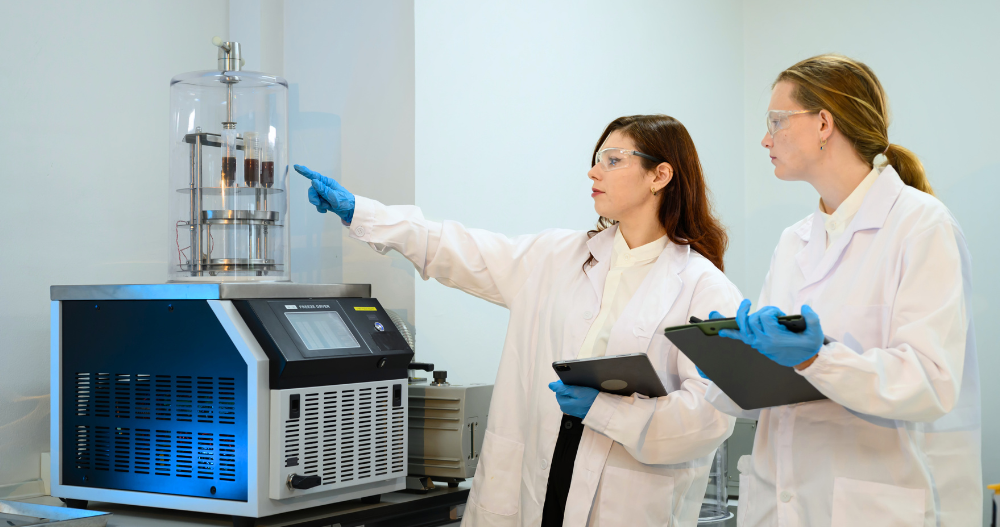
Lyophilization, more commonly known as freeze drying, is one of the most elegant preservation techniques in the analytical laboratory. By freezing a sample and then removing moisture through sublimation under vacuum, the process preserves structural integrity, biological activity, and long-term stability in a way that conventional heat-based drying simply cannot match. It is an indispensable workhorse in pharmaceutical development, environmental testing, food science, and biological research.
And yet, for all its power, freeze drying has a reputation among lab professionals for being slow, demanding, and expensive to maintain. That reputation is well-earned.
In Organomation's 2026 Sample Concentration Survey — which gathered responses from 135 laboratory professionals across industries including pharmaceutical/biotech, academic research, analytical testing, and environmental science — freeze drying users were asked to identify their top three evaporation frustrations. The results were revealing. The three most commonly cited pain points were maintenance needs (67%), evaporation taking too long (50%), and limited capacity (50%). Together, these three challenges paint a picture of a technology that labs depend on but frequently struggle to optimize.
This post examines each frustration in depth, drawing on current research and best practices to offer practical, science-backed recommendations.
Frustration #1: Maintenance Needs (67%)
No other evaporation method in the Organomation survey generated as high a maintenance complaint as freeze drying. It topped the list for lyophilizer users at 67% — a striking figure that reflects the complexity of a system with multiple interdependent components, each of which requires regular attention.
A modern freeze dryer is, at its core, a precision instrument combining refrigeration, vacuum, and thermal control systems. When any one component drifts out of specification, the integrity of the entire drying process is at risk.
The Vacuum Pump: The Heart of the System
Industry experts consistently identify the vacuum pump as the most maintenance-critical component of a lyophilizer. According to a technical guide published by Lyophilization World (2026), "The vacuum pump is the 'heart' of the system. Failure to maintain it is the #1 cause of lyophilization failure." For oil-sealed rotary vane pumps — the most common type in laboratory freeze dryers — pump oil should be changed approximately every 2,000 operational hours, or whenever the oil becomes visibly cloudy or discolored. Oil mist eliminators (OMEs) should be inspected and replaced annually, as a clogged OME increases backpressure and causes the pump to run hotter, degrading ultimate vacuum capability.
For dry (oil-free) pumps, tip seals typically require replacement every 8,000–10,000 hours of operation.
A Proactive Maintenance Framework
Lab Manager magazine (2025) emphasizes that "regularly scheduled maintenance of freeze dryers translates to long-term low maintenance and limited downtime." A well-designed preventive maintenance (PM) program addresses four core systems:
Vacuum system: Regular leak checks on the chamber door gaskets and manifold seals, plus pump oil verification
Refrigeration system: Periodic inspection of the condenser coils and defrost cycle performance
Control systems: Calibration of temperature sensors (typically T-type thermocouples) and pressure transducers to ensure accurate set-point control
Chambers and shelves: Post-run cleaning to prevent contamination and solvent damage to shelf surfaces
MarathonLS (2025) notes that failing to maintain calibration of sensors and controllers leads to "inaccurate results" and "inconsistent or invalid data," compounding the maintenance burden with downstream analytical failures. Similarly, published best practice guidance in AAPS PharmSciTech (Springer Nature, 2023) calls for maintenance programs to be built on scientific rationale rather than overly conservative estimates of time-to-failure, which often generate redundant labor without improving reliability.
Recommendation
Build a written, interval-based PM schedule into your freeze dryer SOPs from day one, not after a failure occurs. Tie maintenance intervals directly to operational hours (tracked via instrument logs) rather than to calendar dates alone. Invest in a service contract with the manufacturer if internal expertise is limited, and ensure that all freeze dryer operators are trained on post-run defrost and cleaning procedures after every cycle. Early intervention is dramatically cheaper than emergency repair.
Frustration #2: It Takes Too Long (50%)
Long cycle times are the most universal complaint across all evaporation methods in the Organomation survey — 59% of labs cited it as a top concern regardless of method. Among freeze drying users specifically, 50% ranked it in their top three. The frustration is entirely understandable: a typical laboratory lyophilization cycle can run anywhere from 24 to 72 hours depending on the sample matrix, fill volume, and equipment. In high-throughput environments, this is a genuine productivity bottleneck.
The scientific explanation for freeze drying's slow pace lies in the physics of primary drying. As the National Institutes of Health's PubMed database summarizes via a 2023 review published in Pharmaceutical Research, "primary drying (ice sublimation) [is] the longest" of freeze drying's three stages — freezing, primary drying, and secondary drying. The sublimation of ice requires controlled heat and mass transfer under vacuum, and pushing conditions too aggressively risks product collapse — an irreversible structural failure of the dried cake.
Optimizing Primary Drying: The Biggest Lever
Research published in the International Journal of Pharmaceutics (2024) demonstrated that product temperature management during primary drying is the key variable. A vaccine formulation study found that by carefully pushing product temperature closer to the collapse temperature — rather than maintaining a large safety buffer below it — researchers reduced total drying time by approximately 45% while maintaining all critical quality attributes. This approach, sometimes called "aggressive drying," requires robust characterization data, including glass transition temperature (Tg') measured by differential scanning calorimetry (DSC) and collapse temperature (Tc) determined by freeze-drying microscopy (FDM).
Controlled nucleation is another powerful strategy for compressing cycle times. Traditional freeze drying relies on stochastic (random) ice nucleation, which produces small, irregular ice crystals that create high resistance to sublimation and slow the primary drying phase. Controlled nucleation techniques — which trigger ice formation simultaneously across all vials at a defined temperature — generate larger, more uniform ice crystals with lower sublimation resistance, directly accelerating primary drying. As documented in PMC (2025), controlled nucleation also reduces inter- and intra-batch heterogeneity in drying behavior, improving both speed and consistency simultaneously.
Mathematical modeling tools, including open-source platforms such as LyoPRONTO (AAPS PharmSciTech), can help labs generate predicted drying times for different shelf temperature and chamber pressure combinations without running expensive experimental cycles. Newer commercially available systems incorporate digital twin modeling, coupling computational fluid dynamics (CFD) with vial-scale simulations to optimize cycle parameters in silico before committing bench time.
Recommendation
Begin every freeze drying method development project with thermal characterization of your sample matrix. Knowing your Tg' and Tc gives you the scientific basis to push primary drying conditions as aggressively as product quality permits. If your lab is still running cycles designed by conservative rule-of-thumb, you may be leaving substantial time on the table. Consider annealing steps (typically −15°C to −10°C for 3–5 hours, as recommended by Pharmaceutical Research, 2023) to promote ice crystal growth and reduce primary drying resistance. Finally, evaluate whether controlled nucleation technology is appropriate for your sample types — for labs running repetitive cycles on similar matrices, it can be a transformative investment.
Frustration #3: Limited Capacity (50%)
The third major frustration freeze drying users reported is limited throughput capacity — the physical constraint of how many samples can be processed in a single run. This is partly an equipment problem and partly a workflow problem, and it has meaningful implications for productivity.
Most benchtop and compact laboratory freeze dryers are designed for light-to-moderate sample loads. As labs scale their workflows, they frequently encounter a ceiling: either the shelf area is insufficient to accommodate the required number of vials or flasks, or the condenser capacity (measured in kilograms of ice capture) cannot handle the moisture load from a larger batch without becoming overloaded. As documented in Pharmaceutical Research (2023), "the dryer's performance could be limited by the onset of choked flow, which limits the ability to control pressure, or by condenser capacity, where condenser temperature increases excessively" — both of which constrain effective batch size.
Pharmaceutical Technology (2025) further documents that scale-up from laboratory to commercial-scale freeze dryers introduces additional complexity: differences in shelf thickness, vial loading configurations, and wall heat transfer all affect sublimation rates and require compensating adjustments to cycle parameters. This means that capacity expansion is rarely as simple as moving to a larger instrument.
Solutions for Capacity-Constrained Labs
Several strategies can meaningfully expand lyophilization throughput without requiring a complete equipment overhaul:
Staggered scheduling: If your current freeze dryer operates as a single large batch, consider whether your workflow could accommodate shorter, more frequent runs with faster turnaround. Smaller, fully-characterized batches may complete primary drying faster than one large batch, improving overall weekly throughput.
Modular scale-up systems: Manufacturers such as SP Industries (LyoStar 4.0), Telstar (LyoAlfa series), and IMA Life (LYOFAST MINI) offer pilot-scale systems designed specifically for labs that need to expand capacity while retaining full process control and GMP-compatible data management. These systems often include process analytical technology (PAT) integration, enabling real-time monitoring that can reduce conservative safety margins in cycle design.
Outsourcing for surge capacity: Contract development and manufacturing organizations (CDMOs) with lyophilization capabilities — such as Patheon (Thermo Fisher Scientific) and Jubilant HollisterStier — offer access to larger-capacity lyophilizers for peak demand periods or for projects requiring scale-up validation.
Condenser capacity matching: When purchasing or upgrading equipment, ensure that condenser ice capacity is sized at a minimum of 15–25% above the estimated maximum moisture load for your largest anticipated batch. Undersized condensers are a common source of cycle failures and effective batch size limitations.
Recommendation
Conduct a throughput audit before investing in new equipment. Map your current weekly sample volume, cycle frequency, and typical batch sizes. Identify whether your capacity ceiling is driven by shelf area, condenser capacity, or cycle time — each requires a different solution. If cycle time is the limiting factor, optimization (as described above) may solve the problem more cost-effectively than purchasing a larger instrument.
Putting It All Together
Lyophilization remains one of the most powerful sample concentration and preservation tools available to the modern laboratory. The Organomation 2026 Survey data confirms that it is widely used across diverse industries and sample types — but also that its three core operational frustrations (maintenance, cycle time, and capacity) are experienced broadly and consistently.
The good news is that none of these challenges is insurmountable. Preventive maintenance programs protect equipment and data integrity. Thermal characterization and controlled nucleation compress cycle times. Thoughtful equipment selection and staggered workflows expand effective throughput. And a growing suite of process modeling and PAT tools is making it easier than ever to implement these improvements without disrupting existing workflows.
As laboratories continue to face pressure to process more samples, faster, with tighter budgets and headcounts, understanding — and addressing — the specific limitations of lyophilization is not a technical nicety. It is a competitive necessity.