
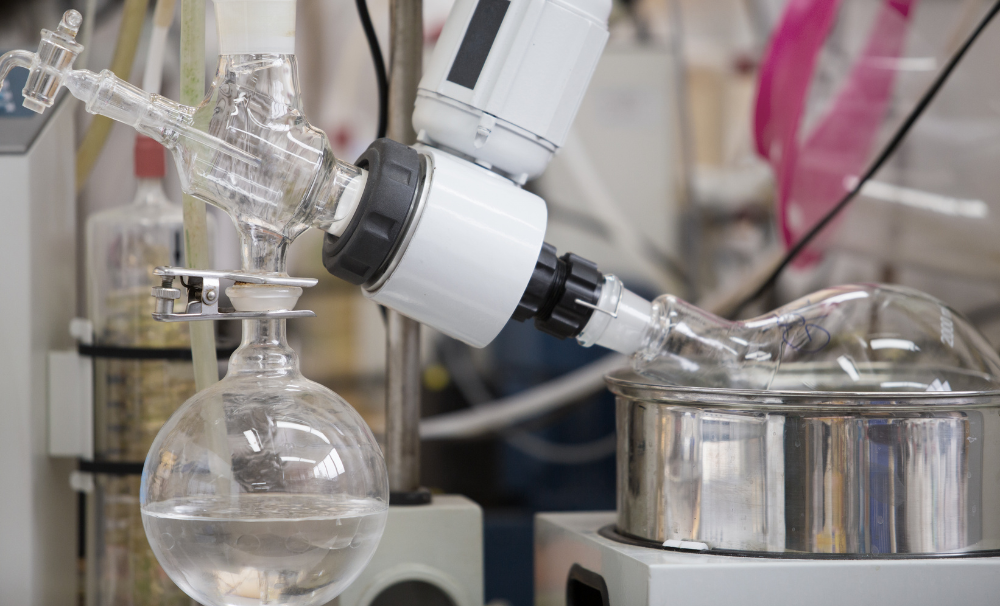
Rotary evaporators have earned their place in the laboratory. Since Swiss company Büchi first commercialized the technology in 1957, the rotovap has become a cornerstone of solvent removal in chemistry, pharmaceuticals, environmental testing, and beyond. The fundamental principle — combining reduced pressure, controlled heat, and rotation to spread liquid into a thin film for rapid evaporation — is elegant and effective. But elegant does not always mean efficient, and effective does not always mean easy to live with on a day-to-day basis.
Organomation's 2026 Sample Concentration Survey captured 135 responses from lab professionals across academia, pharma/biotech, analytical testing, environmental research, and more. When respondents who use rotary evaporators were asked to name their top frustrations, three challenges rose clearly to the surface: limited capacity (86%), evaporation taking too long (71%), and constant monitoring (50%). These are not minor inconveniences — they represent real drains on throughput, researcher time, and lab productivity.
Let's examine each frustration in depth, explore the underlying chemistry and physics driving it, and discuss how modern alternatives can help.
Frustration #1: Limited Capacity (86%)
Nearly nine out of ten rotary evaporator users flagged limited capacity as a top-three complaint — the highest-ranked frustration of any issue in the survey. The reason is structural: a rotovap is a single-sample instrument. One flask. One run. One concentration step at a time.
This constraint becomes acutely painful in high-throughput environments. Environmental labs, food and beverage facilities, and pharmaceutical screening groups often need to process dozens of samples per day. With a rotovap, each sample occupies the instrument for its entire run duration before the next can begin. The sequential nature of the process creates a bottleneck that no amount of operator skill can fully overcome.
There is also the question of flask geometry. To form an effective evaporating film, the flask must be sized to accommodate the sample with adequate headspace — a requirement that limits how much material can actually be loaded per run. Pushing beyond this fill level risks bumping, sample loss, and carryover into the receiving flask.
For labs wrestling with this constraint, the Organomation S-EVAP+ Solvent Evaporator offers a compelling answer. Designed explicitly as a higher-capacity alternative to rotary evaporation, the S-EVAP+ can evaporate up to 10 samples simultaneously. All samples are arranged in a circular configuration with a compact benchtop footprint, and the instrument rotates so that every sample remains accessible from the front. It incorporates vacuum technology to handle solvents with boiling points up to 115°C — covering the vast majority of solvents encountered in standard laboratory workflows. For labs where the rotovap has become the rate-limiting step, the capacity leap from 1 sample to 10 per run is a meaningful operational change.
Frustration #2: Evaporation Takes Too Long (71%)
More than two-thirds of rotary evaporator users cite long evaporation time as a major pain point, and this frustration has a deeper physical explanation than it might initially appear. The rotovap is efficient at bulk solvent removal — but it becomes progressively less efficient as the sample volume shrinks.
Here is the core mechanism: a rotary evaporator's performance is built around the thin-film principle. Rotation spreads liquid across the inner wall of the flask, maximizing surface area and enabling rapid evaporation under vacuum. As Chemistry LibreTexts explains, rotating the flask increases the liquid's surface area and thus the rate of evaporation. But this principle depends critically on there being enough liquid to coat the flask walls. As solvent is removed and volume decreases, less liquid is available to maintain that continuous, thermally-coupled film. Effective evaporation surface area drops, heat transfer from the water bath becomes less uniform, and the process slows — even as the operator waits for the last few milliliters to disappear.
This phenomenon is well documented in practical guidance for rotovap users. Achieving efficient evaporation requires the fill level to be managed so the flask maintains adequate wall contact — and yet as the run proceeds, that fill level inevitably falls toward the point of diminishing returns. Organomation's own technical literature confirms this pattern: nitrogen blowdown evaporators are specifically described as ideal for evaporating a high number of small samples, with an average evaporation time for a 10 mL sample of about 20 to 30 minutes.
This points toward a practical, hybrid workflow solution: use the rotovap for what it does well (bulk removal of large solvent volumes) and then switch to nitrogen blowdown evaporation for the final concentration step. Nitrogen blowdown works by directing a controlled stream of dry nitrogen gas across the liquid surface, continuously sweeping away solvent vapor and reducing vapor pressure above the sample to drive rapid evaporation. Critically, this mechanism does not depend on film formation or flask geometry — it remains effective even as the sample approaches dryness, precisely the stage where the rotovap struggles most. Furthermore, nitrogen blowdown evaporators like Organomation's N-EVAP line allow multiple samples to be concentrated simultaneously, meaning the final dry-down step for an entire batch can be completed in a single run rather than sequentially.
This rotary-then-blowdown approach leverages the complementary strengths of each technology: the rotovap handles high solvent loads quickly at the start, while nitrogen blowdown efficiently finishes the job at small volumes where the rotovap's performance degrades. The result is a faster end-to-end process than either method alone.
Frustration #3: Constant Monitoring (50%)
Half of all rotary evaporator users named the need for constant monitoring as a top frustration. Unlike instruments that can be set and left to run unattended, a rotovap demands sustained operator attention throughout the process — and for good reason.
The combination of reduced pressure, heated water bath, and rotating glassware creates multiple failure modes that require active oversight. Bumping — the sudden, violent boiling of a superheated liquid — is an ever-present risk, particularly when vacuum is applied too quickly or the bath temperature is set too high relative to the solvent's boiling point. This can result in rapid, uncontrolled loss of sample into the collection flask or solvent trap. Operators must monitor vacuum levels and apply pressure changes gradually, especially at the start of each run.
Flask security is another concern. The evaporating flask must be properly secured with a clip to prevent it from falling off the vapor duct during rotation. Joints need to be greased, checked for wear, and resealed regularly to maintain the vacuum integrity that the entire process depends on. A leak anywhere in the system reduces evaporation efficiency and may allow atmospheric oxygen to contaminate sensitive samples.
There is also the matter of knowing when to stop. Because the rotovap doesn't automatically signal when the sample has reached the desired concentration, the operator must periodically interrupt the run to inspect the flask — releasing the vacuum, raising the flask from the bath, and visually estimating the remaining volume. This cycle of monitoring and assessment can become genuinely time-consuming in a busy lab.
Nitrogen blowdown evaporators, by contrast, offer a simpler operational profile. Individual needle valves at each sample position allow gas flow to be adjusted per sample, and because the process runs at atmospheric pressure with no vacuum system to maintain, the failure modes are fewer. Labs running high sample volumes have reported dramatic reductions in hands-on time by transitioning finish steps from rotary to nitrogen blowdown. The monitoring burden is not zero — endpoint detection still requires attention — but the overall operator engagement per sample is substantially lower.
Looking Ahead
The Organomation 2026 survey data reveals that over a third of labs plan to make changes to their sample concentration workflows in the next year, with the primary driver being adoption of new methods or applications. Rotary evaporation will continue to play an important role in labs where bulk solvent removal from large-volume samples is required. But for labs where limited capacity, slow finishing times, and constant monitoring have become chronic productivity drains, the case for supplementing or partially replacing the rotovap is compelling.
Whether the solution is a parallel evaporator like the S-EVAP+ for high-capacity large-sample work, an N-EVAP nitrogen blowdown system for small-volume finishes, or a hybrid approach that routes samples through both technologies at different stages, the path forward is a workflow built around the right tool for each phase of sample concentration — not a single instrument asked to do everything.
Data cited in this post is drawn from Organomation's 2026 Sample Concentration Survey (n=135), which gathered responses from laboratory scientists, analysts, managers, technicians, and QA/compliance personnel across academic, pharmaceutical, environmental, food and beverage, and other industries.