
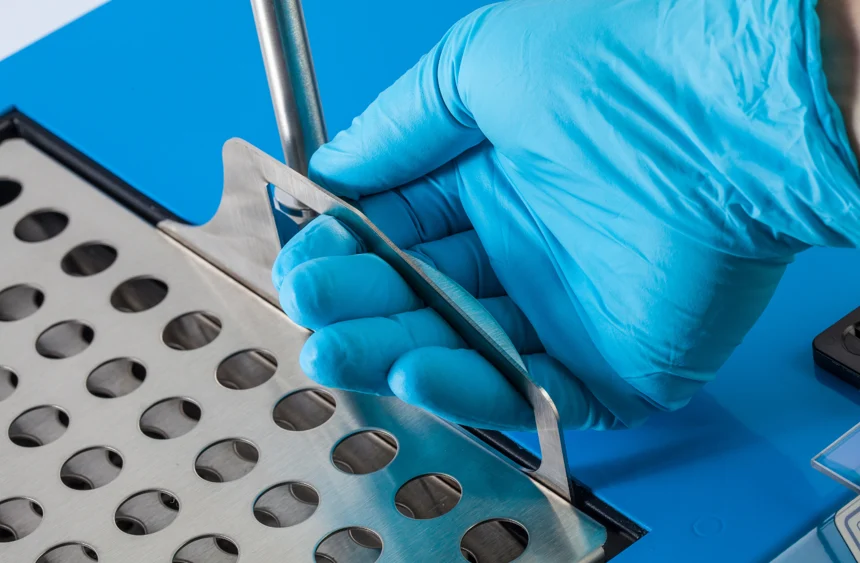
Most days, running a small instrument manufacturer is fairly quiet work. We design, we machine, we assemble by hand, we ship, and we hope the phone doesn't ring because something broke. So when I came across a recent customer story from SPADIA LAB, one of the largest diagnostic laboratory networks in the Czech Republic, describing how their chromatography and mass spectrometry department has been using our 80 Position MULTIVAP nitrogen evaporator, I read it a few times over. It is not often you get this kind of unfiltered look at how your equipment performs on someone else's bench, on the other side of the world, years after it left our shop floor.
The story surfaced through LabRulez, a Czech-based analytical chemistry information platform and one of our distribution partners, which connects laboratories across Europe with instrumentation, application notes, and technical publications. LabRulez describes its mission as setting "a new global standard for access to information" in analytical chemistry, and it regularly publishes real-world laboratory experiences like this one, giving end users a direct, unfiltered account of how equipment performs outside the demo room. I wanted to share what stood out to me in this particular story, because I think it says something about how a small manufacturer earns trust, and I suspect the lesson applies well beyond laboratory equipment. I hope to have their founders on my Concentrating on Chromatography podcast later this year.
Reliability is the whole pitch
SPADIA LAB employs somewhere north of 500 people and runs central laboratories in Ostrava, Brno, and Prague, supported by a wide network of satellite locations across the country. Their Department of Chromatography and Mass Spectrometry in Ostrava is not running one simple test. The department covers steroid hormone panels, therapeutic drug monitoring for medications like digoxin and theophylline, toxicology screening and confirmation, biogenic amine testing, fatty acid profiling, and a growing vitamin panel. This is not a laboratory with room for equipment that behaves inconsistently.
What struck me was how the team described the instrument in their own words: "sample preparation represents one of the most important phases of the analytical process in an LC-MS/MS laboratory," directly affecting reproducibility, throughput, and overall method quality. We agree that LC-MS/MS sample prep is important, and I realized that unacceptable variability is what we design against. We cannot promise a laboratory that our evaporator will make their science more interesting or their day more exciting. What we can promise is that row three will evaporate at the same rate as row one, today and five years from now. SPADIA LAB's technicians said as much themselves, pointing to "stable performance, simple operation, and the ability to process a larger number of samples in parallel without a negative impact on preparation quality" as the reasons the instrument earned a permanent place in their workflow.
Fundamentals before features
I will admit our instruments are not flashy. There is no touchscreen, no app, no artificial intelligence deciding when a sample is dry. The 80 Position MULTIVAP that SPADIA LAB uses does something fairly unglamorous: it evaporates methanol and methyl tert-butyl ether off of extracted samples using a controlled stream of nitrogen and a heated aluminum dry block, holding temperature between 30°C and 120°C to within about ±2°C, across up to 80 samples running side by side. Nitrogen flows evenly to every position through stainless steel needles, and technicians can shut off gas to individual rows of ten samples when running smaller batches, so nothing is wasted
I have noticed, in almost every conversation I have with a laboratory manager, that the instruments earning the most loyalty are rarely the newest or most automated ones. They are the ones that do one job extremely well and then get out of the way. SPADIA LAB used the MULTIVAP not only for routine steroid hormone testing but also while developing an entirely new method to quantify B-vitamins — B3, B5, and B7 — which tells me the instrument earned enough confidence to be trusted with new, unproven work, not just repetitive production runs. That kind of trust is not won with a feature list. It is won by showing up the same way, batch after batch, for long enough that a laboratory stops thinking about the evaporator at all.
Small company, global reach
I think about our size a lot. We are not a large multinational instrument company, and we will probably never out-market one. What we can do is build something well enough that it gets picked up by a distribution partner like LabRulez and passed along to a laboratory network most people in Massachusetts have never heard of, and have it hold up under real, demanding, clinical use.
That is genuinely humbling. We did not invent the first nitrogen evaporator imagining a hospital-affiliated laboratory network in Ostrava relying on it for hormone panels and vitamin diagnostics that inform patient care. But that is the nature of building something dependable: you rarely know where it ends up, and you find out secondhand, through a customer story you stumble across, that it mattered somewhere far from home.
What I take from this
We have heard similar feedback closer to home. One U.S. environmental laboratory measured a 400 percent increase in efficiency on the blow-down step of its PFAS sample prep after switching to a MULTIVAP, citing the same consistent, even nitrogen flow across all sample positions that SPADIA LAB relies on . Independent comparison data we have published alongside competing dry-bath evaporators shows a similar pattern: our systems tend to use meaningfully less nitrogen per run while matching or exceeding comparable capacity and temperature range. I do not think that is a coincidence. I think it means the fundamentals we have leaned on for decades — even gas distribution, precise temperature control, and a design simple enough that a technician can trust it without thinking about it — translate across industries, continents, and testing panels.
None of this happens by accident. It traces back to 1959, when our founder, the late Dr. Neal McNiven, built the first multiple-sample, high-speed nitrogen evaporator because he saw laboratories struggling with exactly this bottleneck. Every instrument we have built since, including the one running in Ostrava today, is a descendant of that same idea: keep it simple, keep it even, and keep it working.
SPADIA LAB summed it up better than I could. They called the MULTIVAP "a robust and reliable laboratory instrument that has become an integral part of our analytical workflow." For a small manufacturer, there is no higher compliment than a laboratory on the other side of the world saying our instrument simply disappeared into their process and let them focus on the science. That is what we set out to build, and it is good to be reminded, occasionally, that it is working.
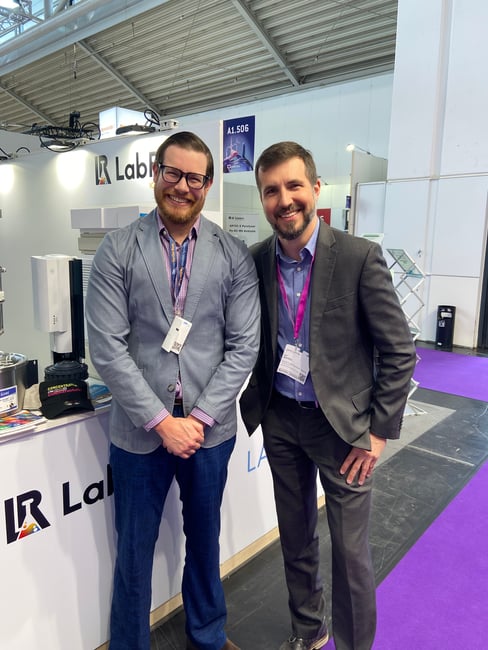
David Oliva, General Manager of Organomation (left) with Ivo Novotný, CEO of LabRulez (right)