
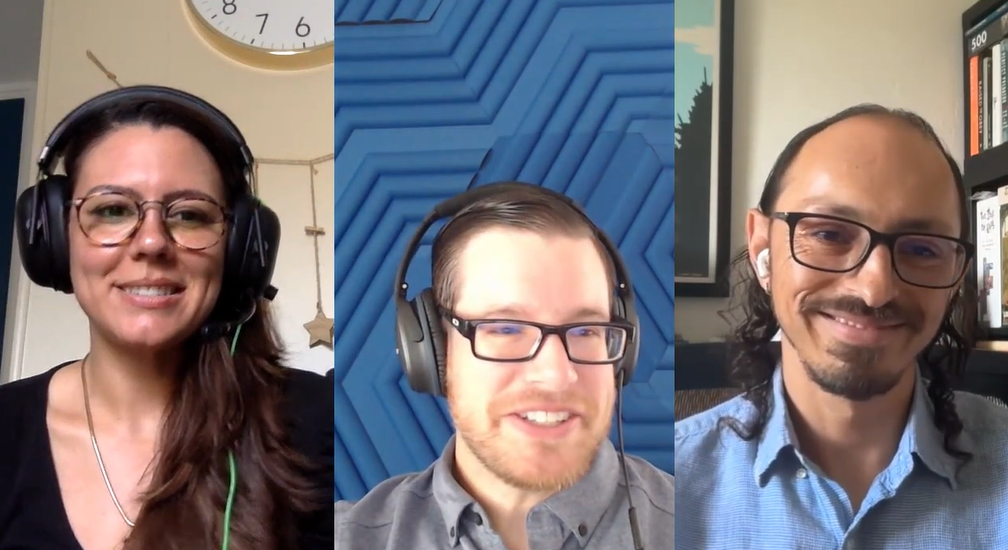
Seawater, according to Mauricio Caraballo, PhD, contains "probably all the molecules in the world solubilized there." Cosmetics, herbicides, plastics byproducts, coral signaling compounds, microbial toxins, human contaminants — all of it, dissolved in the same complex matrix. If you're a bench chemist, that sentence alone should make you wince a little, because you already know what that means for sample prep.
On the latest episode of Concentrating on Chromatography, Candi Gokey and I sat down with Caraballo — Director of the MSCollaboratory at UC San Diego — to talk about how his team is using untargeted LC-MS/MS metabolomics to decode the chemistry behind coral-algae symbiosis, fungus-farming ants, and fish that have never been studied before. It's a conversation that's as much about analytical rigor as it is about ocean science, and it has real implications for anyone doing sample preparation for mass spectrometry, regardless of your field.
What Is the MSCollaboratory? A "Lab Without Walls"
Q: What is the MSCollaboratory?
The MSCollaboratory began in 2024, when Peter Dorrestein received a grant from the Gordon and Betty Moore Foundation to build what Caraballo describes as "a lab without walls" — a collaborative model where marine scientists studying aquatic symbiosis can access mass spectrometry instrumentation, sample prep guidance, and hands-on training, even if they've never touched an LC-MS system before.
Caraballo's own path to the project is a case study in how modern natural products chemistry cuts across disciplines. Trained as a pharmacist in Colombia, he moved into natural products chemistry during his PhD at the University of São Paulo, where he first met Dorrestein. After a postdoc studying the chemistry of fungus-farming ants — insects that have cultivated microorganisms under controlled conditions for an estimated 50 million years, something researchers still struggle to replicate reliably in a lab — he shifted into metabolomics and eventually into leading the MSCollaboratory's aquatic symbiosis initiative.
The mission is narrower than "marine biology" and broader than any single project: build the analytical capability for scientists who already understand their biological system but don't yet know how to extract a chemical story from it.
Untargeted vs. Targeted Metabolomics: Why the Method Matters
Q: What is the difference between targeted and untargeted metabolomics?
If you've spent time in an analytical lab, you know the fundamental trade-off. Targeted methods chase specific, known analytes with high sensitivity and quantitative rigor — the approach behind most EPA and regulatory methods. Untargeted methods cast a wide net, capturing as much of a sample's chemical space as possible without deciding in advance what you're looking for.
The MSCollaboratory deliberately builds around untargeted liquid chromatography-tandem mass spectrometry. As Caraballo put it, that choice is precisely why the "MS" in MSCollaboratory does double duty: it's a Mass Spectrometry Collaboratory that isn't restricted to any single research question, because untargeted acquisition doesn't require one.
That flexibility comes with a cost that any bench chemist will recognize immediately: more molecules detected means more opportunities for something in your workflow — extraction efficiency, solvent choice, contamination, sample degradation — to distort what you eventually see in the data. Caraballo frames the resulting picture bluntly: what metabolomics measures is never the full metabolome, only the "extracted metabolome" — whatever survived your specific sample prep and made it into the instrument.
From Sample to Spectrum: The Unsung Role of Sample Prep
Q: How do researchers prepare biological samples for untargeted LC-MS/MS?
This is where the MSCollaboratory's actual day-to-day work gets interesting for anyone who's ever had to standardize an extraction protocol from scratch.
Collaborators typically start with an office-hours conversation, not a data acquisition slot. Many arrive knowing their biological system intimately but having no metabolomics experience at all. Caraballo's team then works backward from the sample: Is it liquid, solid, or animal tissue? Is there an existing extraction protocol, or does one need to be built? One example from the episode: a multi-institution project studying stickleback fish from Alaskan lakes (with collaborators from the University of Connecticut, University of Wisconsin, and McGill University) required the MSCollaboratory to co-develop a dedicated protocol for preparing fish liver samples — a process very similar in principle to serum sample preparation workflows used for LC-MS and GC-MS, involving protein removal, extraction, and concentration before the extract is ready for the instrument.
That kind of protocol harmonization is a bigger deal than it sounds. In untargeted metabolomics, consistency between samples matters as much as sensitivity within a single sample, because the entire downstream comparison — treatment versus control, one ecosystem versus another — depends on every sample having gone through an equivalent extraction and concentration process. A batch that's inconsistently concentrated, contaminated with plasticizers from mismatched tubes, or partially degraded before analysis doesn't just add noise; it can manufacture false differences that look biologically meaningful.
Solvent evaporation and sample concentration are a routine but consequential part of that chain. Nitrogen blowdown evaporation — using a gentle, steady stream of dry nitrogen directed at the sample surface — is a standard method for concentrating extracts prior to LC-MS/MS analysis precisely because it minimizes analyte loss and thermal degradation compared to more aggressive evaporation methods, while allowing multiple samples to be processed in parallel under controlled, reproducible conditions (LabRulez). This is the same principle behind Organomation's approach to concentrating PFAS extracts ahead of LC-MS analysis, and behind high-throughput microplate concentration workflows used in plasma metabolite studies. For a lab running dozens of tissue or environmental extracts through an untargeted workflow, that kind of parallel, gentle, reproducible concentration step is exactly the sort of unglamorous detail that determines whether a molecular network downstream is trustworthy or misleading.
Molecular Networking and GNPS: Turning Spectra into a Map
Q: What is molecular networking in mass spectrometry?
Once the data exists, the next challenge is interpretation — and this is where the MSCollaboratory leans on infrastructure developed within the Dorrestein lab itself: the Global Natural Products Social Molecular Networking platform, or GNPS.
Molecular networking works by comparing the fragmentation pattern of each detected molecule — essentially its chemical fingerprint — against every other molecule in the dataset. Structurally related molecules produce similar fragmentation spectra and cluster together into a network, or "molecular family," even when the exact identity of every member isn't known (GNPS Documentation). Molecules that match a spectral library entry get identified outright; those that don't can still be characterized by their position in the network relative to known compounds.
Q: What percentage of metabolomics data can currently be identified?
The scale of what's unknown is worth sitting with. Caraballo noted that annotation rates for well-studied metabolomes are only reaching around 20-25% today — up from roughly 1% a decade ago as instruments have become faster and more sensitive. Published analyses of public GNPS data put baseline spectral library annotation rates in the low single digits for repository-scale reanalysis, with molecular networking techniques boosting effective annotation by connecting unidentified spectra to known neighbors (ion identity molecular networking study; GNPS community curation paper). In other words: even with today's best tools, most of what an untargeted LC-MS/MS run detects remains chemically anonymous. That's not a limitation to apologize for — it's the actual frontier of the field.
"Living Data": Why Today's Run Still Matters in Ten Years
Q: What is ReDU in mass spectrometry?
One of the more compelling ideas from the conversation is what Dorrestein's lab calls "living data." Because untargeted LC-MS/MS datasets capture fragmentation spectra for everything detected — not just molecules that were identifiable at the time — a dataset acquired today can be reanalyzed years later once a molecule's structure is finally confirmed elsewhere.
That capability depends on rigorous, standardized metadata. The ReDU framework, developed within the Dorrestein lab and now extended through Pan-ReDU, captures structured information about each sample — organism, environment, extraction method, instrument, solvent — using controlled vocabularies, so that data deposited in public repositories like GNPS/MassIVE, MetaboLights, and the Metabolomics Workbench can be searched and reanalyzed at repository scale rather than sitting unused in supplementary material (Pan-ReDU, Nature Communications; original ReDU paper). Pan-ReDU alone has grown the pool of harmonized, reanalysis-ready mass spectrometry files more than fifteen-fold, from roughly 38,000 to over 640,000 files, by connecting metadata across previously siloed repositories.
For a researcher, that means the extraction protocol and instrument parameters you document today aren't just lab-notebook housekeeping — they're what makes your data usable to someone else's discovery a decade from now.
Why This Matters for Your Bench Work
You don't have to be studying coral symbiosis to take something from this conversation. Whether you're running EPA method extractions, pharmaceutical impurity profiling, or untargeted marine metabolomics, the underlying lesson is the same: the sophistication of molecular networking, spectral libraries, and repository-scale reanalysis only pays off if the sample prep upstream was rigorous, consistent, and well documented, as we explored in how smarter instruments and better sample prep are reshaping analytical chemistry. Contamination, inconsistent concentration, and undocumented protocol drift don't just add noise to a single result — in an untargeted workflow, they can quietly become "discoveries" that never should have made it into a molecular network in the first place.
The MSCollaboratory's model — pairing serious analytical infrastructure with equally serious attention to how samples are prepared before they ever reach the mass spectrometer — is a useful reminder that in mass spectrometry, the story starts long before the instrument does.
Listen to the full conversation with Mauricio Caraballo, PhD, and Candi Gokey on Concentrating on Chromatography, and explore Organomation's LC-MS/MS sample preparation guide to learn more about reproducible concentration and extraction techniques for your own untargeted or targeted workflows.