-2.png)
The European Union's revised Drinking Water Directive (EU 2020/2184), which entered into force on January 12, 2021, represents one of the most comprehensive water quality frameworks in the world. With stringent parametric values for emerging contaminants and a precautionary approach that sets limits up to 20 times stricter than WHO guidelines, compliance laboratories face unprecedented analytical challenges. Success in meeting these standards depends not only on advanced instrumentation but on robust sample preparation workflows—particularly for trace pesticide analysis, pharmaceuticals, heavy metals, and endocrine disruptors.
Understanding EU 2020/2184: A New Era in Water Quality Protection
The Directive establishes health-based parametric values for drinking water that protect both human health and the environment. Key provisions include:
Pesticides: Individual pesticide limits remain at 0.1 μg/L, with total pesticides capped at 0.5 μg/L. This stringent threshold—established as a precautionary value—applies to active substances and their relevant metabolites, requiring laboratories to detect compounds at sub-parts-per-billion levels.
Heavy Metals: Updated limits include lead (10 μg/L until 2036, then 5 μg/L), chromium (50 μg/L until 2036, then 25 μg/L), arsenic (10 μg/L), cadmium (5 μg/L), and mercury (1 μg/L). These concentrations demand analytical methods with exceptional sensitivity and minimal contamination risk.
PFAS (Per- and Polyfluoroalkyl Substances): Total PFAS must not exceed 0.5 μg/L, while the sum of 20 individual PFAS compounds is limited to 0.1 μg/L. Member States must achieve compliance by January 12, 2026.
Endocrine Disruptors: Bisphenol A (BPA) has a parametric value of 2.5 μg/L effective January 12, 2026. Beta-estradiol and nonylphenol are monitored via the Directive's watch list mechanism, which identifies emerging compounds requiring enhanced surveillance throughout the water supply chain.
The Analytical Challenge: Why LC-MS/MS Prep Demands Precision
Liquid chromatography-tandem mass spectrometry (LC-MS/MS) has become the gold standard for multi-residue analysis of polar contaminants in drinking water. Unlike gas chromatography methods, LC-MS/MS excels at detecting thermally labile and polar compounds including many pesticides, pharmaceuticals, and PFAS without derivatization.
However, achieving detection limits in the low ng/L range—as required by EU 2020/2184—requires sample concentration factors of 100 to 1,000-fold. This presents a fundamental challenge: aqueous samples must be enriched while maintaining analyte integrity and minimizing matrix interference.
Solid-Phase Extraction: The Foundation of Drinking Water Compliance
Solid-phase extraction (SPE) has emerged as the preferred enrichment technique for trace pesticide analysis and pharmaceutical monitoring in drinking water. SPE offers several advantages over traditional liquid-liquid extraction:
- Reduced solvent consumption and improved environmental sustainability
- Simultaneous extraction mechanisms including adsorption, partition, and ionic exchange
- Compatibility with multi-residue methods covering chemically diverse analytes
- Lower contamination risk compared to bulk solvent techniques
The SPE workflow for drinking water compliance typically involves:
-
Cartridge conditioning with methanol followed by water or buffer
-
Sample loading at controlled flow rates (typically 10-20 mL/min for 250-1000 mL samples)
-
Washing to remove interfering matrix components
-
Elution with organic solvent (commonly methanol, ethyl acetate, or acetonitrile)
-
Concentration to final volume for LC-MS/MS analysis
This final concentration step—where the SPE eluate is reduced from several milliliters to a precise endpoint volume—is where nitrogen evaporation technology becomes indispensable.
Nitrogen Evaporation: The Critical Link Between SPE and LC-MS/MS
Following SPE, the eluate typically contains 5-10 mL of organic solvent. To achieve the necessary sensitivity for EU drinking water compliance, this volume must be reduced to 0.5-1 mL or even to complete dryness for reconstitution in LC-mobile phase. Nitrogen blowdown evaporation provides the optimal solution for this critical step.
The Science Behind Nitrogen Evaporation
Nitrogen evaporation accelerates solvent removal by directing a stream of inert nitrogen gas over the sample surface. This process:
- Displaces the vapor pressure layer above the liquid surface, preventing vapor from re-entering the solvent
- Maintains sample integrity by using chemically inert nitrogen that doesn't react with sensitive analytes
- Provides precise control over evaporation rates through individual needle valves
- Enables gentle heating via water bath or dry block to enhance evaporation without thermal degradation
For drinking water contaminant analysis, this gentle, controlled evaporation is essential. Many target compounds—including certain pesticides, pharmaceuticals, and PFAS—are susceptible to oxidative degradation or volatilization losses. Nitrogen's inert properties protect these analytes while enabling efficient concentration.
Organomation N-EVAP Systems: Purpose-Built for Environmental Analysis
Since 1959, Organomation has specialized in nitrogen evaporator design for analytical chemistry applications. The N-EVAP line represents over six decades of refinement specifically for sample preparation workflows in environmental, clinical, and regulatory laboratories.
Key Features for Drinking Water Compliance Testing:
- Multi-Sample Capacity: N-EVAP models accommodate 6 to 45 simultaneous samples, enabling high-throughput analysis essential for monitoring programs under EU 2020/2184. The 24-position model—Organomation's most popular configuration—provides an ideal balance of capacity and benchtop footprint.
- Universal Sample Holder Design: The rotating sample holder accepts vials from 10-30 mm outside diameter without requiring additional racks or accessories. This flexibility is critical when processing diverse sample types—from SPE cartridge eluates to direct aqueous injections.
- Individual Flow Control: Chrome-plated precision needle valves at each position allow independent gas flow adjustment. This enables simultaneous evaporation of samples with different solvents or target endpoint volumes—a common scenario in multi-residue pesticide methods.
- Temperature Control Options: Standard water bath models provide reliable, uniform heating with mechanical thermostat control. For applications requiring more precise temperature management, dry block heaters offer rapid heat-up and enhanced temperature uniformity.
- Contamination Prevention: All sample-contacting components are manufactured from inert materials to minimize background interference. This is particularly critical for ultra-trace PFAS analysis, where ubiquitous environmental contamination poses significant analytical challenges.
Real-World Applications: Nitrogen Evaporation in Action
Case Study 1: University of Cincinnati PFAS Research
%20-%20Copy.jpg?width=227&height=242&name=Image%20(1)%20-%20Copy.jpg)
The University of Cincinnati's Department of Chemical and Environmental Engineering analyzes water and sediment samples focusing on PFAS and pharmaceuticals/personal care products (PPCPs). Their workflow—SPE to evaporation to LC-MS—faced a critical bottleneck: technicians were manually drying samples one at a time in a fume hood without heat, requiring over 2 hours per sample without achieving complete dryness.
Implementation of a 12-position N-EVAP nitrogen evaporator transformed their operation:
- 20× faster processing: All 10 samples concentrated simultaneously in one hour
- Enhanced sensitivity: Complete evaporation to dryness enabled more accurate analyte detection
- Improved precision: Controlled gas flow to each sample eliminated variability from fume hood spigot use
Case Study 2: Microbac Laboratories PFAS Testing
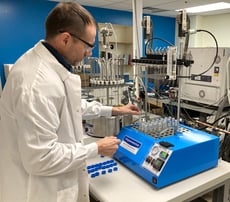
Microbac Laboratories, an environmental testing facility analyzing drinking water for PFAS using EPA Methods 537.1 and 533, initially used 24-position N-EVAPs—the models historically cited in EPA methodologies. When increasing sample throughput became necessary, they upgraded to higher-capacity automated systems.
The benefits included:
- Doubled capacity with the same benchtop footprint
- Enhanced thermal efficiency through improved water bath and sample rack design
- Consistent evaporation rates across all sample positions
- Automated timer functionality for reproducible method execution
Integrating Nitrogen Evaporation into Multi-Residue Workflows
Modern drinking water compliance laboratories typically analyze 50-200+ compounds per sample using multi-residue LC-MS/MS methods. This requires sample preparation workflows that are both robust and flexible.
Optimized Workflow for Trace Pesticide Analysis:
-
-
Sample Collection & Preservation: 250-1000 mL drinking water samples in amber glass bottles, acidified if necessary
-
SPE Enrichment: Polymeric reversed-phase or mixed-mode sorbents (e.g., Oasis HLB, Strata-X)
-
Nitrogen Evaporation: Reduce 5-10 mL eluate to 0.5-1 mL final volume using N-EVAP system
-
LC-MS/MS Analysis: Inject 5-20 μL for multi-residue screening in positive and negative ionization modes
-
Critical Parameters for Nitrogen Evaporation:
- Temperature: 35-60°C depending on solvent boiling point and analyte thermostability
- Nitrogen flow rate: 5-15 L/min total, adjusted per sample via needle valves
- Needle position: 0.5 inches (13 mm) above sample surface for optimal evaporation
- Endpoint monitoring: Visual observation or timed protocols to prevent over-drying
For PFAS analysis—where contamination control is paramount—additional precautions include use of PFAS-free nitrogen filters, dedicated glassware, and isotopically labeled internal standards added post-evaporation.
The Regulatory Context: Meeting ISO and CEN Standards
Laboratories performing drinking water compliance testing under EU 2020/2184 must demonstrate competence through accreditation to ISO/IEC 17025 or equivalent standards. This requires:
- Method validation demonstrating accuracy, precision, and detection limits meeting regulatory requirements
- Quality control including blank samples, matrix spikes, and certified reference materials
- Equipment qualification with documented performance verification
- Traceability of measurements to international standards
Nitrogen evaporators play a documented role in validated methods for pesticide analysis, pharmaceutical monitoring, and PFAS determination. Their reproducible performance—when operated according to standard procedures—supports method validation and regulatory compliance.
Beyond Drinking Water: Broader Applications in Environmental Analysis
While EU drinking water compliance drives significant demand for nitrogen evaporation technology, the same systems support diverse environmental applications:
- Surface Water Monitoring: The Water Framework Directive (2000/60/EC) establishes environmental quality standards for pesticides, pharmaceuticals, and other priority substances in rivers, lakes, and coastal waters. Sample preparation workflows mirror those for drinking water, with nitrogen evaporation enabling trace-level detection.
- Wastewater Analysis: Treatment plant monitoring for emerging contaminants—including pharmaceuticals, endocrine disruptors, and personal care products—relies on SPE-nitrogen evaporation-LC-MS/MS workflows. These data inform risk assessments and treatment optimization strategies.
- Soil and Sediment Testing: Environmental laboratories extend their analytical capabilities to solid matrices using Soxhlet extraction or pressurized liquid extraction followed by nitrogen evaporation for extract concentration.
- Food Safety: Pesticide residue analysis in food matrices—regulated under EU legislation—employs QuEChERS extraction followed by dispersive SPE cleanup and nitrogen evaporation. Many laboratories use the same N-EVAP systems for both food and water applications.
Selecting the Right Nitrogen Evaporator for Your Laboratory
Choosing an appropriate nitrogen evaporation system depends on several factors:
- Sample Throughput: Laboratories processing 10-20 samples daily may find 12 or 24-position N-EVAPs optimal, while high-volume facilities testing 50+ samples require 34 or 45-position models.
- Sample Types: Universal sample holders accommodate standard test tubes and vials, but specialized applications may require custom racks. Large-volume water extracts (≥50 mL) benefit from optional oversized sample holders.
- Automation Requirements: Manual N-EVAPs offer simplicity and reliability for routine operations. Automated models with programmable timers and nitrogen flow control enhance reproducibility and reduce hands-on time.
- Budget Considerations: N-EVAP systems represent a lower per-position cost compared to centrifugal evaporators or automated concentration platforms, while offering superior control and gentler evaporation conditions for sensitive analytes
- Facility Infrastructure: Standard models require only a nitrogen source (cylinder, generator, or house line) and standard electrical service. Optional integrated nitrogen generators eliminate cylinder management.
Best Practices for Nitrogen Evaporation in Water Analysis
To maximize performance and ensure regulatory compliance, laboratories should implement these practices:
Method Development:
- Optimize temperature and gas flow rates during method validation
- Evaluate recovery of target analytes across the complete workflow including evaporation step
- Document evaporation time-to-dryness for reproducible execution
Quality Control:
- Process method blanks through complete SPE-evaporation workflow to assess background contamination
- Include matrix spike samples to verify analyte recovery
- Monitor internal standard responses to detect evaporation-related losses
Maintenance:
- Inspect and clean needle tips regularly to ensure consistent flow
- Verify water bath temperature accuracy monthly
- Check nitrogen purity specifications for trace organic analysis
Contamination Prevention:
- Dedicate glassware and sample racks to specific analyte classes (e.g., PFAS-only equipment)
- Use inert needle materials (stainless steel or FEP-coated) to minimize adsorption
- Implement rigorous cleaning protocols between sample batches
The Future of Water Quality Monitoring in Europe
The EU's commitment to protective water quality standards continues to evolve. The Drinking Water Directive's watch list mechanism enables rapid response to emerging contaminants, while ongoing reviews of substances like pharmaceuticals and microplastics drive analytical innovation.
For compliance laboratories, this dynamic regulatory landscape demands flexible, robust sample preparation capabilities. Nitrogen evaporation technology—refined over 65 years of analytical chemistry applications—provides the reliability and precision necessary for meeting today's stringent requirements while adapting to tomorrow's challenges.
Sample Preparation Excellence for Regulatory Success
Meeting EU Drinking Water Directive 2020/2184 compliance requires more than advanced instrumentation—it demands meticulous attention to every step of the analytical workflow. From solid-phase extraction through nitrogen evaporation to LC-MS/MS detection, each stage contributes to the sensitivity, accuracy, and reproducibility necessary for protecting public health.
Organomation's N-EVAP nitrogen evaporators represent purpose-built solutions for the critical sample concentration step in trace contaminant analysis. With configurations spanning 6 to 45 positions, universal sample compatibility, and individual flow control, these systems support high-throughput multi-residue testing while maintaining the gentle conditions required for sensitive analytes.
As European water quality regulations continue advancing toward ever-more protective standards, laboratories equipped with robust sample preparation technology will lead in delivering accurate, defensible analytical results. The combination of optimized SPE protocols, precision nitrogen evaporation, and state-of-the-art LC-MS/MS detection provides the comprehensive analytical capability required for drinking water compliance in the 21st century.
Ready to optimize your drinking water testing workflow? Contact Organomation to discuss how N-EVAP nitrogen evaporators can enhance your laboratory's EU 2020/2184 compliance capabilities. Our team offers complimentary method consultation and application support for environmental analysis. Visit www.organomation.com or call +1 (978) 838-7300.