
Nitrogen blanketing, purging, and inert backfill reduce the exposure of samples, reagents, products, or equipment to atmospheric oxygen and moisture. Blanketing maintains nitrogen over a material, purging sweeps air from a vessel or line, and inert backfill replaces the atmosphere after evacuation or material removal.
For compatible bench-scale workflows, an on-site membrane nitrogen generator can provide a convenient alternative to cylinders. Compatibility cannot be established from nitrogen purity alone, however. Laboratories must evaluate the required residual oxygen, gas dryness, contaminant limits, operating pressure, peak flow, vessel volume, leakage rate, and consequences of a loss of inert conditions.
What is nitrogen blanketing?
Nitrogen blanketing is the maintenance of a nitrogen-rich atmosphere over a material to limit the entry of air. A low, controlled flow or slight positive pressure helps protect the vessel headspace as its internal volume or pressure changes.
In a laboratory, a nitrogen blanket may be used over oxidation-sensitive solutions, lipid standards, formulations, resins, oils, solvents, intermediates, or stored samples. The objective is usually product protection rather than creating an atmosphere suitable for the most air-sensitive synthetic chemistry.
A blanket can help:
- Reduce repeated exposure to atmospheric oxygen
- Limit moisture ingress when sufficiently dry gas is used
- Replace headspace lost when liquid is withdrawn
- Reduce oxidative degradation during short-term processing or storage
- Maintain a protective atmosphere during transfers
A reagent bottle provides a useful small-scale example. When liquid is withdrawn through a septum, the removed volume must be replaced. A blanket of dry nitrogen or inert gas can prevent moist air from replacing the withdrawn reagent. [1]
What is nitrogen purging?
Nitrogen purging is the intentional displacement or dilution of air, oxygen, moisture, solvent vapor, or another gas from a vessel, container, tubing network, or enclosure. Unlike blanketing, purging is generally a finite conditioning step performed before filling, sealing, storage, analysis, or another operation.
Common laboratory purge arrangements include:
- Flow-through purge: Nitrogen enters through one port and displaced gas exits through another.
- Headspace flush: Nitrogen is directed into a vial or bottle before sealing.
- Pressure-cycle purge: A pressure-rated system is alternately pressurized with nitrogen and vented.
- Vacuum–nitrogen cycle: A compatible vessel is evacuated and refilled with nitrogen one or more times.
- Two-needle vial purge: One needle introduces nitrogen through a septum while the second vents displaced gas.
Organomation has already developed a two-needle nitrogen purging system for capped sample tubes. Its inlet needle introduces gas while a second needle vents the displaced atmosphere, allowing multiple tubes to be purged for long-term sample storage. [2]
Purging efficiency depends on vessel geometry, mixing, inlet and outlet locations, dead volumes, leakage, temperature, pressure, and whether the process behaves like ideal displacement or dilution. Consequently, “purge for a few minutes” is not a transferable specification. A validated endpoint should be based on oxygen concentration, a qualified number of volume exchanges, or evidence that the protected material remains stable.
What is inert backfill?
Inert backfill is the controlled replacement of a vacuum or displaced volume with nitrogen. It is commonly performed after vessel evacuation, vacuum drying, filtration, freeze-drying, transfer, or removal of liquid from a sealed container.
In air-sensitive synthesis, vacuum–inert-gas cycles are used to remove air from Schlenk glassware. The University of York’s Schlenk purging guidance describes evacuating a vessel, slowly refilling it from an inert-gas manifold, and repeating the cycle—typically at least three times—to remove oxygen and water vapor. [3]
That procedure should not be interpreted as evidence that every nitrogen source is suitable for every Schlenk operation. Highly air- or moisture-sensitive reagents may require rigorously dry, high-purity gas, validated gas purification, or argon. For example, MilliporeSigma’s guidance for handling air-sensitive reagents specifies dry, high-purity nitrogen for flushing and warns against exposing sensitive reagents to atmospheric oxygen or moisture. [4]
How are the three methods different?
|
Technique |
Primary purpose |
Typical operating pattern |
Common laboratory examples |
Key design variable |
|
Blanketing |
Maintain a protective headspace |
Low continuous flow or slight positive pressure |
Solvent reservoir, formulation vessel, lipid solution, reaction hold vessel |
Leakage and breathing demand |
|
Purging |
Remove or dilute the original atmosphere |
Temporary higher flow with a defined outlet |
Vials, bottles, tubing, manifolds, small enclosures |
Vessel volume and verified endpoint |
|
Inert backfill |
Replace vacuum or withdrawn volume |
Intermittent gas demand |
Schlenk flask, vacuum oven, dried vessel, septum bottle |
Instantaneous flow and pressure control |
A laboratory may use all three in sequence: purge a vessel before filling, maintain a blanket during processing, and backfill the headspace as product is withdrawn.
Where do laboratories use these techniques?
Analytical and sample-storage laboratories
Environmental, food, clinical, toxicology, forensic, and chromatography laboratories may purge vial headspace or maintain a nitrogen atmosphere over stored extracts and standards. The goal is often to reduce oxidation during holding or to displace residual air before a container is sealed.
This opportunity is particularly relevant when a laboratory already operates an Organomation evaporator and needs modest additional nitrogen for post-concentration sample protection. A shared source can be practical only when total simultaneous demand remains below the generator’s available flow at the selected purity.
Pharmaceutical and formulation laboratories
Drug-discovery, preformulation, stability, process-development, and quality-control laboratories may use nitrogen to protect oxidation-sensitive active ingredients, excipients, solutions, intermediates, or formulations. The required nitrogen quality should be set by a risk assessment and, where applicable, the validated manufacturing or analytical procedure.
A bench-scale generator may be appropriate for non-GMP development work or qualified laboratory procedures. It should not be promoted as suitable for pharmaceutical manufacturing, sterile processing, or direct product contact without application-specific qualification, contaminant specifications, change control, and quality-system review.
Organic synthesis laboratories
Medicinal chemistry, process chemistry, catalysis, polymer chemistry, and academic research laboratories use inert gas for reaction setup, vessel purging, cannula transfer, and vacuum backfill. Nitrogen is suitable for many—but not all—chemistries.
The most demanding reagents and catalysts may be sensitive to trace oxygen, water, or nitrogen itself. A glovebox used for air- and moisture-sensitive compounds can target atmospheres below 1 ppm oxygen and water, which is far beyond a 95–99% nitrogen source without downstream purification. The NITRO-GEN therefore should not be positioned as a direct substitute for an ultra-high-purity cylinder, purifier-equipped Schlenk line, or recirculating glovebox. [5]
Materials and polymer laboratories
Battery-materials, nanomaterials, polymers, coatings, adhesives, and electronic-materials laboratories may use nitrogen during precursor handling, resin storage, casting, curing, thermal treatment, or transfer. A nanomaterials synthesis facility, for example, may combine a nitrogen-controlled dry chamber with a Schlenk line for reactions requiring moisture and oxygen control. [6]
Suitability depends on the material. Moderate-purity nitrogen may be adequate for routine oxidation control, while battery electrolytes, organometallic precursors, semiconductor materials, and highly reactive monomers can require much tighter oxygen, moisture, or hydrocarbon limits.
Food, lipid, and natural-products laboratories
Food-science, nutrition, lipidomics, flavors, fragrances, cosmetics, and natural-products laboratories frequently handle oxidation-prone oils and extracts. Published research found that flushing cold-pressed rapeseed and sunflower oils with nitrogen inhibited peroxide formation during accelerated and long-term storage tests. [7]
These laboratories represent a strong bench-scale opportunity because the desired function is often oxidation reduction rather than ultra-trace oxygen exclusion. The laboratory must still validate headspace oxygen and sample stability for its container, matrix, storage time, and acceptance criteria.
Can the NITRO-GEN support these applications?
The Organomation NITRO-GEN can be a candidate for selected bench-scale blanketing, flow-through purging, and inert-backfill workflows that tolerate 95–99% nitrogen and require no more than the available flow at the chosen purity. It should not be described as universally suitable for inerting or air-sensitive chemistry.
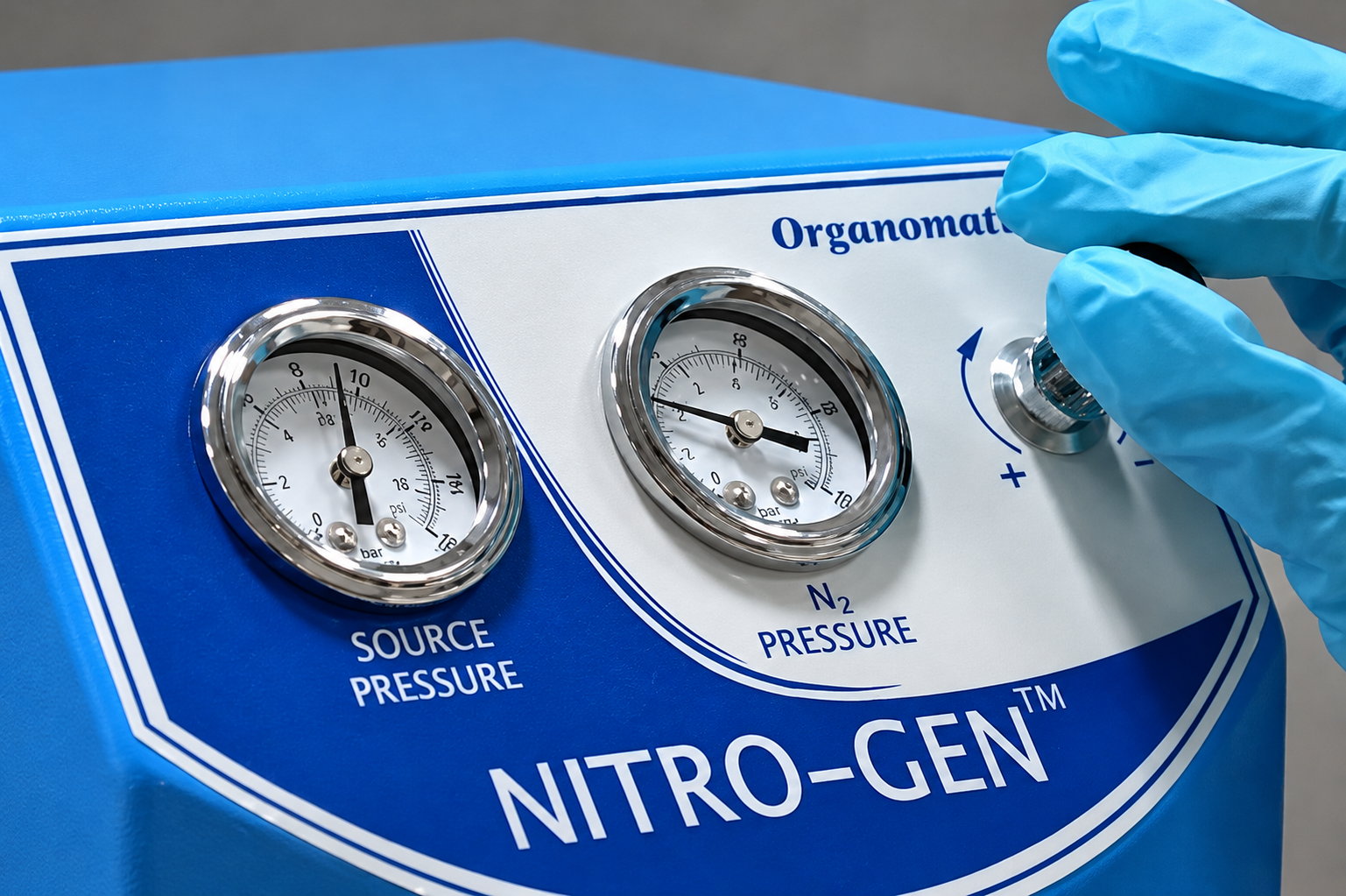
The NITRO-GEN nitrogen generator uses hollow-fiber membrane technology and produces 95–99% nitrogen. Organomation lists an adjustable outlet-pressure regulator from 0 to 100 psi, a maximum flow of 20 L/min, dual-stage air filtration, no electrical requirement for the generator itself, and a requirement for oil-less compressed air.[^8]
When paired with Organomation’s recommended oil-free air compressor, the currently published operating points are:
|
Nominal nitrogen purity |
Published flow with recommended compressor |
Potential use profile |
|
99% |
4 L/min |
Small vessels, low-flow blankets, sequential vial purge, controlled backfill |
|
97% |
8 L/min |
Moderate purge demand or several restricted low-flow outlets |
|
95% |
16 L/min |
Faster air displacement where the process tolerates higher residual oxygen |
These are linked purity–flow operating points, not independent specifications. The unit should not be represented as delivering 20 L/min at 99% purity, and its maximum 100 psi regulator setting should not be assumed to remain available at maximum flow. Actual delivered pressure and flow depend on the feed-air system, tubing, restrictions, fittings, regulator settings, and downstream demand. [9]
How should purity be selected?
Select nitrogen purity from the maximum oxygen and contaminant levels the process can tolerate—not from a general preference for the highest available percentage. Higher membrane purity normally reduces available flow, so unnecessary purity can slow purging or reduce the number of simultaneously supplied vessels.
For product-quality blanketing, the most useful criterion may be residual oxygen in the vessel or product stability rather than generator purity by itself. Even 99% nitrogen does not automatically create a 1% oxygen headspace: the final atmosphere depends on initial air, purge efficiency, vessel leakage, mixing, gas-distribution design, and time.
A practical selection framework is:
- 95% mode: Consider for noncritical air displacement and oxidation reduction when the process has demonstrated tolerance for moderate residual oxygen.
- 97% mode: Consider when a balance between purge speed and oxygen reduction is needed.
- 99% mode: Consider for smaller-volume or more oxygen-sensitive workflows that remain compatible with approximately 4 L/min using the recommended compressor.
- Above 99% or trace-level control: Select another nitrogen source or add a properly engineered purifier when the method requires tighter oxygen, moisture, hydrocarbon, or particulate limits.
For flammability-control applications, purity cannot be chosen from a generic table. NFPA 69 bases inerting on the material-specific limiting oxidant concentration and requires an operating safety margin below that value. A 95–99% source therefore must not be marketed as providing explosion protection without a qualified process-safety design, oxygen measurement, control logic, alarms, pressure protection, and applicable-code review. [10, 11]
How should flow be sized?
Start with the process demand rather than the generator’s headline maximum. The required supply may include:
- Purge flow to each open vessel
- Continuous blanket flow
- Intermittent backfill demand
- Leakage through seals and fittings
- Simultaneous use by other equipment
- A reasonable capacity margin
For a simple mixed-volume purge, the oxygen concentration decreases approximately exponentially with ideal volume exchanges. Real vessels seldom behave ideally because of dead zones, short-circuiting between inlet and outlet, diffusion, and imperfect mixing. The number of required exchanges must therefore be demonstrated experimentally for the actual setup.
Install a downstream flowmeter or flow controller for each critical branch. A pressure regulator controls pressure, not flow; without a restriction or metering device, an open line can consume more gas than expected and starve other users.
A small receiver can help smooth intermittent backfill demand, but it does not increase the generator’s average production capacity. Any receiver, vacuum vessel, bottle, or manifold must be pressure-rated and protected from overpressure.
Why do dryness and cleanliness matter?
Atmospheric oxygen is only one source of degradation. Moisture and compressor-derived contaminants can also affect sensitive reagents, samples, catalysts, coatings, and analytical results.
The NITRO-GEN product page specifies clean, non-condensing inlet air; particulates at or below 0.01 µm; and oil vapor below 0.01 mg/m³. Organomation’s recommended compressor provides oil-free compressed air and lists a -40 °C air-output dew point. However, Organomation does not currently publish a guaranteed NITRO-GEN product-gas dew point, residual oxygen concentration for every flow condition, or complete hydrocarbon specification on the model’s product page. [8, 9]
Before promoting the system for moisture-sensitive backfill or direct contact with critical product, verify:
- Nitrogen outlet dew point at the intended flow and ambient conditions
- Residual oxygen under steady and peak demand
- Oil vapor, hydrocarbon, and particulate performance
- Filter-maintenance interval and breakthrough indicators
- Startup stabilization and shutdown behavior
- Effects of simultaneous users and pressure transients
Recommended setup
A robust bench-scale installation generally includes:
- A suitable oil-free, dry compressed-air source
- The NITRO-GEN operated at a validated purity–flow setting
- An application pressure regulator located near the point of use
- A flowmeter, needle valve, or mass-flow controller for each branch
- A check valve where backflow could contaminate the supply
- Compatible tubing and fittings with low leakage and low extractables
- A defined vent path that does not pressurize the receiving vessel
- An oxygen sensor when residual oxygen is critical
- A dew-point measurement or periodic verification when moisture is critical
- Written startup, shutdown, purge-endpoint, and maintenance procedures
For septum-capped tubes, a two-needle arrangement is preferable to injecting nitrogen through a single needle into a sealed container. One needle supplies gas and the other provides a controlled escape path, reducing overpressure risk and improving atmospheric displacement. [2]
Qualification protocol
Before routine use, qualify the complete system rather than the generator in isolation.
Define acceptance criteria
Document the maximum allowable:
- Residual oxygen
- Water content or dew point
- Hydrocarbon and particulate contamination
- Purge time
- Pressure and flow variation
- Sample oxidation or degradation
Challenge realistic conditions
Test the largest vessel, longest tubing run, highest simultaneous demand, lowest expected feed pressure, and worst-case ambient temperature. Include startup, prolonged idle periods, and switching between flow settings.
Measure at the point of use
Measure oxygen, dew point, pressure, and flow at the vessel inlet—not only at the generator outlet. If sample protection is the actual objective, perform stability or recovery testing on representative samples.
Establish routine controls
Define acceptable ranges, verification frequency, filter changes, leak checks, alarm response, and requalification triggers. Requalify after changes to the compressor, membrane, filters, regulator, tubing, manifold, vessel, process scale, or operating setpoint.
What applications should be excluded?
The NITRO-GEN should not be positioned as a universal solution for:
- Recirculating gloveboxes requiring ppm-level oxygen and moisture
- Pyrophoric or exceptionally air-sensitive reagents without additional validated purification
- Processes requiring ultra-high-purity nitrogen
- Safety-critical vessel inerting based only on nominal generator purity
- Large tanks or high-volume enclosures whose purge demand exceeds available capacity
- Sterile or regulated product-contact gas without appropriate qualification
- Semiconductor processes with stringent moisture, oxygen, particle, or hydrocarbon specifications
- Sealed, non-pressure-rated containers without a controlled vent
Organomation offers higher-purity and higher-capacity nitrogen-generator options for applications beyond the NITRO-GEN’s range. The laboratory nitrogen generator portfolio should be consulted when a workflow needs greater flow, lower dew point, or higher purity. [12]
Safety considerations
Nitrogen is colorless and odorless and can displace oxygen. OSHA defines an oxygen-deficient atmosphere as one below 19.5% oxygen by volume, and inerting a permit space with nitrogen creates an immediately dangerous oxygen-deficient atmosphere. [13, 14]
Laboratories should complete an oxygen-deficiency risk assessment based on room volume, maximum credible release, ventilation, generator and receiver capacity, and occupancy. Depending on the result, controls may include fixed oxygen monitoring, local exhaust, automatic isolation, alarms, restricted access, and documented emergency procedures.
Additional precautions include:
- Never direct nitrogen toward a person or use it as breathing air.
- Never purge a sealed vessel without a safe vent path.
- Do not exceed the pressure rating of glassware, vessels, tubing, septa, filters, or fittings.
- Use a relief device where blocked-in pressure is credible.
- Prevent liquid or vapor backflow into the generator.
- Vent hazardous process vapors to an appropriate exhaust system.
- Treat flammability-control inerting as an engineered safeguards application, not merely a gas-supply choice.
Is on-site generation better than cylinders?
For laboratories with recurring, moderate nitrogen demand, on-site generation can reduce cylinder changes, delivery dependence, and handling of high-pressure cylinders. The generator also provides nitrogen on demand as long as qualified compressed air remains available.
Cylinders may remain preferable for very low consumption, infrequent emergency use, certified gas composition, ultra-high purity, or applications that demand a quality the generator has not been shown to deliver. The appropriate comparison should include gas quality, utilization, maintenance, compressor energy, backup supply, downtime consequences, and qualification costs—not purchase price alone.
Organomation’s article on laboratory nitrogen-cylinder costs and on-site generation provides additional factors for laboratories assessing the economic case. [15]
Frequently asked questions
What is the difference between nitrogen blanketing and nitrogen purging?
Blanketing maintains a nitrogen-rich atmosphere over a material during storage or processing. Purging is a temporary operation used to displace or dilute the atmosphere already present in a vessel, container, line, or enclosure.
What is nitrogen backfill?
Nitrogen backfill replaces a vacuum or withdrawn volume with nitrogen. Laboratories use it after vacuum drying, vessel evacuation, transfer, filtration, or withdrawal of material from a closed container.
Can 95% nitrogen be used for blanketing?
Sometimes. A 95% nitrogen stream may be suitable for noncritical oxidation reduction when the process tolerates the remaining impurities and validation demonstrates acceptable headspace oxygen and product stability. It is not automatically suitable for air-sensitive synthesis or explosion prevention.
Is 99% nitrogen sufficient for air-sensitive chemistry?
It depends on the reaction and contaminant limits. Many highly air- or moisture-sensitive chemistries require dry, high-purity gas or ppm-level oxygen and moisture control. A 99% source should not be treated as equivalent to ultra-high-purity nitrogen.
How much nitrogen is needed to purge a vessel?
The answer depends on vessel volume, geometry, mixing behavior, inlet and outlet placement, target oxygen concentration, leakage, and purge method. Determine the endpoint through oxygen measurement or a validated vessel-specific procedure rather than a universal time rule.
Can the NITRO-GEN deliver 20 L/min at 99% purity?
Organomation lists “up to” 20 L/min and a 95–99% purity range, but those maxima are not presented as one simultaneous operating point. With the recommended compressor, the published values are 4 L/min at 99%, 8 L/min at 97%, and 16 L/min at 95%. [8, 9]
Does nitrogen blanketing make a flammable process safe?
Not by itself. Explosion prevention requires a material-specific limiting oxidant concentration, an adequate safety margin, verified oxygen control, instrumentation, interlocks, pressure protection, and compliance with applicable standards. [10, 11]
What laboratories are the best fit for this application?
Strong candidates include analytical and sample-storage laboratories; food, lipid, flavor, fragrance, and natural-products laboratories; pharmaceutical-development and formulation laboratories; and selected organic-synthesis, polymer, coatings, and materials laboratories. Fit depends on the required oxygen, moisture, contaminant, pressure, and flow limits.
Choosing a nitrogen source
The NITRO-GEN is best positioned for qualified, bench-scale blanketing, flow-through purging, and inert-backfill tasks that can tolerate membrane-grade nitrogen. Its compact format, adjustable pressure, and range of purity–flow operating points can support multiple laboratory workflows without relying exclusively on cylinders. [16]
The correct sales and technical message is not “nitrogen is inert, so the generator will work.” It is: define the process requirement, select a compatible purity–flow point, control pressure and flow, verify oxygen and dryness at the point of use, and validate that the protected material meets its acceptance criteria.
Discuss the application with Organomation to review the vessel volume, target oxygen level, gas-quality requirements, operating pressure, peak flow, number of simultaneous outlets, and available compressed-air supply.