
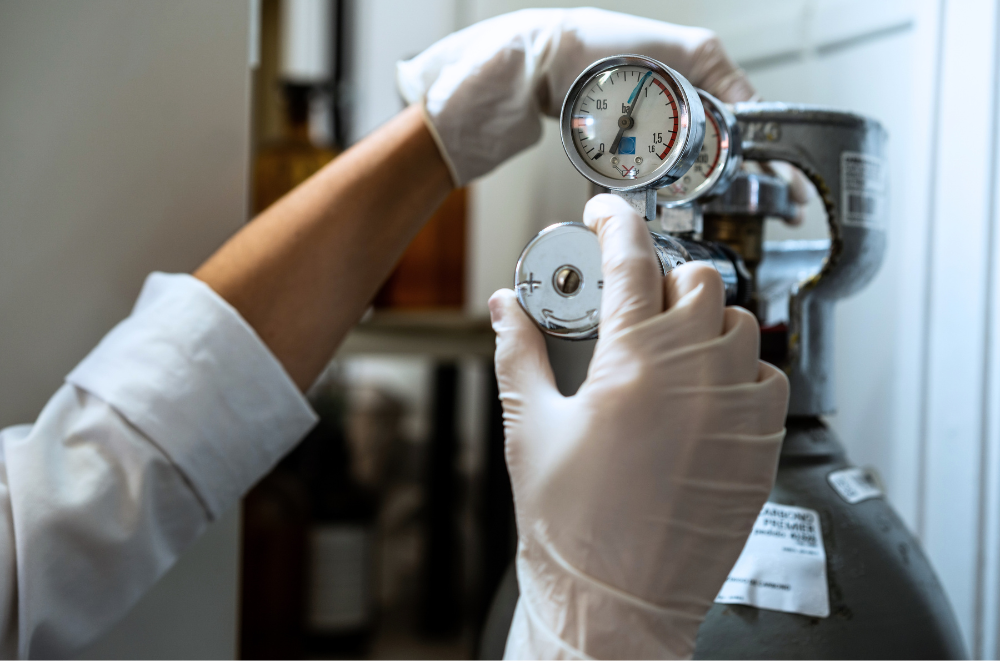
If you’ve reviewed your laboratory’s operational budget recently, you have likely noticed a troubling trend: the cost of keeping your instruments running is climbing, and nitrogen gas is a major culprit.
According to Organomation’s newly released Nitrogen Usage 2025 Survey Report, you are not alone in this frustration. In fact, 35% of laboratories ranked high costs as their number one frustration with their current nitrogen supply — overshadowing safety, logistics, and maintenance concerns.
With 96% of labs expecting their nitrogen demand to increase or remain steady over the next three years, waiting for prices to drop isn’t a viable strategy. To protect your budget, you need to understand why prices are surging and, more importantly, how to insulate your lab from the volatility.
The "Perfect Storm" Driving Prices Up
As a chemist, you know that nitrogen is abundant in the atmosphere. However, the industrial process of separating, purifying, compressing, and transporting it is energy-intensive and tied heavily to global markets. Three key factors are driving the 2025 price surge:
1. Rising Energy Costs
While nitrogen itself is free, the energy required to produce high-purity nitrogen gas (via fractional distillation) is not. Industrial gas manufacturing is heavily reliant on energy prices. In 2025, U.S. natural gas prices for industrial sectors have seen significant volatility, with some forecasts showing double-digit percentage increases for power plants due to export demands and tightening domestic supply. When the cost of energy rises, gas suppliers pass those costs directly to the consumer.
2. The Logistics Premium
If you rely on high-pressure cylinders or liquid dewars, you aren't just paying for gas; you are paying for diesel, driver wages, and truck maintenance. Logistics frustrations were a top complaint in our 2025 survey, particularly for labs using liquid dewars.
• Delivery Fees & Surcharges: Fuel surcharges are now a standard line item on many invoices, fluctuating weekly with the oil market.
• Cylinder Rental: The "rent" for holding steel cylinders often creeps up annually, regardless of how much gas you actually consume.
3. Hidden Waste (The "Boil-Off" Tax)
For labs using liquid nitrogen dewars, the "price per liter" is deceptive. Liquid nitrogen constantly boils off to maintain its temperature. If your lab uses dewars for gaseous applications (like evaporation), you are paying for gas that vanishes into the room before it ever reaches your instrument. Our survey found that while dewars nominally cost $2.06/liter, the effective cost is often higher due to this inevitable waste.
The Data: Cylinders vs. Generators
The most striking finding from our 2025 Survey Report was the massive price disparity between supply methods. When we analyzed the average cost per liter across 78 laboratories, the data was clear:
| Nitrogen Source | Average Cost Per Liter |
| Gas Cylinders | $2.79 |
| Liquid Dewars | $2.06 |
| Lab-Scale Generator | $0.70 |
Laboratories relying on cylinders are paying nearly 400% more per liter than those generating their own gas. Over the course of a year, this difference can amount to thousands of dollars in operational waste.
How to Reduce the Price Tag: A Two-Step Strategy
You cannot control the global energy market or supply chain logistics. However, you can control how you source and use your nitrogen.
Step 1: Cut the Cord (Switch to Generation)
The single most effective way to lower your nitrogen spend is to stop buying it in tanks. While the upfront cost of equipment can sometimes be a hurdle for capital budgets, new financial models are making this transition accessible for labs of all sizes.
Why Generation Wins on Cost
A nitrogen generator, like the Organomation NITRO-GEN, separates nitrogen from your lab's existing compressed air supply using a hollow-fiber membrane. Once installed, your "cost per liter" drops to essentially zero—you are only paying for the electricity to run the compressor.
• Rapid ROI: Most labs see a return on investment in 12 to 18 months by generating nitrogen. After this break-even point, your nitrogen supply becomes a fixed asset rather than a monthly liability.
• Operational Freedom: Weighing under 20 lbs and wall-mountable, the NITRO-GEN N2 generator produces up to 20 L/min of gas, sufficient to support blowdown evaporators with up to 48 sample positions.
Overcoming the "Sticker Shock" with Lease-to-Own
Historically, the barrier to entry for nitrogen generators has been the initial purchase price. To solve this, Organomation has introduced a Lease-to-Own program designed to align equipment costs with your operating budget rather than your capital reserves.
This program transforms a large capital expenditure into a manageable monthly operating expense. Unlike standard rental agreements where payments are lost forever, this program allows you to build equity.
• Immediate Savings: You can install the unit and stop paying cylinder rental fees immediately, often letting the operational savings offset the lease payments.
• Path to Ownership: At the end of the lease term, you own the equipment outright—often for a nominal final payment (as low as $1).
• Preserve Capital: By spreading the cost over time, you keep your cash reserves available for other critical research needs or staffing.
By leveraging a lease-to-own model, you can "cut the cord" on gas contracts today without waiting for next year’s capital budget approval.
Step 2: Optimize Your Usage (Stop Wasting Gas)
Even with a cheap supply, wasting gas is bad science and bad business. especially if you use nitrogen for sample concentration (blowdown evaporation).
• Use Individual Flow Control: Many basic evaporators blow gas into every position, regardless of whether a sample is present. High-quality units (like the N-EVAP) feature individual needle valves for each sample position. Rule of thumb: If you are running 10 samples in a 24-position unit, ensure the other 14 needles are closed.
• Check for Leaks: It sounds basic, but a loose fitting on a regulator can waste cylinders of gas over a weekend. A simple "snoop test" (soapy water) on your connections every quarter is a zero-cost maintenance habit that saves money.
• Optimize Bath Temperature: In nitrogen blowdown evaporation, gas flow and temperature work together. If your water bath is too cool, you have to blow gas for longer to achieve dryness. Ensuring your bath is at the optimal temperature for your solvent (e.g., 35-40°C for DCM) reduces the total time the gas needs to run.
Conclusion
The era of "cheap" delivered gas is likely behind us. As the 2025 survey data shows, labs sticking to the status quo of cylinders and dewars are facing rising costs and logistical headaches. By transitioning to on-demand generation and optimizing your evaporation workflows, you can insulate your lab from market volatility and keep your budget focused on research, not utility bills.
Want to see the full data?
Download the Laboratory Nitrogen Usage Report to benchmark your lab’s spending against industry peers.
Curious about your potential savings?
Try our Nitrogen Generator Savings Calculator to see exactly how much you could save by making the switch.