
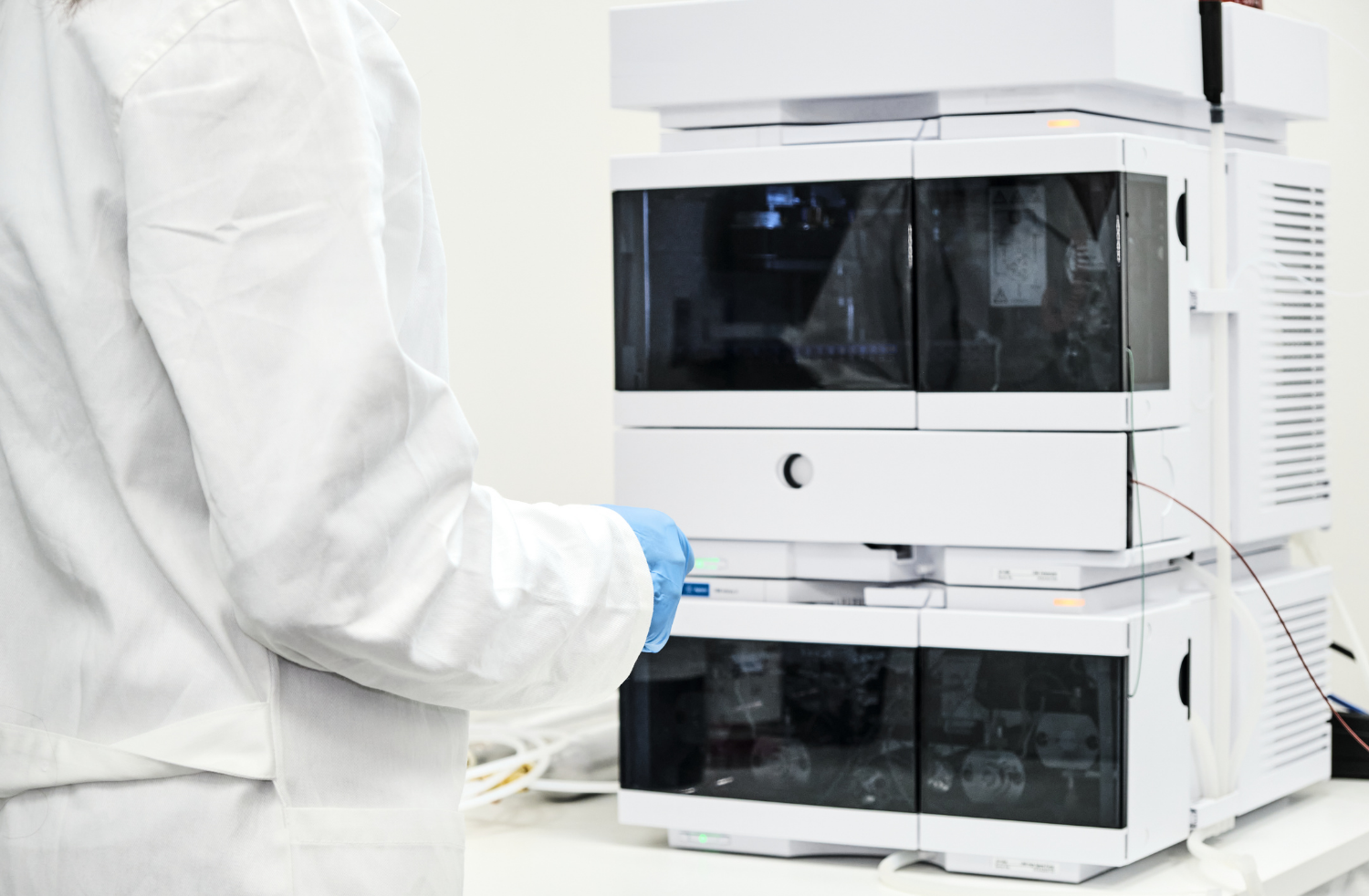
Yes—a properly specified nitrogen generator can supply a charged aerosol detector (CAD), provided that it meets the detector manufacturer’s requirements for flow, pressure, purity, and contaminant control at the same time.
For many current Thermo Scientific CAD models, the relevant design target is typically no more than 4 L/min at 70–80 psi, with nitrogen purity of at least 95% for most applications. The gas must also be free of water vapor, particles, and nonvolatile hydrocarbons such as compressor oil. Thermo Fisher Scientific’s Vanquish CAD operating manual describes these requirements and recommends a non-bottled gas source for routine operation.
Those requirements place a single CAD within the nominal flow, purity, and pressure range of Organomation’s compact NITRO-GEN nitrogen generator. However, compatibility must be confirmed against the exact CAD model, nebulizer certificate, solvent system, required gas quality, air compressor, and the generator’s performance at the chosen purity setting. A specification such as “up to 20 L/min” should never be interpreted as 20 L/min at the generator’s maximum 99% purity. [1, 2]
What is charged aerosol detection?
Charged aerosol detection is a liquid-chromatography detection technique used for nonvolatile and many semivolatile compounds, including analytes that have little or no useful UV chromophore. Published reviews describe applications involving carbohydrates, lipids, proteins, steroids, polymers, peptides, pharmaceutical compounds, food components, consumer products, and other chemically diverse analytes. [3]
A CAD converts the liquid leaving an HPLC or UHPLC column into a measurable electrical signal through four main steps:
-
Nebulization: The column effluent is pneumatically converted into droplets.
-
Evaporation: Volatile mobile-phase components are removed, leaving particles of less-volatile analyte.
-
Particle charging: A corona-generated ion stream transfers charge to the analyte particles.
-
Measurement: An electrometer measures the charge collected from those particles.
This operating principle explains why CAD requires a stable gas supply. Nitrogen participates directly in aerosol formation and gas handling inside the detector; inconsistent pressure or contaminated gas can affect nebulization, detector background, noise, reproducibility, and instrument reliability. [4]
Why laboratories use CAD
UV detection remains highly effective when an analyte absorbs at a suitable wavelength. It becomes less useful for compounds with weak or absent chromophores, or for mixtures in which chemically different components produce substantially different UV responses. CAD offers near-universal detection for nonvolatile compounds and is used for analyses involving sugars, carbohydrates, polymers, surfactants, excipients, pharmaceutical formulations, impurities, and cleaning-validation samples. [5]
Common users include:
- Pharmaceutical development and quality-control laboratories
- Biopharmaceutical characterization and formulation laboratories
- Contract research and contract testing laboratories
- Food, beverage, and dietary-supplement laboratories
- Chemical and specialty-material laboratories
- Cosmetics and consumer-products laboratories
- Academic chromatography and separation-science laboratories
CAD is not completely universal. The analyte must remain after mobile-phase evaporation, and detector response can change with mobile-phase composition. Gradient methods may therefore require careful optimization or inverse-gradient compensation when uniform response is important. [6]
What gas does a CAD require?
Current Thermo Scientific Vanquish CAD documentation permits nitrogen or compressed air in appropriate applications, but recommends nitrogen for most work. Nitrogen is mandatory for THF and other highly combustible solvents because using air can create an explosion hazard inside the detector. The detector manual describes nitrogen of typically at least 95% purity, gas consumption of typically no more than 4 L/min, and a supply-pressure range of 482–551 kPa, equivalent to 4.8–5.5 bar or 70–80 psi.
|
CAD requirement |
Typical specification for current Vanquish CAD models |
Why it matters |
|
Supply gas |
Nitrogen recommended; air permitted for suitable low-combustibility methods |
Solvent safety and detector operation |
|
Nitrogen purity |
Typically at least 95% for most applications |
Provides the inert-gas fraction specified by the manufacturer |
|
Gas consumption |
Typically no more than 4 L/min |
Determines generator capacity |
|
Inlet pressure |
70–80 psi |
Supports the detector’s internal gas regulation and nebulization |
|
Particles |
Particle-free; submicron filtration if necessary |
Helps protect the gas path and control background |
|
Water |
Free from water vapor |
Reduces contamination and unstable performance |
|
Oil and hydrocarbons |
No nonvolatile hydrocarbons such as compressor oils |
Oil contamination may damage the detector |
|
Combustible solvents |
Nitrogen required; check method-specific purity guidance |
Reduces explosion risk |
The detector’s exact operating pressure is not simply chosen from the general supply range. The installed nebulizer has a certificate specifying its required pressure, and the configured value should match that certificate. Thermo Fisher warns that operating at a different pressure can produce unpredictable performance deviations.
Can the NITRO-GEN meet CAD requirements?
On paper, the Organomation NITRO-GEN occupies the appropriate capacity class for one CAD. It uses hollow-fiber membrane technology, produces 95–99% nitrogen, provides adjustable outlet pressure from 0–100 psi, and requires an oil-less compressed-air source. The product is rated for up to 20 L/min, but available flow depends on the purity selected. [1]
When paired with Organomation’s recommended oil-free air compressor, the published operating points are 4 L/min at 99% purity, 8 L/min at 97% purity, and 16 L/min at 95% purity. These data show why flow and purity must always be evaluated as a paired operating point rather than as independent maximum specifications. [2]
|
Operating point |
NITRO-GEN with recommended compressor |
CAD interpretation |
|
Highest listed purity |
4 L/min at 99% nitrogen |
Nominally matches typical single-CAD consumption, but provides little published flow margin |
|
Intermediate setting |
8 L/min at 97% nitrogen |
Provides nominal capacity above one CAD’s typical consumption |
|
Highest listed CAD-relevant capacity |
16 L/min at 95% nitrogen |
Provides substantial nominal flow margin for one CAD while meeting the typical minimum purity cited for most applications |
|
Maximum product-page flow |
Up to 20 L/min |
Do not assume this is available at 99% purity |
|
Outlet pressure |
Adjustable from 0–100 psi |
Encompasses the common 70–80 psi CAD supply window |
For a single CAD using a method for which 95–97% nitrogen is acceptable, the published flow margin is favorable. At 99% purity, however, the stated 4 L/min output is equal to the detector’s typical consumption rather than comfortably above it. Laboratories should therefore confirm sustained outlet flow and pressure under real operating conditions rather than selecting the generator from headline specifications alone. [2]
The overlooked requirement: gas quality
Purity is not the same as gas quality. A stream containing 99% nitrogen may still be unsuitable if it carries excessive water, oil vapor, solvent vapor, or particles. Thermo Fisher specifies gas free from water vapor, particles, and nonvolatile hydrocarbons such as compressor oils; its CAD setup guidance recommends appropriate particle filtration, carbon filtration, and condensate management when necessary. [7]
The NITRO-GEN includes dual-stage clean-air filtration and requires an oil-less compressed-air source. Organomation lists inlet-air conditions including particulates of no more than 0.01 µm, oil vapor below 0.01 mg/m³, noncondensing humidity, and clean air without contaminants. [1]
Even so, the public product page does not state a numeric outlet dew point or an outlet-water specification. It also does not publish a CAD-specific validation statement. Before positioning or installing the NITRO-GEN as a CAD gas source, the laboratory should obtain written confirmation that the complete installed system—compressor, inlet treatment, membrane generator, downstream filtration, tubing, and regulator—meets the detector manufacturer’s gas-quality requirements. If a detector manufacturer, validated method, service agreement, or site SOP specifies a dew point or contaminant limit, that limit should control the decision.
A five-step compatibility check
1. Identify the exact detector
Record the CAD manufacturer, model, serial number, nebulizer type, and nebulizer-certificate pressure. Requirements can differ across instrument generations, configurations, and gas-regulation modes. Do not qualify a gas source using a generic statement about “CAD” alone.
2. Confirm simultaneous demand
Document all required values at the same operating condition:
- Minimum nitrogen purity
- Continuous flow at that purity
- Required inlet pressure
- Allowed pressure variation
- Water or dew-point limit
- Particle limit and filtration requirement
- Oil, hydrocarbon, and solvent-vapor limits
- Expected operating hours and duty cycle
This prevents a common sizing error: combining maximum purity, maximum flow, and maximum pressure values that the generator may not deliver simultaneously.
3. Review the mobile phase
Nitrogen is required when using THF or other highly combustible solvents. Thermo Fisher’s CAD laboratory guidance calls for 99% nitrogen with solvents that form combustible or explosive mixtures. [7]
Because the NITRO-GEN’s published 99% operating point is 4 L/min with the recommended compressor, a laboratory using such a method should pay particular attention to capacity margin, pressure stability, ambient conditions, and performance over time. A higher-capacity or CAD-dedicated gas solution may be preferable if the validated method cannot tolerate supply variation.
4. Qualify the compressed-air system
The NITRO-GEN requires oil-less compressed air. Confirm that the compressor can deliver the required inlet pressure and volume continuously after accounting for filter pressure drop, duty cycle, ambient temperature, and other air users. Use clean, dedicated tubing and keep downstream components free of compressor oil, plasticizer, moisture, and solvent vapors. [1]
5. Validate at the detector
Qualification should assess performance under normal and worst-case demand. A practical protocol includes:
- Measuring pressure and flow at the CAD inlet while the detector is consuming gas
- Verifying nitrogen purity at the selected generator setting
- Confirming gas-quality requirements, including moisture and hydrocarbon control
- Monitoring pressure stability through startup, equilibration, and a full sequence
- Comparing detector background current, baseline noise, drift, response, and repeatability with the existing qualified gas source
- Testing the most demanding approved mobile phase
- Documenting acceptance criteria, results, maintenance intervals, and change control
Regulated laboratories should process the gas-source change through their established equipment-qualification, method-validation, and quality procedures. The CAD manufacturer should approve any point that is unclear or potentially warranty-sensitive.
Why consider on-site nitrogen?
CAD gas demand is continuous during operation. Cylinders can therefore introduce recurring delivery, rental, changeover, storage, and administrative requirements. Thermo Fisher recommends a non-bottled source such as a nitrogen generator with a suitable compressor or in-house compressed-air supply for routine Vanquish CAD operation; smaller compressed-gas cylinders may be convenient during installation but are not recommended for routine use.
An on-site generator can offer:
- Continuous gas production from compressed air
- Fewer cylinder changes and delivery dependencies
- Reduced cylinder handling and storage
- More predictable gas availability
- A compact point-of-use supply for one detector
- Potentially lower long-term operating costs, depending on utilization and local gas pricing
The financial case should be calculated from the laboratory’s actual invoices, utilization, compressor electricity, maintenance, filters, qualification costs, and expected equipment life. Organomation’s analysis of laboratory nitrogen-cylinder costs illustrates how rental, hazmat, delivery, and payment charges can add to the apparent gas price. [8]
Correct startup and shutdown matter
Gas sequencing helps protect a CAD from flooding. Thermo Fisher instructs users to turn on detector gas flow first, wait at least five minutes, and only then start mobile-phase flow. For a routine shutdown, stop the liquid flow first, allow gas to continue for at least five minutes, and then turn off detector gas flow. Long-term shutdown may require an extended drying period and additional steps.
Always follow the current operating manual for the installed detector. The nitrogen generator does not replace detector-specific procedures, ventilation, exhaust routing, solvent controls, or preventive maintenance.
Is the NITRO-GEN the right choice?
The NITRO-GEN is a technically plausible candidate for supplying one compatible CAD because its published purity, pressure, and flow operating points overlap common single-detector requirements. The strongest fit is a method accepting 95–97% nitrogen, where the published 8–16 L/min operating points provide capacity above the typical 4 L/min detector demand. [2]
It should not be promoted as universally compatible with every CAD or every method. At 99% purity, the published 4 L/min capacity matches typical CAD consumption with little stated reserve, and the public NITRO-GEN page does not provide a numeric outlet dew point. The final decision should be based on the exact detector manual, nebulizer certificate, mobile phase, gas-quality criteria, compressor configuration, and site qualification.
To review the available generator models, visit Organomation’s laboratory nitrogen generator selection. For an application-specific assessment, provide the detector model, required inlet pressure, gas purity, continuous flow, mobile phase, and required gas-quality limits when requesting a quote. [9]
Frequently asked questions
How much nitrogen does a charged aerosol detector use?
A current Thermo Scientific Vanquish CAD typically consumes no more than approximately 4 L/min. Confirm the requirement for the exact detector model and installed nebulizer before sizing a gas source. [10]
What nitrogen purity does a CAD require?
Thermo Fisher specifies nitrogen of typically at least 95% purity for most Vanquish CAD applications. Its CAD setup guidance calls for 99% nitrogen when using THF or solvents that can form combustible or explosive mixtures. [7]
What pressure does a CAD require?
Current Thermo Scientific Vanquish and Corona Veo specifications list an inlet range of 70–80 psi. The nebulizer-specific setting must match the certificate supplied with the nebulizer. [10]
Can compressed air run a CAD?
Some CAD models permit compressed air for mobile phases of low combustibility. Nitrogen is generally recommended, and nitrogen must be used with THF or other highly combustible solvents. Follow the detector manufacturer’s current instructions.
Can one nitrogen generator supply more than one CAD?
Possibly, but total nominal flow alone is not enough. The system must maintain required purity, pressure, gas quality, and reserve capacity during simultaneous peak demand. Each detector and method should be included in the qualification.
Is 99% nitrogen always better for CAD?
Not necessarily. Higher purity usually reduces membrane-generator output, and current Thermo documentation indicates that at least 95% is typical for many applications. Use the purity required by the detector manufacturer and method rather than maximizing purity without considering flow margin. [2]
Does a CAD need zero-grade or ultra-high-purity nitrogen?
Not generally for the current Vanquish models discussed here; the manual recommends nitrogen typically at or above 95%. Cleanliness and dryness remain essential, however, so a purity percentage alone does not establish compatibility.
Is the NITRO-GEN compatible with every charged aerosol detector?
No universal compatibility claim should be made. Its published operating range overlaps the needs of many single-CAD installations, but the exact detector, nebulizer, solvent, pressure, flow, purity, contaminant limits, and validation requirements must be checked before connection.
References
-
#NA1955 - High-purity nitrogen generator by Organomation | MedicalExpo - Compact Nitrogen Generator for Efficient Sample Concentration The NITRO-GEN nitrogen generator is a ...
-
what are the common ways nitrogen gas in used in the laboratory? - Nitrogen gas serves as a fundamental utility in modern laboratories across multiple industries, with...
-
Similar to MaxStrength Fitness, what would be Organomation's signature differentiator? - Organomation's signature differentiator, similar to MaxStrength Fitness's "20 minutes, twice a week"...
-
Organomation unveils new re-designed NITRO-GEN nitrogen ... - - Nitrogen Blanketing: Blanketing involves covering the surface of a reactive or sensitive substance...
-
Low-Cost Nitrogen Generator Featured in Sample Prep Perspective ... - Organomation’s new NITRO-GEN nitrogen gas generator uses a hollow-fiber membrane to convert compress...
-
Purge nitrogen generator - All medical device manufacturers - Find your purge nitrogen generator easily amongst the 7 products from the leading brands (PEAK, F-DG...
-
Nitrogen Generator Comparison Organomation NITRO-GEN vs ... - Significance of the topic Continuous and reliable nitrogen supply is critical for many sample prepar...
-
Agilent 1290 Infinity II Evaporative Light Scattering Detector