
If your laboratory has no house compressed air, you have four options: pair an external-feed nitrogen generator with a dedicated oil-free compressor, buy a generator with a built-in compressor, extend or install house compressed air, or continue using supplied nitrogen cylinders or Dewars. Each works in some labs; none is automatically cheapest. The right choice depends on your nitrogen demand, budget, facility constraints, and how you value installation and maintenance effort.
Below is a decision table and a comparison of each option's real trade-offs.
Decision table
|
Option |
Best when |
Key questions to resolve |
|
External-feed generator + dedicated compressor |
You need a defined nitrogen output, already own a generator, or want a modular system |
Does the complete package meet your demand at your target purity? What installation and maintenance does it require? |
|
Generator with built-in compressor |
You want plug-and-play simplicity and minimal sourcing effort |
Does its nitrogen output fit your application? How does full-system cost compare? |
|
Extend or install house air |
Your facility already has or can justify a building-wide air system |
What facility work is required? Will the supplied air meet the generator's specifications? |
|
Continue with supplied nitrogen |
Your nitrogen use is low, irregular, or temporary |
Is on-site generation justified by your actual usage and costs? |
Option 1: External-feed generator plus a dedicated compressor
A membrane or PSA generator that requires external compressed air, paired with a dedicated oil-free compressor at the point of use, is a common setup for laboratories without house air.
How it works:
The compressor supplies clean, dry, oil-free air to the generator's inlet. The generator separates nitrogen from that air stream.
Advantages:
- Modular: you can upgrade the generator or compressor separately.
- The compressor may be able to serve other low-demand laboratory equipment when the generator is idle — confirm allowable duty cycle and air-quality requirements before doing so.
Disadvantages:
- You must verify compressor-to-generator compatibility yourself (pressure, flow, air quality, duty cycle).
- Two pieces of equipment to install, maintain, and troubleshoot.
Compatibility matters:
The compressor must meet the generator's feed-air pressure, consumption, and air-quality requirements — not just its nitrogen output. See the companion sizing article for the workflow.
Organomation example:
The W-M57391 oil-free compressor paired with the NITRO-GEN membrane generator delivers 4 L/min at 99% purity, 8 L/min at 97% purity, or 16 L/min at 95% purity.
Option 2: Generator with a built-in compressor
Some nitrogen generators include one or more internal compressors, eliminating the need to source one separately.
How it works:
The generator's internal compressor(s) draw ambient air and supply the separation process directly.
Advantages:
- Plug-and-play: no separate compressor to size, source, or plumb.
- Simpler installation for labs without facility support.
Disadvantages:
- Less flexibility to upgrade or reuse components separately.
- Cost relative to an external-feed setup varies by configuration — compare quotes before deciding.
Questions to investigate:
Who services the system, what does the warranty cover, and what happens during compressor service?
Organomation example:
The NITRO-GEN+ is a PSA generator with integrated low-noise, oil-free compressors, producing up to 99% purity at flow rates up to 25 L/min (and up to 98% purity above 25 L/min, up to its 35 L/min maximum). Its published specifications list a 55 dBA operating noise level at 1 meter and a two-year or 8,000-hour warranty.
Option 3: Extend or install house compressed air
If your building already has a compressed-air system, or if you are renovating a laboratory space, extending house air to the generator's location is another option.
How it works:
A building-wide compressor system supplies multiple points of use through fixed piping.
Advantages:
- Single utility serving many devices.
- No dedicated compressor footprint at the generator.
- Often already available in shared or multi-user facilities.
Disadvantages:
- Requires facility approval, engineering, and plumbing work.
- House air quality may not meet a specific generator's dew-point, particulate, or oil-vapor limits without additional point-of-use filtration and drying.
Verify air quality:
The NITRO-GEN requires air filtered at 0.01 µm with oil vapor below 0.01 ppm and non-condensing humidity, per its published inlet-air conditions. Peak's Infinity XE membrane generators specify ISO 8573-1:2010 Class 1.4.1 inlet air. Confirm your house air meets these limits at the generator connection, not just at the building's main supply.
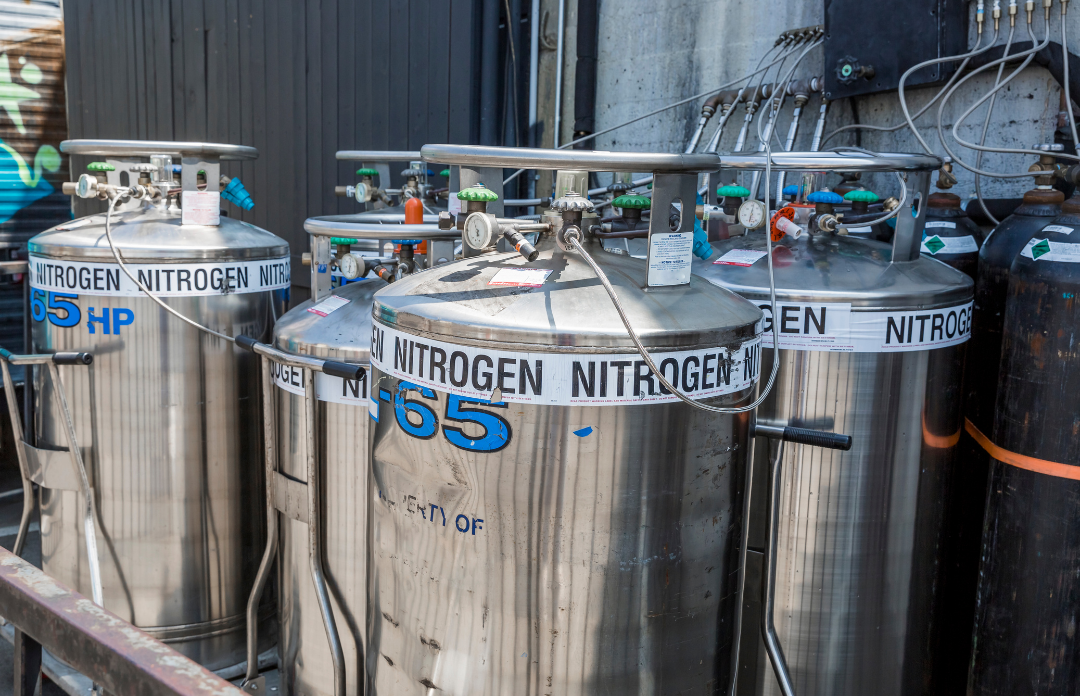
Option 4: Continue with supplied nitrogen
Cylinder or Dewar delivery remains a valid choice for some labs. Supplied nitrogen serves your laboratory application directly — it is not feed air for a generator.
Advantages:
- No nitrogen-generation equipment purchase.
- Potentially suitable for very low or intermittent demand.
- Simple to discontinue if your needs change.
Buyer checklist:
Ask the nitrogen supplier for delivery and rental charges, expected changeover frequency, and applicable storage and handling requirements. Compare those recurring costs against the total cost of ownership for on-site generation before deciding.
Cost comparison guidance
We recommend comparing these options using total cost of ownership over your expected ownership period, not just the purchase price:
|
Cost element |
What to include |
|
Purchase price |
Generator + compressor (or integrated unit) |
|
Installation |
Plumbing, electrical, ventilation, facility work |
|
Consumables |
Filters, dryer maintenance, membrane or sieve replacement |
|
Electricity |
Compressor and generator operating power |
|
Cylinder alternative |
Delivery fees, rental, hazmat handling |
|
Downtime risk |
Service intervals, warranty terms, backup arrangements |
Compare current, scope-equivalent quotes for your specific nitrogen demand before concluding which option is less expensive. Blanket claims that one approach is always cheaper do not hold across every configuration.
Which option should you choose?
If you already own a nitrogen generator and lack suitable air, Option 1 (a dedicated compressor) is usually the most direct fix.
If you are purchasing new and want minimal sourcing effort, Option 2 (an integrated generator) is often simpler.
If your facility has or is installing house air, Option 3 can serve multiple needs, but verify air quality at the point of use.
If your nitrogen use is low, irregular, or temporary, Option 4 (cylinders) may still be the pragmatic choice.
Compare a dedicated compressor package with an integrated nitrogen system
Send us your target nitrogen flow, purity, and expected operating hours. We'll help you compare a dedicated compressor package against an integrated generator for your specific requirements.
FAQs
Can I run a nitrogen generator without an external compressed-air connection?
Yes, if the generator has an integrated compressor — it produces the compressed feed air internally. External-feed membrane and PSA generators require a compressed-air source at their inlet. Integrated models like Organomation's NITRO-GEN+ include built-in compressors.
Is a dedicated compressor cheaper than an integrated nitrogen generator?
It depends on the configuration. Compare complete, scope-equivalent quotes for your specific nitrogen demand before deciding — blanket claims that one approach is always cheaper do not hold across every setup.
Can I use a general-purpose shop compressor instead of an oil-free laboratory compressor?
Check the generator's inlet-air specification first. The NITRO-GEN requires oil vapor below 0.01 ppm and air filtered at 0.01 µm, per its published inlet-air conditions — confirm any compressor you consider can meet those limits at the generator connection before connecting it.
How do I know if my house air is good enough for a nitrogen generator?
Check the generator's inlet-air specification (pressure, dew point, particulate, and oil limits) and compare it to your house air's actual measured quality at the generator connection. Peak's Infinity XE membrane generators, for example, require ISO 8573-1:2010 Class 1.4.1 air.
What is the difference between a membrane and a PSA nitrogen generator?
Membrane generators pass compressed air through hollow-fiber membranes that allow oxygen, water vapor, and CO₂ to permeate while retaining nitrogen — Organomation's NITRO-GEN specifications, for example, list a purity range of 95–99%. PSA generators use carbon molecular sieves that adsorb oxygen under pressure, as described in Organomation's nitrogen generation options overview, with capabilities up to 99.999% purity.