
What are the biggest frustrations in sample evaporation workflows today? Rather than guessing, Organomation went directly to the source. In our 2026 Sample Concentration Survey, we asked 135 active lab professionals to tell us — in plain terms — where their workflows break down. The results reveal a field under pressure: pressed for time, stretched on staff, and constrained by equipment that wasn't designed for today's sample volumes.
Here's what they told us, and more importantly, what you can do about it.
Download the full 2026 Sample Concentration Industry Report
How the Data Was Collected
The survey collected 135 responses from a broad cross-section of the laboratory community, including scientists and analysts (54%), lab managers and directors (36%), technicians (9%), and QA/compliance personnel (1%). Respondents represented industries spanning academic research, pharmaceutical and biotechnology, analytical testing, environmental research and testing, government labs, food and beverage, forensic science, chemical manufacturing, and clinical settings.
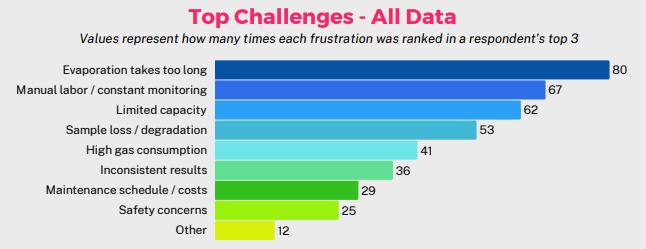
Each participant was asked to select their top three frustrations with their current evaporation process. That constraint matters: every challenge listed below didn't just receive a mention — it earned a spot in a respondent's personal shortlist of pain. The results are ranked by total frequency across all responses.
Challenge #1: Evaporation Takes Too Long
80 mentions — the most cited frustration in the entire survey.
Long evaporation time topped the list across virtually every method used: nitrogen blowdown users cited it 69% of the time, rotary evaporator users 71% of the time, centrifugal/vacuum users 52% of the time, and freeze drying users 50% of the time. This near-universal frustration points to a systemic throughput gap, not a flaw unique to any one technique.
The physics are straightforward — and unforgiving. Evaporation rate depends on the interplay of temperature and gas flow, and the rate increases as temperature approaches the boiling point of the solvent. But pushing those parameters too hard risks sample degradation. The result is a constant tension: labs want to go faster, but the safest path keeps them slow. As Organomation's technical documentation puts it, "the ideal solution is to balance the temperature and gas flow rate to obtain the highest evaporation rate, while minimizing thermal degradation and excessive turbulence."
The downstream effects compound quickly. Slow evaporation reduces the volume of material a lab can process per day, creating a cascade that affects productivity, throughput, and ultimately profitability. A single inefficient step can disturb every step that follows. As one industry guide to solvent evaporation notes, "many facilities use systems that are slow and cumbersome simply because they have always been used" — yet "with the technologies available today there is no reason why evaporation should be either complex or time-intensive."
Recommended Solutions:
Add heat strategically: For non-heat-sensitive samples, combining nitrogen blowdown with a temperature-controlled water bath — as in Organomation's N-EVAP series — significantly accelerates evaporation without increasing turbulence or gas waste. The key is optimizing both temperature and flow rate simultaneously rather than simply increasing one variable.
Switch to parallel processing: Modern multi-sample evaporation systems address throughput at the architectural level. Nitrogen blow-down arrays and centrifugal concentrators now support parallel processing of anywhere from 6 to 100 samples simultaneously — a fundamentally different approach to the throughput problem than squeezing more speed from a single-sample instrument.
Use an evaporation time calculator: Before investing in equipment changes, benchmark your current setup. Organomation's Evaporation Time Calculator can help identify where time is actually being lost and quantify the potential gain from targeted adjustments.
Challenge #2: Manual Labor and Constant Monitoring
67 mentions — the second most cited frustration.
Modern labs are being asked to do more with less. Staffing is tighter, sample volumes are growing, and researchers are increasingly expected to run multiple workflows simultaneously. Yet evaporation — the essential middle step between extraction and analysis — still demands a technician's sustained attention in many facilities.
The consequences extend beyond inconvenience. Manual processes introduce variability. When a technician must make judgment calls about when to stop evaporation, when to adjust gas flow, or how to respond to a sample that's concentrating unevenly, human error enters the picture.
Recommended Solutions:
Invest in programmable evaporation systems: Modern nitrogen evaporators with temperature control, timer functions, and consistent flow regulation eliminate the need for continuous monitoring. A technician can set parameters and step away — freeing skilled personnel for higher-value tasks.
Standardize protocols: Even without new capital investment, formalizing evaporation parameters — target temperature, gas flow rates, time ranges — reduces variability and monitoring demands. Consistency in inputs produces more predictable outputs, fewer intervention points, and less time standing over a water bath. As The Analytical Scientist noted in a 2026 review, manual workflows "create challenges" in reproducibility precisely because they are "difficult to standardize, and vulnerable to human variation."
Challenge #3: Limited Capacity
62 mentions — the third most cited frustration.
The capacity problem is not evenly distributed. While 62 respondents overall flagged it as a top-three concern, the impact is concentrated among specific techniques. Rotary evaporator users cited limited capacity 86% of the time — making it their single biggest frustration. Among Kuderna-Danish users, 100% cited it. The reason is structural: these methods were designed for a different era of laboratory throughput.
The rotary evaporator is a workhorse of the analytical lab, and rightly so — but its core design processes one sample at a time. One technical overview states it plainly: "Its major disadvantage is the lack of capacity to process more than one sample at a time." In a lab running 40 or 80 samples per day across multiple studies, a single-flask instrument is simply not built for the job. A 2026 analysis of parallel evaporation systems noted that these capacity limitations "highlight the need for a compact, parallel-processing system that fits benchtop space and accommodates diverse vessel types."
Growing sample volumes are not a temporary condition. As analytical instruments downstream become faster and more sensitive, upstream sample preparation — including evaporation — faces escalating throughput expectations. A 2026 article in The Analytical Scientist noted that "technological developments have led to significant reductions in analytical run times such that sample preparation can be the most time-consuming part of an assay and a major bottleneck."
Recommended Solutions:
Move to multi-position nitrogen evaporators: Organomation's S-EVAP and N-EVAP systems accommodate 6 to 45 samples simultaneously, allowing labs to process an entire batch in the same time a rotary evaporator handles one. For labs currently relying on rotary evaporation as their primary method, adding a parallel nitrogen evaporation system dramatically changes throughput economics.
Consider centrifugal evaporation for tube-format samples: For molecular biology, genomics, and other workflows using microtubes or 96-well plates, centrifugal vacuum concentrators can process large numbers of samples in parallel with no active monitoring.
Right-size your equipment to your sample load: Many labs are operating instruments purchased for a workflow that has since scaled significantly. Evaluating current sample volume against instrument capacity — using tools like Organomation's S-EVAP+ vs. Rotary Evaporator Comparison Tool — can quickly reveal whether a capacity upgrade is warranted.
Honorable Mentions
Three additional frustrations deserve attention even if they didn't crack the top three overall:
Sample loss and degradation (53 mentions) is not merely a workflow inconvenience — it's a data quality issue. When samples degrade during concentration, results become unreliable and re-runs consume time and materials. This concern is especially acute for heat-sensitive analytes and requires careful optimization of temperature, gas flow, and exposure time.
High gas consumption (41 mentions) is disproportionately concentrated among nitrogen blowdown users, for whom it ranked as a top-three concern 46% of the time. Labs running nitrogen-intensive workflows may find meaningful cost relief in an on-site nitrogen generator, which eliminates recurring cylinder costs. Organomation's Nitrogen Generator Savings Calculator can help quantify potential ROI.
What Labs Are Doing About It
The survey data suggests change is already underway. 36% of respondents said they plan to make changes to their evaporation workflow within the next year. Of those, 61% cited adopting new methods or applications as the primary driver — meaning the motivation is largely proactive, not reactive. Labs aren't just replacing broken equipment; they're upgrading because their science has outpaced their tools.
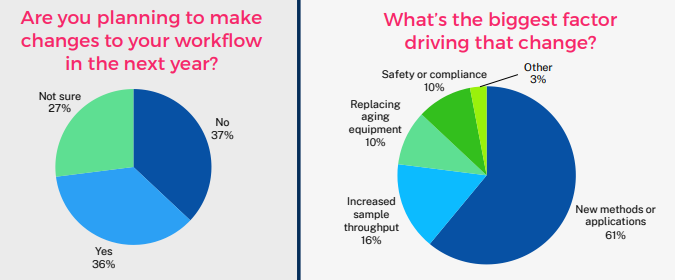
The distribution of planned changes by method is telling. Among centrifugal evaporation users planning to change, 86% cited new methods as the driver. Among those using manual, by hand evaporation, 67% named new methods and 33% named increased throughput. Even among nitrogen blowdown users — whose method is already the most broadly adopted at 66% of all labs — 36% of those planning changes are motivated by throughput increases.
The upgrade cycle is accelerating, and the direction is consistent: more samples, more automation, more flexibility.